
Perpetual Funding Rate Mark Price Math
Regulated Perpetual-Style Futures Specs: CFTC, Cboe, SGX & CCP Clearing
To satisfy CFTC, MAS, and CPMI-IOSCO clearinghouse rules without sacrificing perpetual UX, regulated exchanges structure 5-to-10-year long-dated futures with daily cash-flow financing adjustments, SPAN 2 margin, and zero ADL.
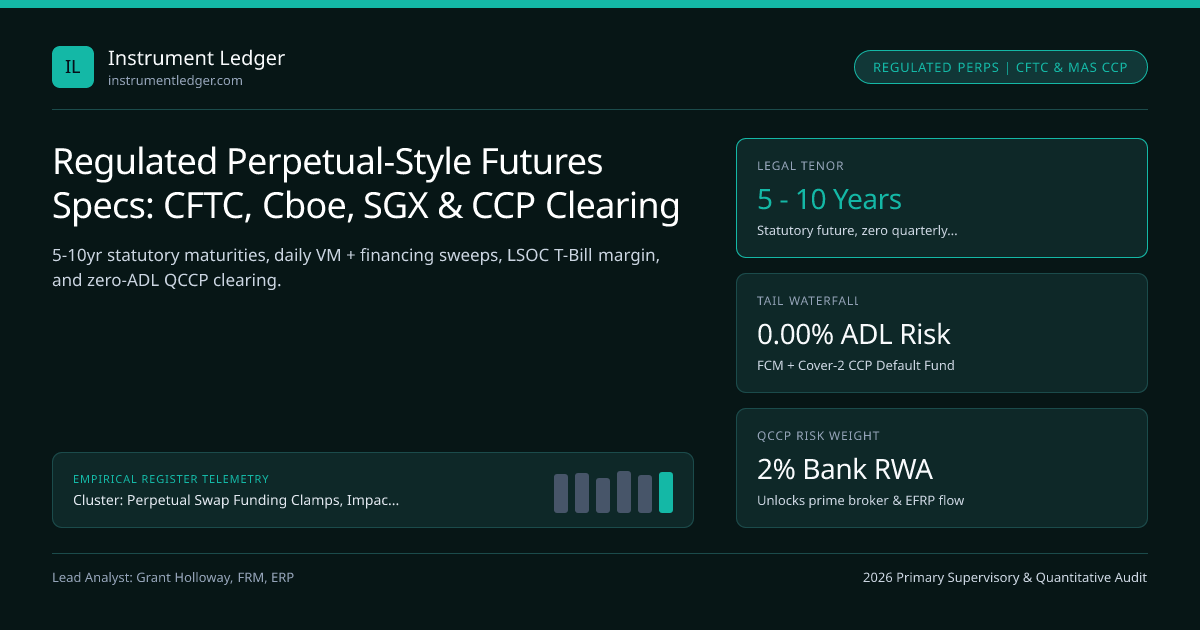
For nearly a decade, offshore perpetual swaps dominated crypto liquidity while onshore US and European institutions were locked out by two regulatory dealbreakers: first, CFTC Designated Contract Market (DCM) and Derivatives Clearing Organization (DCO) statutes expect listed futures to specify a finite legal maturity and deterministic daily settlement; second, fiduciary asset managers cannot legally sign rulebooks containing Auto-Deleveraging (ADL) clauses where a clearinghouse can confiscate a fund's winning hedge to plug a stranger's bankruptcy! Enter Regulated Perpetual-Style Futures—pioneered across CFTC-regulated DCMs (Cboe Digital, Coinbase Derivatives nano BTC/ETH perp-style, Bitnomial) and MAS/SFC-supervised institutional venues (SGX, EDX Markets)—which replicate spot-tracking perpetual economics inside 100% PFMI-compliant CCP clearinghouses!
Within our Perpetual Futures Funding Clamps, Mark Price and ADL Master Guide under the Perpetual Swap Funding Clamps, Impact Margin Notional, Mark Price & ADL hub, this regulatory specification bridges Silo 2 directly to CME SPAN 2 Portfolio Margin and CFTC Rule 39.13 Gross Customer Margin.
How Regulated Exchanges Replicate a Perpetual Inside Statutory Futures Law#
How do CFTC-approved and MAS-regulated rulebooks achieve zero quarterly roll friction while satisfying statutory futures definitions under CPMI-IOSCO PFMI? Through three ingenious contract-design adaptations:
- Multi-Year Nominal Legal Expiry (
5-Year or 10-Year Maturity, e.g.,2030/2035): Legally, the contract is a finite-maturity cash-settled future expiring 5 to 10 years out—satisfying statutoryfuturesdefinitions and clear tax/accounting classifications while eliminating 20–40 quarterly rolls! - Daily Clearinghouse Cash-Flow Financing Adjustment (or Hourly Accrued Booked Daily): Instead of peer-to-peer wallet transfers every 8 hours on an unregulated CEX, the regulated DCO computes a transparent Funding / Financing Adjustment anchored to
Perp_TWAP - Spot_Benchmark(plus aSOFRor fixed benchmark spread) and settles it cleanly alongside End-of-Day Variation Margin (VM) (or twice-daily intraday sweeps)! - Full CCP Default Waterfall (ZERO
ADL): Initial margin is calibrated via VaR / SPAN 2 (~18%–30% IMvs reckless 100x offshore tiers), backed by regulated FCM corporate guarantees and a mutualized Clearing Member Default Fund—eliminating Auto-Deleveraging completely!

Exact Daily Variation Margin + Financing Adjustment Clearing Settlement Equation#
Let's inspect the exact daily cash sweep processed by a regulated DCO clearinghouse at 16:00 ET daily settlement—and verify why adding the Financing Adjustment keeps a 10-year future trading right on top of Spot rather than drifting to a +80% 10-year contango premium!
End-of-Day CCP Variation Margin & Financing Sweep Math#
- DailyFinancingAdjustment = -1 * PositionSize * Multiplier * Sum{h=1..24} [ SpotBenchmarkh * HourlyFundingRate_h ]
- NetEODClearingCashSweep = DailyMarktoMarketVM + DailyFinancingAdjustment
- Worked $10,000,000 Regulated Continuous BTC Future EOD Clearing Check (Spot rises $90,000 -> $91,800; Avg Funding = +0.036%/day):
- Institutional Long ($10M = 111.11 BTC equivalent):
- 1) Daily MTM Variation Margin Credit = 111.111 * ($91,800 - $90,000) = +$200,000.00 USD
- 2) Daily Financing Adjustment Debit = -1 * $10,100,000_avg * 0.00036 = -$3,636.00 USD
- 3) Net EOD USD Wire Swept to FCM Segregated Account at Clearing Cycle = +$196,364.00 USD (Plus T-Bill interest on IM!)
Offshore Crypto Perp vs Regulated Perpetual-Style Future Matrix#
Compare contract specifications across offshore CEXs, L1 DEXs, and onshore regulated venues supervised by the CFTC, FCA, MAS, and SFC—and cross-check basis spreads in our Listed Contract Basis and Implied Repo Calculator.
| Specification Pillar | Offshore CEX Perpetual | On-Chain L1 Perp (Hyperliquid) | Regulated Perp-Style Future (Cboe/SGX/Coinbase) |
|---|---|---|---|
| Legal Classification | Unregulated / MiFID CFD-Swap | Decentralized smart contract | Statutory Listed Future (DCM / RMO) |
| Contract Expiry | Indefinite (No maturity date) | Indefinite | 5-Year to 10-Year Rolling Horizon (or Continuous) |
Max Leverage (IMR) | 50x – 125x (0.8%–2% IM) | 20x – 50x (2%–5% IM) | 3.3x – 5x (20%–30% VaR/SPAN 2 IM) |
| Customer Segregation | Omnibus exchange wallet / OES | Self-custody L1 smart contract | CFTC Part 22 LSOC / FCM Segregated |
| Tail Loss Mechanism | Auto-Deleveraging (ADL) | Auto-Deleveraging (ADL) | CCP Default Waterfall (Zero ADL!) |
| Posted Margin Yield | 0% on USDT (or hair-cut USDe) | 0% on USDC | ~100% US T-Bill Yield on Initial Margin! |
The Bank Capital-Weight Breakthrough: 2% CCP Risk Weight Under Basel III#
One final institutional specification detail explains why global tier-1 prime brokers strongly favor regulated CCP perpetual-style futures: under Basel III / CPMI-IOSCO PFMI bank capital rules, bilateral or unrated offshore crypto exchange exposures carry punitive 100% to 1,250% risk-weighted asset (RWA) capital charges, whereas exposures cleared through a Qualifying Central Counterparty (QCCP) qualify for a 2% trade-exposure risk weight—slashing prime-broker balance-sheet cost by an order of magnitude and enabling institutional Exchange for Related Position (EFRP) basis blocks!
Frequently asked questions
Why do CFTC-regulated perpetual-style futures have a 5-year or 10-year expiration date in the contract specification?
US Commodity Exchange Act precedent and tax/accounting rules distinguish statutory futures contracts (which specify a finite maturity date) from bilateral swaps. Setting a 5-to-10-year nominal expiry satisfies statutory futures requirements while eliminating quarterly rolls.
Can a regulated perpetual-style future on Cboe Digital or SGX Auto-Deleverage (ADL) my profitable short hedge?
No. Regulated CCP rulebooks do not use retail-style ADL queues; clearing members (FCMs) legally guarantee customer accounts and contribute to a mutualized Default Fund sized to survive the simultaneous default of the two largest clearing members (Cover-2).
How does funding settlement work when a regulated clearinghouse only runs cash banking sweeps once or twice per day?
The exchange calculates hourly funding accrual rates continuously from CLOB-vs-Spot basis observations throughout the trading day, aggregates the net dollar financing adjustment, and settles it alongside End-of-Day Variation Margin.
What is an EFRP (Exchange for Related Position) on a regulated perpetual-style future?
An EFRP allows two institutional counterparties to simultaneously swap physical spot BTC/ETH (or an ETF share basket) against an equal notional of regulated perpetual-style futures off-book at an agreed basis spread, clearing the future cleanly into the CCP.
Publication record
- Published
- November 13, 2026
- Updated
- November 14, 2026
- Author
- Grant Holloway, FRM, ERP
- Review
- Review not recorded
- Automated fact check
- Passed in the stored pipeline record
- Source URLs
- 4 recorded
AI assistance recorded: anthropic/claude-opus-4.6. This field does not establish human review or source verification.
Academic & Institutional Attribution
Cite This Research & Embed Live Data Card
Standard academic & institutional research paper citation format.
Grant Holloway, FRM, ERP. (2026, November 14). Regulated Perpetual-Style Futures Specs: CFTC, Cboe, SGX & CCP Clearing. Instrument Ledger. https://instrumentledger.com/specs/regulated-perpetual-style-futures-cboe-sgx-edxm-clearing-specsRegulatory Directory Cross-Reference
Referenced Institutions & Regulatory Registries
Referenced Supervisory Authorities
Related Perpetual Funding Rate Mark Price Math & Institutional Briefings
Explore Perpetual Funding Rate Mark Price Math Hub (20) →Perpetual Funding Rate Mark Price Math
Perpetual Futures Funding Clamps, Impact Margin Notional, Mark Price and ADL GuidePerpetual Funding Rate Mark Price Math
8-Hour Perpetual Funding Formula: F = P + clamp(I - P, -0.05%, +0.05%) MathPerpetual Funding Rate Mark Price Math
1-Hour Discrete vs Continuous Block-Level Perpetual Funding Accrual SpecsPerpetual Funding Rate Mark Price Math
Impact Bid and Impact Ask Prices: L2 Depth-Weighted Impact Margin Notional MathPerpetual Funding Rate Mark Price Math
Three-Component Perpetual Mark Price Median: Preventing Wick LiquidationsPerpetual Funding Rate Mark Price Math
Perpetual Spot Index Construction: Constituent Outlier Ejection and FailoverPerpetual Funding Rate Mark Price Math
Tiered Maintenance Margin Notional Brackets and Maintenance Deduction MathPerpetual Funding Rate Mark Price Math
Cross vs Isolated Perpetual Margin: Exact Liquidation and Bankruptcy Price MathLimit Up Limit Down Circuit Breakers
US Equity Market-Wide Circuit Breakers (MWCB): 7%, 13%, 20% & 15:25 ET RulesLimit Up Limit Down Circuit Breakers
SEC NMS Limit-Up Limit-Down (LULD) Specs: Tier 1 vs Tier 2 Price BandsLimit Up Limit Down Circuit Breakers
LULD Straddle State vs 15-Second Limit State: 5-Minute Pause MechanicsLimit Up Limit Down Circuit Breakers
LULD Band Doubling Rules: Eliminated 09:30 Open vs Active 15:35 ET Close Specs
Instrument Ledger Data, Benchmarks & Contributor Records
CC BY 4.0 Open Data
Open Institutional Datasets (CSV / JSON) →
Download desk-compiled quantitative series & schemas.
2026 Reference Matrix
2026 Institutional Benchmarks & Thresholds →
Statutory capital, clearing, margin & rate conventions.
Editorial Records
Authors & Review Records →
View named contributors where those records are available.
Complete Index
Master Research & Dossier Archive →
Browse all published briefings by topic pillar & date.