
Span2 Portfolio Margin Cross Offsets
CFTC Rule 39.13 Gross Customer Margin & Part 22 LSOC Segregation Specs
Following MF Global and Peregrine Financial, CFTC Regulation 39.13(g)(8) mandates that US clearinghouses collect Customer Initial Margin on a strictly GROSS per-client basis—eliminating fellow-customer netting deficits inside FCM omnibus accounts.
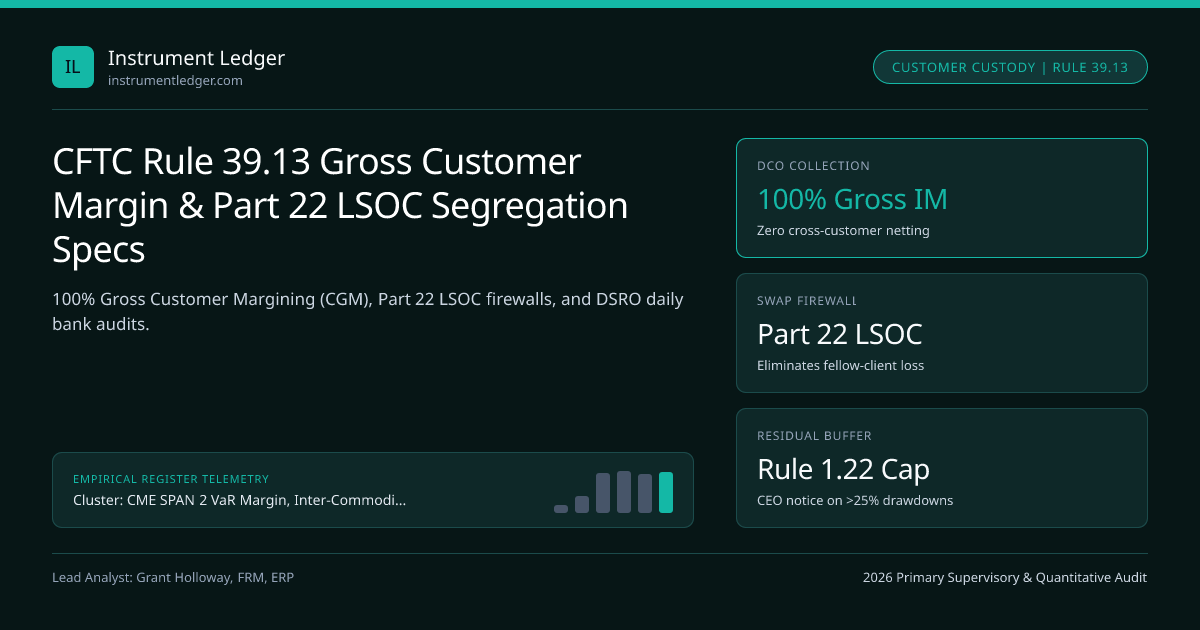
Suppose Hedge Fund Alpha is Long 5,000 E-mini S&P 500 (ES) contracts at Broker X, and Hedge Fund Beta is Short 5,000 E-mini S&P 500 (ES) contracts at the exact same Broker X! How much Initial Margin must Broker X (the FCM) wire upstream to CME Clearing? Under historic pre-2012 "Net Omnibus" rules (and still inside optional European EMIR Net Omnibus Segregated Accounts), +5,000 plus -5,000 netted to 0 contracts, so the clearinghouse held $0.00, leaving $150,000,000 of customer cash sitting internally at the broker! After MF Global (2011)—and to eliminate "Fellow-Customer Risk" where Hedge Fund Alpha's bankruptcy leaves zero margin at the CCP to port Hedge Fund Beta's account—CFTC Regulation 39.13(g)(8)(i) mandates 100% Gross Customer Margining: CME Clearing collects full SPAN 2 margin on BOTH +5,000 AND -5,000 (10,000 gross contracts = $150,000,000 held directly at the CCP!)!
Within our CME SPAN 2 Portfolio Margin, VaR Pods and Spread Offsets Guide under the CME SPAN 2 VaR Margin, Inter-Commodity Spread Credits & Intraday Calls hub, read this statutory custody specification alongside Initial vs Maintenance 110% Restoration Math and Regulated Perpetual-Style Futures Clearing.
Statutory Architecture: CEA Section 4d(a)(2) Futures vs CFTC Part 22 LSOC Swaps#
Institutional operational due diligence (ODD) teams distinguish three statutory customer-asset segregation buckets on US FCM balance sheets supervised by the CFTC and NFA:
- Section 4d(a)(2) Domestic US Futures Segregation ("4d Seg"): Covers all US DCM futures/options (
CME,CBOT,NYMEX,COMEX,ICE US,Cboe Futures). Customer funds sit in legally segregated omnibus accounts, reported daily on CFTCSegregation Statements, fortified by Gross Margining at the DCO (Rule 39.13(g)(8)) plus mandatory FCM Residual Interest buffers (Rule 1.22)! - Part 22
LSOC("Legally Segregated, Operationally Commingled") for Cleared Swaps: Covers cleared OTC swaps (IRS,CDS)—legally prohibiting the DCO or FCM from ever using Non-Defaulting Customer B's margin value to cover Defaulting Customer A's swap loss ("Zero Fellow-Customer Risk"!). - Part 30.7 Foreign Secured Amount: Covers US customers trading non-US exchanges (
Eurex,ICE Europe,JPX/OSE,SGX).
Worked Gross vs Net Omnibus Clearinghouse Custody Flow#
Exact Gross Omnibus Margin & Residual Interest Equations#
Let's write the exact accounting equation executed twice daily via CME's Customer Gross Margining (CGM) reporting feed under CPMI-IOSCO PFMI Principle 14 ("Segregation and Portability"):
- NetOmnibusMarginError = SPAN2PortfolioMM( Sum{client c = 1..K} ClientPositionsc ) [FORBIDDEN in US DCOs!]
- FCMTargetResidualInt >= Sum{undermargined c} [ Max( 0, RequiredSegMarginc - ClientEquity_c ) ]
- Worked FCM Bankruptcy Portability Stress Test (FCM Fails While Client A is Long 5,000 ES & Client B is Short 5,000 ES):
- Under Forbidden Net Omnibus: CCP holds $0.00! Receiving healthy FCM refuses to accept Client A or B without $150M cash!
- Under CFTC Rule 39.13 Gross Margin + Rule 1.22 Residual Interest:
- CME Clearing ALREADY physically holds $75,000,000 for Client A + $75,000,000 for Client B = $150,000,000!
- Healthy backup FCM steps in over the weekend and ports Client A & B intact with 100% of their SPAN 2 margin attached!
Global Customer Segregation Regimes: US 4d/LSOC vs EU EMIR vs Crypto CEX#
Compare counterparty bankruptcy protection across US CFTC rules, European ESMA EMIR Article 39 choices (OSA vs ISA), and offshore crypto exchanges:
| Segregation Regime | CCP Margin Calculation | Fellow-Customer Default Risk | FCM / Exchange Insolvency Protection | Cost to End-User Fund |
|---|---|---|---|---|
US 4d(a)(2) Futures Seg | 100% Gross (Rule 39.13) | Low (Protected by FCM Residual Int) | Statutory US Bankruptcy Subchapter IV | Standard baseline |
US Part 22 LSOC (Swaps) | 100% Gross per Client ID | Strictly Zero (Legal firewall) | Individual legal attribution at DCO | Standard cleared swap |
EU EMIR Net OSA | Netted across omnibus! | Moderate (Less collateral at CCP) | Operational omnibus pool | Lowest fee |
EU EMIR Gross OSA / ISA | 100% Gross / Individual | Zero (ISA) | Ring-fenced CCP account (ISA) | Dedicated CCP acct fee |
| Offshore Crypto Omnibus | None (Internal ledger) | High + ADL clawbacks! | General unsecured creditor (unless OES) | Zero seg fee; tail risk |
Post-MF Global Automated Bank Verification (NFA Daily Seg Confirmation)#
One operational reform enacted alongside Rule 39.13 deserves special mention for institutional CFOs: Automated Daily Segregation Bank Verification! Previously, Peregrine Financial (PFGBest) forged paper bank statements for years. Today, under NFA and CME Designated Self-Regulatory Organization (DSRO) rules, every depository bank and CCP transmits automated daily electronic balance feeds directly to the NFA/CME, cross-checking to the penny against every FCM's daily 12:00 PM Segregation Statement—and any withdrawal of more than 25% of an FCM's Residual Interest requires pre-clearance signature by the FCM CEO/CFO and immediate electronic filing with the CFTC!
Frequently asked questions
What is the difference between Gross Omnibus and Net Omnibus customer margining at a clearinghouse?
Under Net Omnibus, offsetting long and short positions of unrelated clients at the same broker cancel out, leaving little collateral at the CCP. Under CFTC Rule 39.13 Gross Margining, the CCP collects full margin for every individual client portfolio without cross-client netting.
What does LSOC (Legally Segregated, Operationally Commingled) protect against under CFTC Part 22?
Used for cleared swaps, LSOC allows operational pooling of collateral in one omnibus custodial account while legally prohibiting the CCP from touching Non-Defaulting Client B margin value even if Client A and the FCM both default simultaneously.
What is FCM "Residual Interest" under CFTC Regulation 1.22?
Residual Interest is the FCM own corporate capital intentionally deposited inside the Customer Segregated Account as a safety cushion to ensure one client intraday margin deficit never dips into another customer segregated funds.
Why do institutional hedge funds maintain clearing relationships with at least two separate FCMs?
Maintaining two active, onboarded FCM accounts ensures that if one FCM experiences an operational outage, cyber incident, or insolvency, positions and gross margin held at CME Clearing can port seamlessly to the second FCM within hours.
Publication record
- Published
- November 13, 2026
- Updated
- November 18, 2026
- Author
- Grant Holloway, FRM, ERP
- Review
- Review not recorded
- Automated fact check
- Passed in the stored pipeline record
- Source URLs
- 3 recorded
AI assistance recorded: anthropic/claude-opus-4.6. This field does not establish human review or source verification.
Academic & Institutional Attribution
Cite This Research & Embed Live Data Card
Standard academic & institutional research paper citation format.
Grant Holloway, FRM, ERP. (2026, November 18). CFTC Rule 39.13 Gross Customer Margin & Part 22 LSOC Segregation Specs. Instrument Ledger. https://instrumentledger.com/specs/cftc-rule-39-13-gross-customer-margin-lsoc-fcm-omnibus-segRegulatory Directory Cross-Reference
Referenced Institutions & Regulatory Registries
Referenced Supervisory Authorities
Related Span2 Portfolio Margin Cross Offsets & Institutional Briefings
Explore Span2 Portfolio Margin Cross Offsets Hub (20) →Span2 Portfolio Margin Cross Offsets
CME SPAN 2 Portfolio Margin, VaR Pods, Spread Offsets and Intraday Calls GuideSpan2 Portfolio Margin Cross Offsets
OCC STANS Monte Carlo vs CME SPAN 2: SPX Options vs ES Futures Cross-MarginSpan2 Portfolio Margin Cross Offsets
Clearinghouse Collateral Haircut Schedules: T-Bills, TIPS, Gold & Concentration CapsSpan2 Portfolio Margin Cross Offsets
Spot-Month Delivery Margin Step-Up Specs: FND to LTD Full-Value SurchargesSpan2 Portfolio Margin Cross Offsets
FCM Day-Trade Margin vs Exchange SPAN 2: 15:45 CT Auto-Liquidation TrapsSpan2 Portfolio Margin Cross Offsets
LCH SwapClear OTC IRS vs CME Eris SOFR Swap Futures: 2-Day vs 5-Day MPOR MathSpan2 Portfolio Margin Cross Offsets
Legacy 16-Scenario SPAN Risk Arrays vs CME SPAN 2 HVaR ArchitectureSpan2 Portfolio Margin Cross Offsets
SPAN 2 EWMA Volatility Scaling & Anti-Procyclicality (APC) Margin FloorsLimit Up Limit Down Circuit Breakers
JPX / OSE Nikkei 225 Circuit Breakers: J-GATE Dynamic Caps & 8%/12%/16% HaltsLimit Up Limit Down Circuit Breakers
Cboe SPX & Single-Stock Options Halt Rules: LULD Null Quotes & Drill-Through CapsLimit Up Limit Down Circuit Breakers
Clearly Erroneous Executions (CEE) & CME Rule 588: No-Bust Ranges vs Trade BustsLimit Up Limit Down Circuit Breakers
FIX Protocol SecurityTradingStatus (Tag 326): OMS Halt State Machines & MDP 3.0
Instrument Ledger Data, Benchmarks & Contributor Records
CC BY 4.0 Open Data
Open Institutional Datasets (CSV / JSON) →
Download desk-compiled quantitative series & schemas.
2026 Reference Matrix
2026 Institutional Benchmarks & Thresholds →
Statutory capital, clearing, margin & rate conventions.
Editorial Records
Authors & Review Records →
View named contributors where those records are available.
Complete Index
Master Research & Dossier Archive →
Browse all published briefings by topic pillar & date.