
Perpetual Funding Rate Mark Price Math
Cross vs Isolated Perpetual Margin: Exact Liquidation and Bankruptcy Price Math
Solving explicitly for the Fair Mark Price at which Margin Balance intersects Maintenance Margin yields exact Perpetual Liquidation Price equations—while the gap down to zero-equity Bankruptcy Price defines the liquidation engine execution buffer.
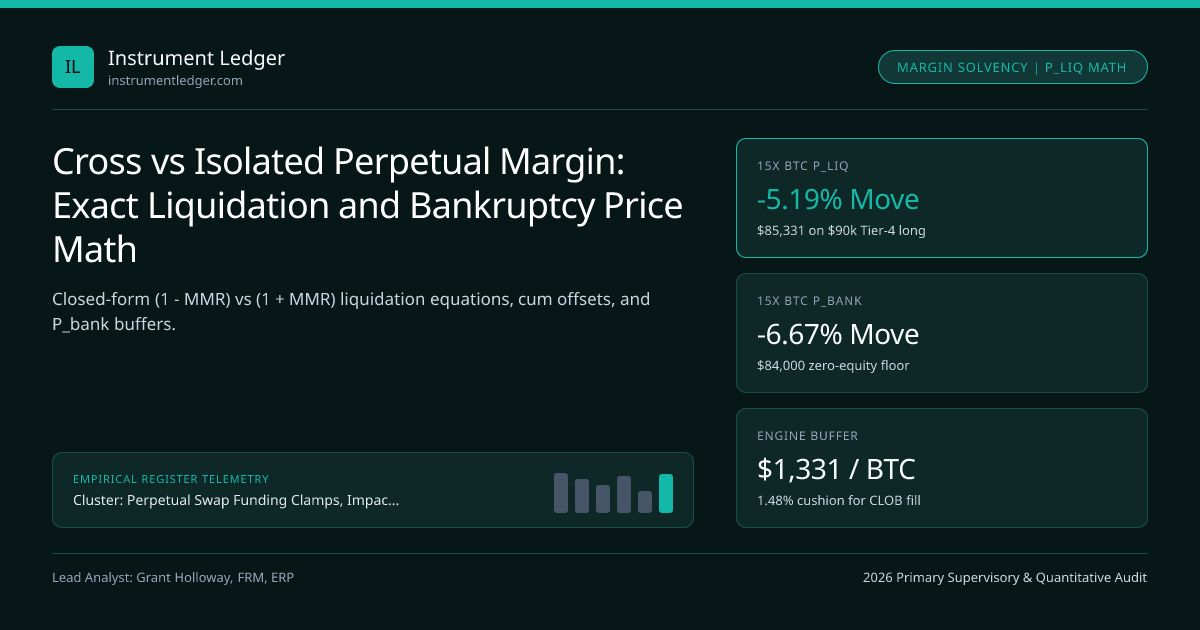
Every perpetual liquidation event revolves around two distinct critical prices: the Liquidation Trigger Price (P_liq)—the Fair Mark Price where the account's live Margin Balance falls below required Maintenance Margin (MM) plus estimated liquidation clearance fees—and the Bankruptcy Price (P_bank), the deeper price where net account equity reaches strictly $0.00. Because P_liq itself enters both sides of the equity equation (since MM = Qty × P_liq × MMR_k - cum_k depends on P_liq!), solving accurately for P_liq in isolated and cross-margin multi-position portfolios requires isolating P_liq algebraically rather than using naive Entry × (1 - 1/Lev + MMR) approximations!
Within our Perpetual Futures Funding Clamps, Mark Price and ADL Master Guide under the Perpetual Swap Funding Clamps, Impact Margin Notional, Mark Price & ADL hub, this closed-form derivation builds directly on Tiered Maintenance Margin Notional Brackets and feeds Exchange Insurance Fund Inflow and Depletion Mechanics.
Exact Closed-Form Linear Perpetual P_liq and P_bank Derivation#
Let a trader hold a signed linear perpetual position of Q base units (Q > 0 for long, Q < 0 for short; let |Q| be unsigned size and s = +1 for long, s = -1 for short) entered at P_entry, backed by allocated wallet balance WB (excluding unrealized PnL on this position). At any Mark Price P, live equity equals WB + s × |Q| × (P - P_entry), while required Maintenance Margin in bracket k equals |Q| × P × MMR_k - cum_k (note some venues also reserve taker/liquidation fee f_liq × |Q| × P). Setting live equity equal to required Maintenance Margin and solving cleanly for P_liq:
Isolated vs Multi-Position Cross-Margin Liquidation Equations#
Let's write both the Exact Single-Position (Isolated) formula and the Multi-Asset Cross-Margin formula (when holding Bitcoin BTC and Ethereum ETH simultaneously) and run a worked $8,000,000 verification:
Closed-Form Long & Short Liquidation vs Bankruptcy Math#
- LongBankruptcyPrice (Pbanklong) = ( |Q| * Pentry - WB ) / |Q| = Pentry - ( WB / |Q| )
- ShortLiquidationPrice (Pliqshort) = ( |Q| * Pentry + WB + cumk ) / ( |Q| * (1 + MMR_k) )
- ShortBankruptcyPrice (Pbankshort)= ( |Q| * Pentry + WB ) / |Q| = Pentry + ( WB / |Q| )
- Worked 100 BTC Long Position @ Pentry = $90,000 ($9,000,000 Notional, Bracket 4: MMR4 = 2.50%, cum_4 = $80,250):
- Posted Isolated Wallet Balance WB = $600,000 (15x initial leverage)
- Exact Pliqlong = (100 * $90,000 - $600,000 - $80,250) / (100 * (1 - 0.0250))
- = $8,319,750 / 97.50 = $85,330.77 (-5.188% from entry!)
- [Verify at $85,330.77: Equity = $600k - 100($4,669.23) = $133,076.92; MM = $8,533,0772.5% - $80,250 = $133,076.92!]
- Exact Pbanklong = $90,000 - ($600,000 / 100) = $84,000.00 (-6.667% from entry; $1,330.77/BTC buffer!)
Isolated Margin vs Cross Margin Operational Specification Table#
Compare perpetual liquidation vs regulated futures variation margin calls in Initial vs Maintenance Margin 110% Restoration Rules and check session sigma risk in our Intraday 0DTE Sigma Band Calculator.
| Margin Architecture | Margin Pool Scope | Hedge Offset Behavior | Primary Institutional Use Case | Fatal Risk Mode |
|---|---|---|---|---|
| Isolated Margin | Strictly ring-fenced per symbol (WB_i) | Zero offset: winning leg cannot rescue losing leg! | Directional breakout bets; capping tail altcoin blowups | Winning short spot/perp sits idle while losing leg liquidates |
| Cross Margin (Single-Asset) | Shared USDT or USDC sub-account | Full PnL offset: unrealized gains rescue losing hedge | Same-venue pair trades (Long BTC / Short ETH beta) | Uncapped tail move on 1 altcoin wipes entire account WB! |
| Portfolio Margin (PM) | Unified Spot + Perps + Options VaR/SPAN | Scenario Greeks/delta netting (up to 85% IM cut) | Delta-neutral spot-vs-perp carry & option market making | Volatility spike expands option vega MM simultaneously |
Two Critical Asymmetries: Short Denominator (1 + MMR) & Funding Drift on WB#
Notice two mathematical traps embedded in the exact equations above:
- Shorts Liquidate Earlier Than Symmetrical Longs: Because required Maintenance Margin
|Q| × P × MMRshrinks in USD terms asPfalls on a losing long (1 - MMRdenominator) whereasMMgrows in USD terms asPrallies on a losing short (1 + MMRdenominator), a 10x short (+8.91%move toP_liq) has an 18-basis-point tighter percentage distance to liquidation than a 10x long (-9.09%move toP_liq)—and at 5x leverage with 2.5% MMR,+17.07%vs-17.95%(88 bps tighter on shorts)! - Every Paid Funding Epoch Erodes
WBand ShiftsP_liq: Because periodic funding debits deduct directly fromWB(WB_new = WB_old - Funding_Paid), holding a static isolated position through 30 days of adverse funding steadily pullsP_liqcloser and closer to current Mark Price even if price never moves!
Frequently asked questions
Why does a 10x short perpetual liquidate on an +8.91% rally while a 10x long survives until a -9.09% drop?
Maintenance Margin equals Position_Units * Mark_Price * MMR. As price rises against a short, notional value and required dollar Maintenance Margin grow simultaneously (dividing by 1 + MMR), whereas on a falling long, required dollar MM shrinks (dividing by 1 - MMR).
Why did my Isolated perpetual Liquidation Price creep closer to market price over two weeks with zero trades?
On Isolated positions (unless auto-margin-replenishment is enabled), periodic funding fees paid every 1 or 8 hours are debited directly from that position allocated Wallet Balance (WB), mathematically shifting both P_liq and P_bank toward entry.
What happens to the remaining margin between Liquidation Price (P_liq) and Bankruptcy Price (P_bank) when liquidated?
On full takeover engines, the liquidation engine takes over the position at Bankruptcy Price (wiping position margin) and closes it into the orderbook; any execution surplus better than P_bank flows into the exchange Insurance Fund (or partial fee schedule).
When should institutional desks use Cross Margin instead of Isolated Margin on perpetual swaps?
Cross Margin (or unified Portfolio Margin) is mandatory whenever running delta-neutral spot-vs-perp or relative-value pair trades on the same venue so unrealized gains on the winning leg dynamically offset unrealized losses on the hedge leg.
Publication record
- Published
- November 14, 2026
- Updated
- November 14, 2026
- Author
- Grant Holloway, FRM, ERP
- Review
- Review not recorded
- Automated fact check
- Passed in the stored pipeline record
- Source URLs
- 3 recorded
AI assistance recorded: anthropic/claude-opus-4.6. This field does not establish human review or source verification.
Academic & Institutional Attribution
Cite This Research & Embed Live Data Card
Standard academic & institutional research paper citation format.
Grant Holloway, FRM, ERP. (2026, November 14). Cross vs Isolated Perpetual Margin: Exact Liquidation and Bankruptcy Price Math. Instrument Ledger. https://instrumentledger.com/specs/perpetual-bankruptcy-price-vs-liquidation-price-cross-isolatedRegulatory Directory Cross-Reference
Referenced Institutions & Regulatory Registries
Primary Tier-1 Supervisory Registries
Related Perpetual Funding Rate Mark Price Math & Institutional Briefings
Explore Perpetual Funding Rate Mark Price Math Hub (20) →Perpetual Funding Rate Mark Price Math
Perpetual Futures Funding Clamps, Impact Margin Notional, Mark Price and ADL GuidePerpetual Funding Rate Mark Price Math
Derivatives Insurance Fund Mechanics: Surplus Capture and Daily Drawdown CapsPerpetual Funding Rate Mark Price Math
Auto-Deleveraging (ADL) Queue Math: PnL-Times-Leverage Percentile RankingPerpetual Funding Rate Mark Price Math
Inverse Coin-Margined vs Linear USDT Perpetuals: 1/P Convexity and Hedging MathPerpetual Funding Rate Mark Price Math
Quanto Perpetual Futures Specs: Fixed Cross-Currency Multipliers & CovariancePerpetual Funding Rate Mark Price Math
Perpetual Funding Rate Caps & Interval Compression: -2% Squeeze MechanicsPerpetual Funding Rate Mark Price Math
TWAP Premium Index Weighting & 8-Hour Funding Boundary MicrostructurePerpetual Funding Rate Mark Price Math
Delta-Neutral Perpetual Cash-and-Carry Yield Attribution & Net ROE MathSpan2 Portfolio Margin Cross Offsets
Eurex Clearing Prisma Margin Specs: Filtered HVaR & Bund-Swap OffsetsSpan2 Portfolio Margin Cross Offsets
ICE Clear IRM 2 Margin Specs: Brent, Gasoil & Dutch TTF Natural Gas VaRSpan2 Portfolio Margin Cross Offsets
Futures Initial vs Maintenance Margin: The 110% Speculative Restoration RuleSpan2 Portfolio Margin Cross Offsets
CME Twice-Daily Settlement Cycle: 12:30 CT Midday Intraday Variation Sweeps
Instrument Ledger Data, Benchmarks & Contributor Records
CC BY 4.0 Open Data
Open Institutional Datasets (CSV / JSON) →
Download desk-compiled quantitative series & schemas.
2026 Reference Matrix
2026 Institutional Benchmarks & Thresholds →
Statutory capital, clearing, margin & rate conventions.
Editorial Records
Authors & Review Records →
View named contributors where those records are available.
Complete Index
Master Research & Dossier Archive →
Browse all published briefings by topic pillar & date.