
Perpetual Funding Rate Mark Price Math
Impact Bid and Impact Ask Prices: L2 Depth-Weighted Impact Margin Notional Math
Perpetual funding engines never read top-of-book 1-lot quotes; instead, they walk L2 bids and asks up to a standardized Impact Margin Notional (IMN) depth to compute manipulation-resistant Impact Bid and Impact Ask prices.
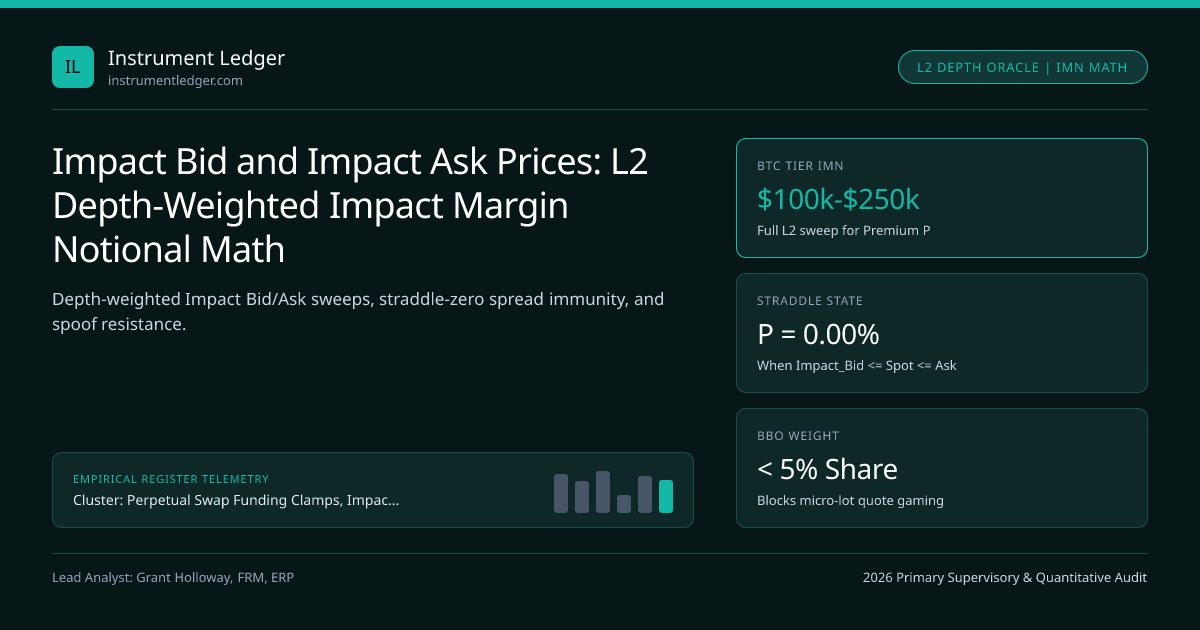
Inside every institutional perpetual swap specification, the Premium Index (P) is explicitly anchored NOT to top-of-book Best Bid/Offer (BBO), nor to Last Traded Price, but to Impact_Bid_Price and Impact_Ask_Price—the volume-weighted average execution prices of walking the central limit order book (CLOB) until cumulative filled quote notional equals the contract's Impact Margin Notional (IMN). Typically parameterized as IMN = Base_Initial_Margin_Bucket / Initial_Margin_Rate (for example, 200 USDT / 0.008 = 25,000 USDT on mid-caps, or 500–2,000 USDT / 0.008 = $62,500–$250,000 on Bitcoin BTC and Ethereum ETH), IMN forces any would-be funding manipulator to post real capital across deep L2 orderbook rungs rather than flashing micro-lots at the inside tick.
Within our Perpetual Futures Funding Clamps, Mark Price and ADL Master Guide under the Perpetual Swap Funding Clamps, Impact Margin Notional, Mark Price & ADL hub, this L2 book walkthrough pairs with 8-Hour Perpetual Funding Clamp Math and Three-Component Fair Mark Price Median Specs.
Exact L2 Orderbook Walk Algorithm for Impact Bid & Impact Ask#
Suppose an exchange specifies IMN = $100,000 USDT on a linear perpetual contract. Every 5 seconds (or 60 seconds), the matching engine snapshots the live L2 bid and ask ladders (Price_k, Qty_k) and executes a virtual market sell of $100,000 notional down the bid side to find Impact_Bid, and a virtual market buy of $100,000 notional up the ask side to find Impact_Ask:
- Walk rungs
k = 1, 2, ..., m-1until adding rungmexceedsIMN. - Take only the partial notional fraction needed on marginal rung
mso cumulative quote notional equalsIMNexactly. - Divide
IMNby total base coins accumulated across rungs1..m:Impact_Price = IMN / Total_Base_Units_Accumulated!
The "Wide-Spread Zero-Premium" Property (Impact_Bid < Spot < Impact_Ask)#
Look closely at the numerator of the canonical Perpetual Contract Funding Rate Convention Premium Index equation: P = [ Max(0, Impact_Bid - Spot_Index) - Max(0, Spot_Index - Impact_Ask) ] / Spot_Index! Why doesn't the exchange simply use (Perp_Mid - Spot_Index) / Spot_Index? Suppose a sudden macro shock (like an FOMC announcement) drains L2 orderbook liquidity on an altcoin perpetual (such as Avalanche AVAX or Arbitrum ARB) so Spot = $10.00, Impact_Bid = $9.85, and Impact_Ask = $10.35 (Mid = $10.10, +1.00% apparent premium, solely because the ask book is temporarily thin!). Under the Max(0, ...) operator:
Max(0, $9.85 - $10.00) = Max(0, -$0.15) = 0!Max(0, $10.00 - $10.35) = Max(0, -$0.35) = 0!- Result:
P = 0.00%! WheneverSpot_Indexlies anywhere betweenImpact_BidandImpact_Ask,Pevaluates to exactly zero—preventing wide, illiquid orderbook spreads from hallucinating fake positive or negative funding spikes!
Step-by-Step L2 Orderbook Sweep & Impact Price Formula#
- ImpactBidorAsk = IMN / BaseQtyforIMN
- PremiumIndex (P) = [ max(0, ImpactBid - Spot) - max(0, Spot - Impact_Ask) ] / Spot
- Worked L2 Depth Walk Audit (SOLUSDT Perpetual, IMN = $50,000, Spot Index = $180.00):
- Bid Ladder: Rung 1 = 20 SOL @ $180.30 ($3,606); Rung 2 = 100 SOL @ $180.20 ($18,020); Rung 3 = 300 SOL @ $180.10
- Remaining IMN on Rung 3 = $50,000 - ($3,606 + $18,020) = $28,374 -> Takes 28,374 / 180.10 = 157.5458 SOL
- Total Base SOL Sold = 20 + 100 + 157.5458 = 277.5458 SOL -> Impact_Bid = $50,000 / 277.5458 = $180.1505!
- Ask Ladder > $180.35 -> Since Impact_Bid ($180.1505) > Spot ($180.00):
- P = ($180.1505 - $180.00) / $180.00 = +0.0836% (+8.36 bps; spoofed $180.30 20-SOL top bid diluted by 93%!)
Typical Impact Margin Notional (IMN) Calibration Across Tiers#
Compare intraday volatility bands during thin-liquidity sweeps in our Intraday 0DTE Sigma Band Calculator and fair-value basis in our Listed Contract Basis and Implied Repo Calculator.
| Asset Liquidity Tier | Representative Symbols | Max Leverage / Base IMR | Standard IMN Threshold | Empty-Book Fallback Rule |
|---|---|---|---|---|
| Tier 1 Mega-Cap | BTC, ETH | 100x–125x (0.8%–1.0%) | $100,000 – $250,000 | Capped at 30th L2 rung or MMR band |
| Tier 2 Large-Cap L1 | SOL, XRP, BNB | 50x–75x (1.33%–2.0%) | $25,000 – $100,000 | Uses deepest available L2 VWAP |
| Tier 3 Mid-Cap DeFi | ARB, SUI | 20x–50x (2.0%–5.0%) | $10,000 – $25,000 | Clamps max spread vs Spot Index |
| Tier 4 Newly Listed | Pre-market / Tail Tokens | 5x–10x (10.0%–20.0%) | $2,500 – $5,000 | Falls back to EWMA internal trade price |
Edge Case: What Happens When Total Orderbook Depth Falls Below IMN?#
During severe flash crashes or API outages on smaller tokens, the sum of all resting bids on the entire L2 orderbook can temporarily drop below the contract's IMN (e.g., only $8,400 of bids remain on a $25,000 IMN book). If coded naively, dividing $25,000 by exhausted book units would divide by zero or return a price of $0.00! Institutional exchange rulebooks under ESMA MiCA and offshore standards handle insufficient depth via two deterministic fallbacks: either capping the Impact Bid/Ask sweep at a maximum price deviation band (such as Spot_Index × (1 ± Maintenance_Margin_Ratio)) or substituting the lowest resting L2 price for the unfilled residual IMN notional, preventing a 30-second liquidity vacuum from corrupting the 8-hour funding TWAP.
Frequently asked questions
Why did the perpetual funding Premium Index print 0.00% even though the perpetual midpoint was 0.40% above spot?
If the ask book is thin (pushing Impact Ask +0.90% above spot) while Impact Bid still sits -0.10% BELOW spot, Spot lies between Impact Bid and Impact Ask. Both Max(0, Impact_Bid - Spot) and Max(0, Spot - Impact_Ask) evaluate to zero, yielding P = 0.00%.
How do exchanges choose the exact dollar value of Impact Margin Notional (IMN) for each contract?
Exchanges typically define IMN as a fixed base margin notional (e.g., 200 to 2,000 USDT) divided by the contract minimum Initial Margin Rate—scaling IMN to $100k–$250k on 100x BTC/ETH books and $5k–$25k on lower-leverage altcoins.
How does Impact Bid/Ask calculation differ on inverse coin-margined perpetuals like BTCUSD?
On inverse contracts where contract size is 1 USD (or 100 USD) and collateral is BTC, IMN is denominated in native base coins (for example, 2 BTC or 5 BTC worth of cumulative resting L2 depth) rather than USDT.
What happens if an illiquid perpetual orderbook has less total resting liquidity than its IMN?
Exchange engines fill available L2 levels and assign the unfilled residual IMN notional at the worst boundary level (capped at a maximum percentage offset from Spot Index) so empty books cannot trigger division-by-zero errors.
Publication record
- Published
- November 14, 2026
- Updated
- November 15, 2026
- Author
- Grant Holloway, FRM, ERP
- Review
- Review not recorded
- Automated fact check
- Passed in the stored pipeline record
- Source URLs
- 3 recorded
AI assistance recorded: anthropic/claude-opus-4.6. This field does not establish human review or source verification.
Academic & Institutional Attribution
Cite This Research & Embed Live Data Card
Standard academic & institutional research paper citation format.
Grant Holloway, FRM, ERP. (2026, November 15). Impact Bid and Impact Ask Prices: L2 Depth-Weighted Impact Margin Notional Math. Instrument Ledger. https://instrumentledger.com/specs/impact-bid-ask-margin-notional-l2-orderbook-depth-weightingRegulatory Directory Cross-Reference
Referenced Institutions & Regulatory Registries
Referenced Supervisory Authorities
Related Perpetual Funding Rate Mark Price Math & Institutional Briefings
Explore Perpetual Funding Rate Mark Price Math Hub (20) →Perpetual Funding Rate Mark Price Math
Perpetual Futures Funding Clamps, Impact Margin Notional, Mark Price and ADL GuidePerpetual Funding Rate Mark Price Math
Three-Component Perpetual Mark Price Median: Preventing Wick LiquidationsPerpetual Funding Rate Mark Price Math
Perpetual Spot Index Construction: Constituent Outlier Ejection and FailoverPerpetual Funding Rate Mark Price Math
Tiered Maintenance Margin Notional Brackets and Maintenance Deduction MathPerpetual Funding Rate Mark Price Math
Cross vs Isolated Perpetual Margin: Exact Liquidation and Bankruptcy Price MathPerpetual Funding Rate Mark Price Math
Derivatives Insurance Fund Mechanics: Surplus Capture and Daily Drawdown CapsPerpetual Funding Rate Mark Price Math
Auto-Deleveraging (ADL) Queue Math: PnL-Times-Leverage Percentile RankingPerpetual Funding Rate Mark Price Math
Inverse Coin-Margined vs Linear USDT Perpetuals: 1/P Convexity and Hedging MathSpan2 Portfolio Margin Cross Offsets
CME SPAN 2 Liquidity and Concentration Add-On (LCA): Whale Margin MathSpan2 Portfolio Margin Cross Offsets
NYMEX 3:2:1 Crack Spread Specs: WTI, RBOB & ULSD Unit Conversion & MarginSpan2 Portfolio Margin Cross Offsets
CBOT Treasury Yield Curve Spreads (TUT, NOB, FYT): DV01 Ratios & SPAN 2Span2 Portfolio Margin Cross Offsets
CME-FICC Cross-Margining Specs: Cash Treasury Repo vs CBOT Futures Offsets
Instrument Ledger Data, Benchmarks & Contributor Records
CC BY 4.0 Open Data
Open Institutional Datasets (CSV / JSON) →
Download desk-compiled quantitative series & schemas.
2026 Reference Matrix
2026 Institutional Benchmarks & Thresholds →
Statutory capital, clearing, margin & rate conventions.
Editorial Records
Authors & Review Records →
View named contributors where those records are available.
Complete Index
Master Research & Dossier Archive →
Browse all published briefings by topic pillar & date.