
Limit Up Limit Down Circuit Breakers
SEC NMS Limit-Up Limit-Down (LULD) Specs: Tier 1 vs Tier 2 Price Bands
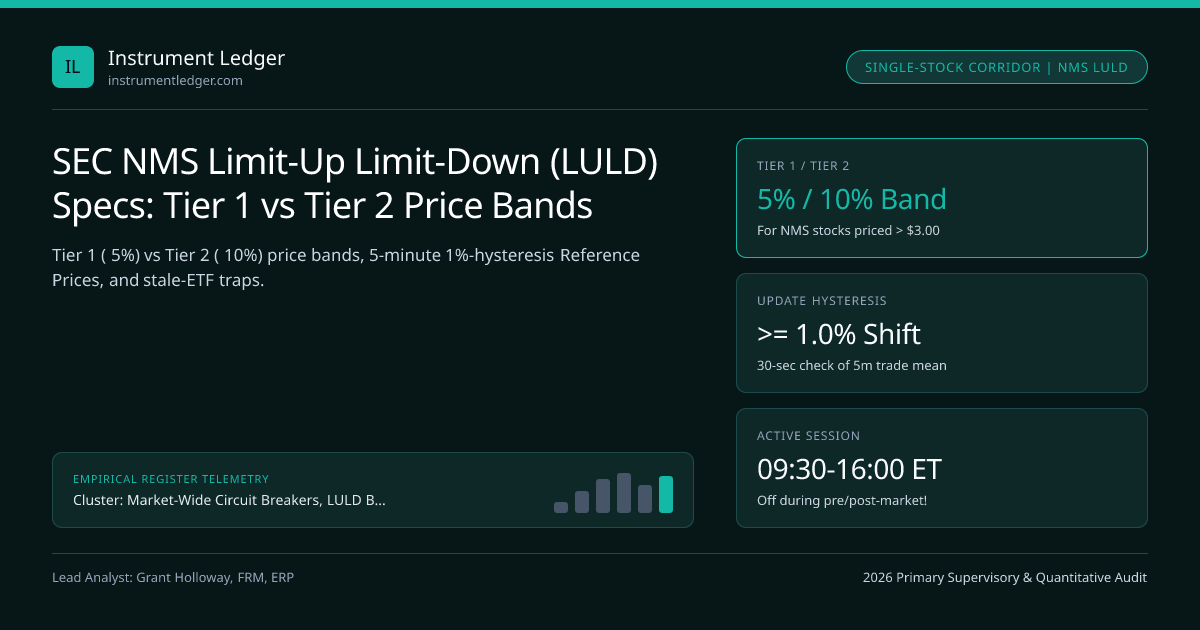
Approved by the SEC to eradicate single-stock $0.01 stub-quote flash crashes, the NMS Limit-Up Limit-Down Plan prohibits trades outside dynamic 5-minute rolling percentage bands tiered by index membership and share price.
During the May 6, 2010 Flash Crash, high-frequency liquidity vanished across 300+ US equities and ETFs while retail market sell orders swept all the way down to market makers' placeholder $0.01 "stub quotes"—printing blue-chip stocks 99% lower in seconds and forcing exchanges to retroactively bust over 20,000 executed trades! To ensure no US National Market System (NMS) stock can ever execute outside a continuous fair-value corridor again, the SEC enacted the Regulation NMS Plan to Address Extraordinary Market Volatility ("Limit-Up / Limit-Down" or LULD Plan)—forbidding every exchange, dark pool (ATS), and internalizer in America from executing a single share outside real-time Upper and Lower Price Bands broadcast by the CTA and UTP SIPs!
Within our MWCB, LULD Bands, CME Velocity Logic & Halt Master Guide under the Market-Wide Circuit Breakers, LULD Bands, Velocity Logic & Halt Reopenings hub, read this band-calculation specification alongside LULD 15-Second Limit State & 5-Minute Pause, LULD 09:30 & 15:35 Band Doubling, and our Exchange Halt & Volatility Registry.
Exact Reference Price Rolling 5-Minute Update Algorithm (>= 1% Trigger)#
How do the CTA (Tape A/B) and UTP (Tape C) SIP processors compute a stock's Reference Price (RP) every 30 seconds between 09:30 ET and 16:00 ET?
- Initial Reference Price: Equals the Primary Listing Exchange Opening Price (or the previous day's Official Closing Price if the stock opens on quotes without an opening trade).
- Rolling 5-Minute Arithmetic Mean (
Pro-Active 1.0% Threshold): Every 30 seconds, the SIP calculates the arithmetic mean of all eligible last-sale prints (>= 100-shareround lots / odd-lot eligible rules, excluding out-of-sequence or cash/next-day special settlement prints) over the preceding 5 minutes. - Anti-Chatter Hysteresis Rule: The new 5-minute average replaces the active
Reference PriceONLY IF it differs from the currentReference Priceby at least1.00%(|Mean_5m - Current_RP| / Current_RP >= 0.01)! If the 5-minute mean moved less than1%,RPand its LULD bands remain completely unchanged—saving market data feeds billions of redundant quote updates!
Tier 1 vs Tier 2 & Low-Priced Stock Percentage Band Pipeline#
Exact Band Rounding Direction (Inward Rounding!) & Leveraged ETP Rule#
Look closely at Step 4 in the diagram above—a precision detail tested in market-making interviews: *LULD Upper Bands round DOWN* to the nearest $0.01 (floor), while Lower Bands round UP to the nearest $0.01 (ceil)** so rounded tick increments never accidentally exceed the statutory percentage limit! Also note Leveraged 2x/3x ETPs (TQQQ, SOXL, UVIX): under the LULD Plan Appendix A, 2x and 3x leveraged/inverse ETPs have their percentage bands multiplied by their stated leverage factor (e.g., 5% × 3 = ±15% or Tier 2 ±20%) so TQQQ doesn't falsely halt when QQQ moves 2%!
- UpperLULDPriceBand = Floorto0.01( RPactive * ( 1 + Pct_Parameter ) )
- LowerLULDPriceBand = Ceilto0.01 ( RPactive * ( 1 - Pct_Parameter ) )
- Worked Tier 1 vs Tier 2 & Penny-Rounding LULD Calculation (09:30–15:35 ET Core Session):
- Example A — Apple (AAPL, Tier 1 S&P 500, RP = $227.35, Pct = 5.0%):
- Raw Upper = $227.35 * 1.05 = $238.7175 -> Rounded DOWN (Floor) = $238.71!
- Raw Lower = $227.35 * 0.95 = $215.9825 -> Rounded UP (Ceil) = $215.99!
- Example B — Biotech Small-Cap (Tier 2 Non-Russell-1000, RP = $14.20, Pct = 10.0%):
- Upper Band = $15.62 (+10.0%); Lower Band = $12.78 (-10.0%) [Or ±20% if 15:35-16:00 ET Close Window!]
Complete SEC NMS LULD Percentage Parameter Schedule (09:30–15:35 ET)#
Cross-check single-stock band widths against Single-Stock Futures (`SSF`) and Cboe Equity Options alongside our Intraday 0DTE Sigma Band Calculator:
| Previous Closing Price Bracket | Tier 1 NMS Securities (S&P 500, R1000, Core ETPs) | Tier 2 NMS Securities (Small-Caps, Other NMS) | Final 25 Mins (15:35–16:00 ET) |
|---|---|---|---|
Greater than $3.00 | ±5.0% | ±10.0% | Doubles (±10% T1 / ±20% T2) |
$0.75 up to & incl. $3.00 | ±20.0% | ±20.0% | Doubles (±40.0%) |
Less than $0.75 | Lesser of ±75% or $0.15 | Lesser of ±75% or $0.15 | Doubles (±150% or $0.30) |
| 2x / 3x Leveraged ETPs | Scaled by ETP Leverage (10%–15%+) | ±20.0% (Tier 2 treatment) | Doubles into close |
The "Illiquid ETF Stale Reference Price" Trap!#
Look at Bar 4 in the chart above—a notorious microstructure trap for ETF market makers! Suppose a thinly traded International or Corporate Bond ETF (Tier 1 or Tier 2) hasn't printed a single 100-share trade since 10:05 AM ET (when RP locked at $50.00, Upper Band = $52.50), while the underlying market steadily rallied +5.2% on futures/quotes (Bid = $52.50, Ask = $52.65)! Because quote changes alone DO NOT update the 5-minute trade-based Reference Price, that ETF's Upper Band stays frozen at $52.50 from 3 hours ago—the first buyer who lifts $52.55 hits the stale band and triggers an unnecessary LULD Straddle/Limit State! Smart ETF market makers print periodic small on-exchange round-lot updates during trends specifically to walk the Reference Price along smoothly!
Frequently asked questions
Are NMS Limit-Up Limit-Down (LULD) bands active during pre-market (04:00–09:30 ET) or after-hours (16:00–20:00 ET) trading?
No! LULD bands operate strictly during Regular Trading Hours (09:30:00–16:00:00 ET). That is why stocks releasing earnings at 16:05 ET or 07:00 ET can jump +40% or drop -50% instantaneously in extended hours without triggering 5-minute LULD pauses.
Which stocks belong to LULD Tier 1 versus Tier 2?
Tier 1 comprises all constituent stocks of the S&P 500 Index, the Russell 1000 Index, and a semi-annually updated list of high-volume Exchange-Traded Products (ETPs). Every other NMS common stock, REIT, warrant, or smaller ETP falls into Tier 2.
Why did an ETF trigger an LULD pause on a calm +5.1% intraday trend day with zero flash crash?
If an ETF goes hours without printing an eligible round-lot trade while market-maker quotes steadily drift +5.1% higher, its trade-based 5-minute Reference Price never updates—leaving the morning +5% Upper Band frozen in place until an incoming buyer hits it.
Can a Dark Pool (ATS) or wholesale retail internalizer fill my order outside the LULD Price Bands?
Strictly NO. Under the SEC LULD Plan, every Trading Center in the United States—including lit exchanges, dark pools, and off-exchange wholesalers—is legally barred from executing trades outside the live SIP LULD Price Bands.
Publication record
- Published
- November 13, 2026
- Updated
- November 15, 2026
- Author
- Grant Holloway, FRM, ERP
- Review
- Review not recorded
- Automated fact check
- Passed in the stored pipeline record
- Source URLs
- 3 recorded
AI assistance recorded: anthropic/claude-opus-4.6. This field does not establish human review or source verification.
Academic & Institutional Attribution
Cite This Research & Embed Live Data Card
Standard academic & institutional research paper citation format.
Grant Holloway, FRM, ERP. (2026, November 15). SEC NMS Limit-Up Limit-Down (LULD) Specs: Tier 1 vs Tier 2 Price Bands. Instrument Ledger. https://instrumentledger.com/specs/nms-luld-plan-tier-1-tier-2-reference-price-percentage-bandsRegulatory Directory Cross-Reference
Referenced Institutions & Regulatory Registries
Related Limit Up Limit Down Circuit Breakers & Institutional Briefings
Explore Limit Up Limit Down Circuit Breakers Hub (20) →Limit Up Limit Down Circuit Breakers
Market-Wide Circuit Breakers, LULD Bands, CME Velocity Logic & Halt Specs GuideLimit Up Limit Down Circuit Breakers
LULD Straddle State vs 15-Second Limit State: 5-Minute Pause MechanicsLimit Up Limit Down Circuit Breakers
LULD Band Doubling Rules: Eliminated 09:30 Open vs Active 15:35 ET Close SpecsLimit Up Limit Down Circuit Breakers
CME Globex Overnight ±7% Hard Limits vs RTH Equity Futures Price CapsLimit Up Limit Down Circuit Breakers
CME Globex Dynamic Circuit Breakers (DCB): Rolling 60-Minute Corridor MathLimit Up Limit Down Circuit Breakers
CME Globex Velocity Logic Specs: Millisecond Stop-Cascade Integrity PausesLimit Up Limit Down Circuit Breakers
CME Globex Price Banding & Protection Points: Fat-Finger Collar MathLimit Up Limit Down Circuit Breakers
CBOT Grain Daily Price Limits: Expanded Limits & Synthetic Option DiscoveryCfd Index Dividend Roll Contract Specs
Ex-Dividend Index Point Drops: CFD Long Credit & Short Debit Neutrality MathCfd Index Dividend Roll Contract Specs
IRS Section 871(m) on US500, NAS100 & Single-Stock CFDs: Qualified Index & W-8BEN MathCfd Index Dividend Roll Contract Specs
DAX 40 (GER40) Total-Return Performance Index vs Price Index CFD SpecificationsCfd Index Dividend Roll Contract Specs
Overnight CFD Financing Math: SOFR, SONIA, €STR Markups & Triple-Swap Cutoff Rules
Instrument Ledger Data, Benchmarks & Contributor Records
CC BY 4.0 Open Data
Open Institutional Datasets (CSV / JSON) →
Download desk-compiled quantitative series & schemas.
2026 Reference Matrix
2026 Institutional Benchmarks & Thresholds →
Statutory capital, clearing, margin & rate conventions.
Editorial Records
Authors & Review Records →
View named contributors where those records are available.
Complete Index
Master Research & Dossier Archive →
Browse all published briefings by topic pillar & date.