
Perpetual Funding Rate Mark Price Math
1-Hour Discrete vs Continuous Block-Level Perpetual Funding Accrual Specs
Modern L1 orderbooks including Hyperliquid and dYdX replace 8-hour funding cliffs with 1-hour 1/8th-scaled settlements or continuous per-second funding indexes, eliminating snapshot boundary arbitrage and accelerating spot convergence.
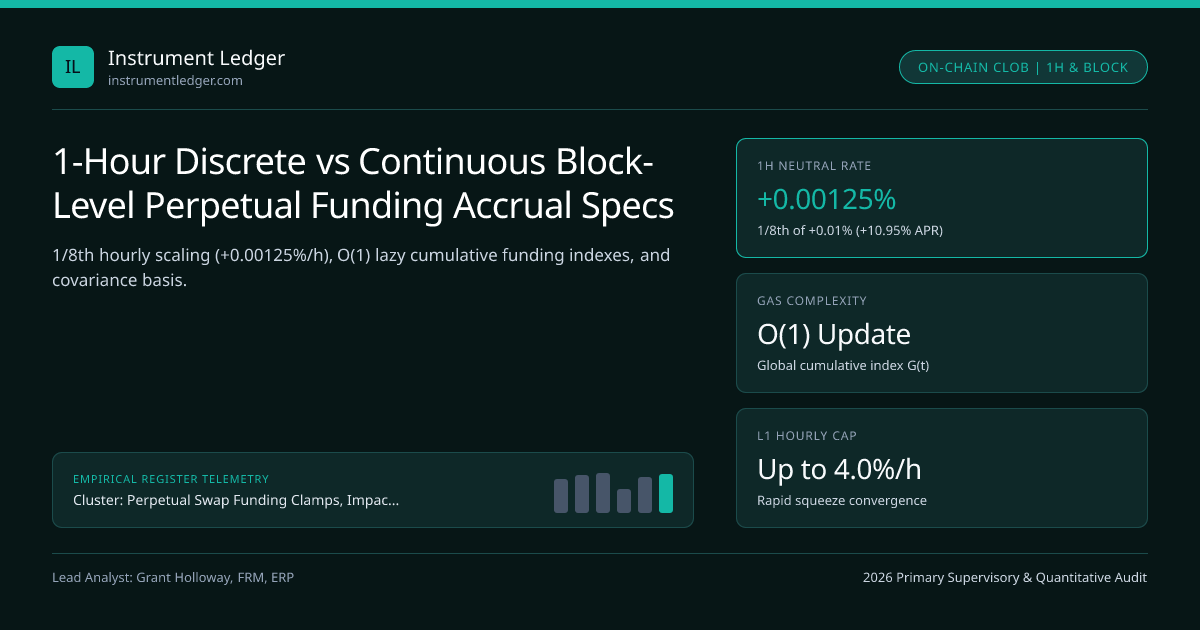
Discrete 8-hour perpetual funding epochs create artificial timestamp cliff distortions: during high-funding regimes (+0.15% per 8 hours), perpetual prices routinely rally right before 07:59:59 UTC as shorts pile in to harvest the 8-hour payout, then gap downward by 12 to 18 basis points at 08:00:01 UTC the instant the cash transfer clears! To eradicate timestamp boundary gaming and tighten basis tracking, decentralized L1 central limit order books led by Hyperliquid HYPE and dYdX Chain—alongside regulated institutional venues—migrated to 1-hour funding epochs (1/8th of the 8-hour rate) or continuous block-timestamp integral accrual.
Within our Perpetual Futures Funding Clamps, Mark Price and ADL Master Guide under the Perpetual Swap Funding Clamps, Impact Margin Notional, Mark Price & ADL hub, this architecture comparison pairs with 8-Hour Perpetual Funding Rate Clamp Math and TWAP Premium Index Sampling Gaming.
Scaling 8-Hour Clamps to 1-Hour Epochs (1/8 × F_8h)#
How do 1-hour perpetual venues preserve cross-exchange comparability so arbitrageurs can compare Hyperliquid against Binance or Bybit at a glance? Inside Hyperliquid's and dYdX v4's protocol engines, the oracle computes the exact same canonical 8-hour clamp formula first—using I_8h = +0.01% and clamp(I_8h - P, -0.05%, +0.05%) over 5-second impact-book samples—and then divides the resulting 8-hour rate by 8 to settle 1/8th of the 8-hour rate at the top of every UTC hour!
- Inside the neutral deadband (
-0.04% <= P <= +0.06%), the hourly transfer equals+0.01% / 8 = +0.00125%per hour (24 × 365 × 0.00125% = +10.95%APR—identical annualized carry, with 8x smaller price-drop cliffs at each settlement!). - Furthermore, while centralized exchanges cap 8-hour funding at
±0.75 × MMR(often ~0.375%–2.0% per 8 hours), Hyperliquid caps hourly funding at 4.00% per hour (32% per 8 hours!), forcing rapid spot-perpetual convergence during parabolic altcoin squeezes!
O(1) Lazy Cumulative Funding Index Math for On-Chain Engines#
Why cannot an on-chain L1 smart contract or rollup iterate over 150,000 open trader accounts at the top of every hour (or every 400ms block) to credit and debit USDC balances? Looping over N accounts (O(N) state writes) would halt block production! Instead, every modern on-chain perpetual engine (dYdX, Hyperliquid, Drift, GMX/Synthetix-style perps) maintains a single global accumulator per market—Cumulative_Funding_Per_Unit(t) (G_t)—updated in O(1) constant time every block or hour, while storing each trader's entry snapshot G_entry inside their position struct:
Global Cumulative Funding Index Settlement Verification#
- Gcurrent = Gprevious + dG(t)
- AccruedFundingPayable = SignedPositionUnits * ( Gcurrent - Guserlastsettled )
- Worked Cross-Venue Basis Arbitrage (Long $2,000,000 Hyperliquid 1h Perp vs Short $2,000,000 CEX 8h Perp):
- Suppose altcoin squeeze spikes Premium Index to P = +0.65% for 2 hours (01:00 to 03:00 UTC), then mean-reverts to 0.00% by 08:00 UTC!
- Hyperliquid (1h Settlement): Settles 2 high-funding hours at (0.65% - 0.05%)/8 = +0.075%/hr -> Long pays 2 * $1,500 = $3,000 immediately!
- CEX (8h TWAP 00:00–08:00 UTC): 2 hrs @ +0.65% + 6 hrs @ 0.00% -> 8h TWAP P = +0.1625% -> F_8h = +0.1125% -> Short receives $2,250 at 08:00!
- Asymmetry Alert: Intraday funding spikes between 8h epochs create -$750 path-dependent divergence across 1h vs 8h hedges!
8-Hour vs 1-Hour vs Block-Continuous Specification Matrix#
Benchmark annualized perpetual funding yields against Treasury and futures implied repo in our Listed Contract Basis and Implied Repo Calculator across USDC and USDT settlement rails.
| Engine Specification | Legacy 8h CEX (BTCUSDT) | 1-Hour L1 CLOB (Hyperliquid) | 1-Hour Cosmos CLOB (dYdX) | Block-Continuous Perp |
|---|---|---|---|---|
| Settlement Cadence | Every 8h (3/day) | Every 1h (24/day) | Every 1h (24/day) | Every Block (0.4s–2.0s) |
| Neutral Baseline Rate | +0.0100% / 8h | +0.00125% / 1h | +0.00125% / 1h (configurable) | +3.472e-7 % / second |
| Boundary Cliff Gaming | High (10–30 bps snaps) | Low (1/8th scale) | Low (validator-sampled) | Zero (time-pro-rata) |
| Accounting Mechanism | Batch DB balance sweep | Hourly account credit/debit | Block/Epoch index update | Lazy O(1) global G_t index |
| Reinvest Compounding | 3x daily | 24x daily (slightly higher APY) | 24x daily | Continuous exp(r*T) |
Path-Dependency Risk in Cross-Exchange Funding Arbitrage#
Cross-exchange market makers running Long Hyperliquid (1h) / Short Binance (8h) (or vice versa) often assume that because both use F = P + clamp(I - P, ±0.05%), identical price paths produce identical 8-hour cashflows. Because clamp is nonlinear AND Mark_Price(t) multiplies each hourly payment at that hour's price (Notional_h × F_h) rather than the 08:00 UTC price (Notional_8h × mean(F_h)), covariance between price spikes and funding spikes (Cov(Mark_Price, F) > 0) causes 1-hour longs to pay systematically MORE USD during bull squeezes than an 8-hour average predicts! Always stress-test cross-cadence covariance alongside Delta-Neutral Cash-and-Carry Yield Attribution and ISO 10962 CFI Classification Standards.
Frequently asked questions
Why does Hyperliquid display a 0.00125% hourly funding rate when centralized exchanges show 0.0100%?
Both represent the exact same +10.95% annualized neutral baseline! Hyperliquid settles funding every 1 hour instead of every 8 hours, so +0.0100% divided by 8 equals +0.00125% per hour (0.00125% x 24 x 365 = 10.95%).
How do on-chain DEX perpetuals settle funding across 100,000 users without running out of block gas?
Instead of updating 100,000 balances every block, the protocol updates one global Cumulative Funding Index variable per market in O(1) time. Individual accounts settle their net difference (G_now - G_entry) lazily on their next interaction.
Can cross-exchange funding arbitrage lose money if 1-hour and 8-hour venues have the same average premium?
Yes. Because 1-hour venues multiply each hourly rate by that hour Mark Price (capturing high Mark Price * high funding at peak squeeze) and apply higher hourly caps (up to 4%/hr), total USD cashflows diverge from an 8-hour endpoint settlement.
Does continuous block-level funding eliminate funding rate volatility?
Continuous accrual eliminates discrete timestamp cliff jumps (opening/closing seconds before 08:00 UTC), while instantaneous funding rates still fluctuate dynamically with orderbook Impact Bid/Ask premium over spot.
Publication record
- Published
- November 14, 2026
- Updated
- November 18, 2026
- Author
- Grant Holloway, FRM, ERP
- Review
- Review not recorded
- Automated fact check
- Passed in the stored pipeline record
- Source URLs
- 3 recorded
AI assistance recorded: anthropic/claude-opus-4.6. This field does not establish human review or source verification.
Academic & Institutional Attribution
Cite This Research & Embed Live Data Card
Standard academic & institutional research paper citation format.
Grant Holloway, FRM, ERP. (2026, November 18). 1-Hour Discrete vs Continuous Block-Level Perpetual Funding Accrual Specs. Instrument Ledger. https://instrumentledger.com/specs/one-hour-continuous-hyperliquid-dydx-perpetual-funding-accrualRegulatory Directory Cross-Reference
Referenced Institutions & Regulatory Registries
Primary Tier-1 Supervisory Registries
Related Perpetual Funding Rate Mark Price Math & Institutional Briefings
Explore Perpetual Funding Rate Mark Price Math Hub (20) →Perpetual Funding Rate Mark Price Math
Perpetual Futures Funding Clamps, Impact Margin Notional, Mark Price and ADL GuidePerpetual Funding Rate Mark Price Math
Impact Bid and Impact Ask Prices: L2 Depth-Weighted Impact Margin Notional MathPerpetual Funding Rate Mark Price Math
Three-Component Perpetual Mark Price Median: Preventing Wick LiquidationsPerpetual Funding Rate Mark Price Math
Perpetual Spot Index Construction: Constituent Outlier Ejection and FailoverPerpetual Funding Rate Mark Price Math
Tiered Maintenance Margin Notional Brackets and Maintenance Deduction MathPerpetual Funding Rate Mark Price Math
Cross vs Isolated Perpetual Margin: Exact Liquidation and Bankruptcy Price MathPerpetual Funding Rate Mark Price Math
Derivatives Insurance Fund Mechanics: Surplus Capture and Daily Drawdown CapsPerpetual Funding Rate Mark Price Math
Auto-Deleveraging (ADL) Queue Math: PnL-Times-Leverage Percentile RankingSpan2 Portfolio Margin Cross Offsets
SPAN 2 Stress VaR Calibration: Historical Crisis Scenarios in Energy & RatesSpan2 Portfolio Margin Cross Offsets
CME SPAN 2 Liquidity and Concentration Add-On (LCA): Whale Margin MathSpan2 Portfolio Margin Cross Offsets
NYMEX 3:2:1 Crack Spread Specs: WTI, RBOB & ULSD Unit Conversion & MarginSpan2 Portfolio Margin Cross Offsets
CBOT Treasury Yield Curve Spreads (TUT, NOB, FYT): DV01 Ratios & SPAN 2
Instrument Ledger Data, Benchmarks & Contributor Records
CC BY 4.0 Open Data
Open Institutional Datasets (CSV / JSON) →
Download desk-compiled quantitative series & schemas.
2026 Reference Matrix
2026 Institutional Benchmarks & Thresholds →
Statutory capital, clearing, margin & rate conventions.
Editorial Records
Authors & Review Records →
View named contributors where those records are available.
Complete Index
Master Research & Dossier Archive →
Browse all published briefings by topic pillar & date.