
Perpetual Funding Rate Mark Price Math
Three-Component Perpetual Mark Price Median: Preventing Wick Liquidations
Institutional perpetual risk engines trigger margin liquidations strictly off a three-component median Fair Mark Price rather than Last Traded Price, neutralizing flash-wick cascades and cross-venue oracle disconnects.
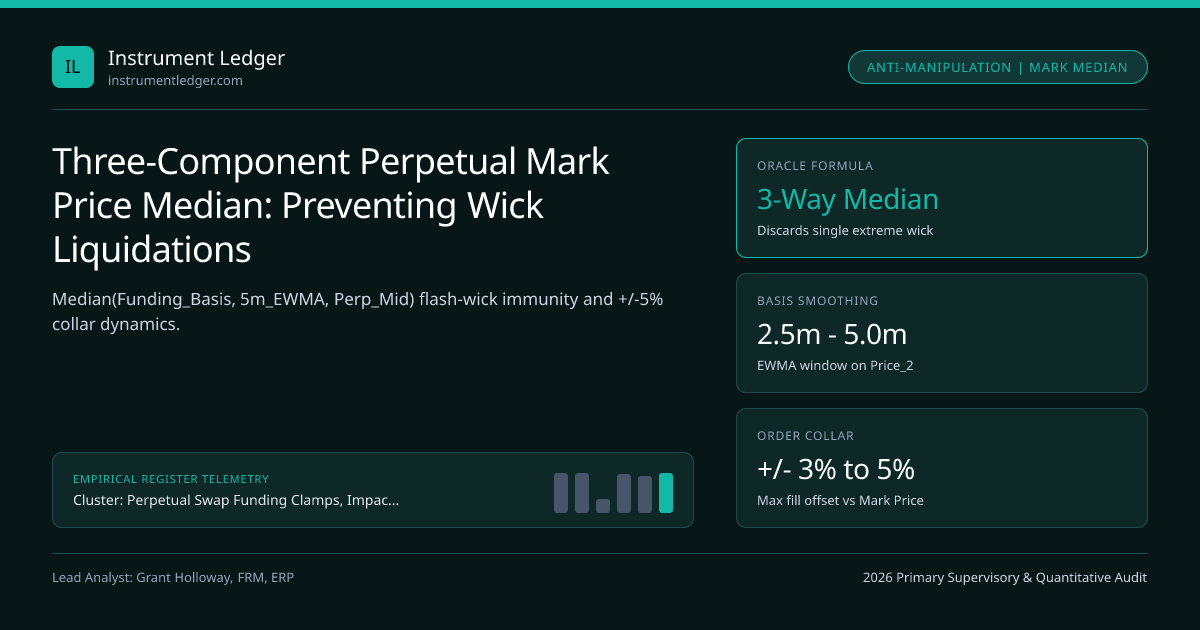
In 24/7 leveraged derivatives markets, triggering margin liquidations off Last Traded Price (LTP) is catastrophic: a single aggressive market order sweeping a thin Sunday night perpetual book by 8% ("scam wick") would detonate cascading stop-out orders even while external spot Bitcoin BTC and Ethereum ETH venues remain rock-steady! Conversely, marking leveraged perpetuals purely to the raw Spot Index ignores legitimate persistent basis premia—immediately liquidating high-leverage shorts when a token enters genuine +1.50% contango! Modern risk engines solve both failure modes simultaneously by defining Fair_Mark_Price = Median(Price_1, Price_2, Price_3).
Within our Perpetual Futures Funding Clamps, Mark Price and ADL Master Guide under the Perpetual Swap Funding Clamps, Impact Margin Notional, Mark Price & ADL hub, this oracle specification pairs directly with Spot Index Constituent Outlier Ejection and Perpetual Bankruptcy vs Liquidation Price Equations.
Anatomy of Price_1, Price_2, and Price_3 Inside the Median Operator#
Every second (or sub-second tick), the margin engine evaluates three distinct price estimators anchored to the composite Spot Index (S) under the Perpetual Contract Funding Rate Convention:
Price_1— Linear Decay Funding-Basis Price:S × [ 1 + F_current × (Time_Until_Next_Funding / Funding_Interval) ]. At the start of an 8-hour epoch (t = 8hremaining) withF = +0.08%,Price_1stands atS × 1.0008, decaying smoothly towardS × 1.0000right as the funding payout approaches!Price_2— Smoothed EWMA / Moving-Average Basis Price:S + MA_N(Perp_Impact_Mid - S), whereMA_Nis a 2.5-minute to 5-minute exponentially weighted (or arithmetic) moving average of the perpetual-minus-spot basis! BecauseMA_Naverages across 30 to 300 five-second samples, a 10-second perpetual flash wick barely movesPrice_2, while a genuine 15-minute market-wide basis shift updatesPrice_2smoothly!Price_3— Live Perpetual Orderbook Midpoint:0.5 × (Perp_Best_Bid + Perp_Best_Ask)(orMedian(Best_Bid, Best_Ask, Last_Price)).
Taking Median(Price_1, Price_2, Price_3) guarantees mathematical outlier immunity: if Price_3 flashes +9% upward in a 3-second perpetual squeeze while Price_1 (+0.04%) and Price_2 (+0.07%) remain anchored to Spot, Median discards Price_3 and returns Price_2 (+0.07%)—saving zero shorts from unfair wick liquidation!
Worked Flash-Wick Stress Test: LTP vs Fair Mark Price#
Let's prove numerically how the three-component median protects a 20x leveraged short trader on Solana SOL (SOLUSDT, Maintenance Margin = 1.00%, Liquidation Trigger = +4.00% adverse move from $180.00 entry = $187.20) when an illiquid Sunday sweep spikes perpetual LTP and Perp_Mid to $194.00 (+7.78%) for 8 seconds while external Spot stays at $180.20:
Median Estimator Evaluation Under Single-Sided Wick Stress#
- Price2 = SpotIndex + EWMA5min( PerpMid - Spot_Index )
- Price3 = Median( PerpBestBid, PerpBestAsk, PerpLast_Trade )
- FairMarkPrice = Median( Price1, Price2, Price_3 )
- Worked 8-Second Flash-Wick Survival Audit (Spot = $180.20, 5h left in 8h epoch, F = +0.024%):
- Price_1 = $180.20 * (1 + 0.00024 * (5 / 8)) = $180.20 * 1.00015 = $180.227
- Price2 = $180.20 + EWMA5min(spiked for 8s of 300s -> +$0.41 basis) = $180.610
- Price_3 = Spiked Perp Orderbook Midpoint = $194.000 (+7.78% scam wick!)
- FairMarkPrice = Median($180.227, $180.610, $194.000) = $180.610 (Well below $187.20 liquidation trigger -> SURVIVES!)
Mark Price vs Last Price Order Trigger Matrix#
Active traders using stop-loss orders and API risk guards must configure whether conditional triggers reference Mark_Price or Last_Price, benchmarking expected normal envelopes in our Intraday 0DTE Sigma Band Calculator.
| Risk Engine Function | Price Reference Used | Why Exchange Enforces This Rule | Trader Configuration Pitfall |
|---|---|---|---|
| Mandatory Liquidation Check | Fair Mark Price | Blocks single-book wick cascades & Insurance Fund drains | Never assume LTP wicks won't fill stop-market orders! |
| Unrealized Cross-Margin PnL | Fair Mark Price | Prevents wash-trading illiquid perp up to borrow cross-collateral | Paper profit at LTP cannot withdraw until Mark catches up |
Stop-Loss (Mark Trigger) | Fair Mark Price | Survives scam wicks; aligns stop strictly ahead of liquidation | During genuine fast crash, fills worse if LTP leads Spot by 2% |
Stop-Loss (Last Trigger) | Last Traded Price | Exits faster when perpetual leads spot discovery | Gets stopped out at the exact top/bottom of thin wicks! |
| Pre-Trade Fat-Finger Collar | Fair Mark Price ± X% | Rejects buy limits > +5% above Mark or sells < -5% below Mark | Blocks closing a hedge at LTP if Perp dislocates >5% from Mark! |
The "Price Collar Deadlock" Trap for Stop-Loss Orders#
Every institutional execution engineer must guard against a subtle second-order edge case of Fair_Mark_Price: to prevent fat-finger sweeps (comparable to CME Price Banding in CME Globex Price Banding and Protection Points), perpetual matching engines reject any aggressive buy order priced higher than Mark_Price × (1 + Collar%) (e.g., +5%). If a micro-cap perpetual violently squeezes +8% above Spot in 20 seconds—faster than the 5-minute EWMA Price_2 can pull Mark_Price up—a voluntary buy stop-market order converts into a limit order capped at Mark × 1.05, sitting 3% below the lowest ask on the book and failing to fill until either LTP drops or the 5-minute EWMA lifts Mark_Price!
Frequently asked questions
Why was my perpetual position NOT liquidated even though the candlestick chart wicked past my liquidation price?
Standard candlestick charts plot Last Traded Price (LTP), whereas the margin engine liquidates strictly off Fair Mark Price. Switch the chart view to Mark Price—the median filter discarded the brief LTP wick.
Why cannot exchanges simply set Mark Price equal to the external Spot Index price?
During genuine bull or bear trends, perpetual futures legitimately trade at a persistent +0.50% to +1.50% basis premium or discount to spot. Marking purely to Spot would instantly liquidate high-leverage traders the moment they enter at market price.
Should institutional execution systems trigger protective stop-losses off Mark Price or Last Price?
For liquidation-prevention stops, always trigger off Mark Price with a sufficient safety buffer ahead of Maintenance Margin so flash wicks do not eject the hedge. However, monitor Mark-to-LTP collar width to ensure marketable limit execution.
Why was my unrealized profit on a spiked perpetual unavailable to withdraw as cross-margin collateral?
Exchanges value unrealized PnL at Fair Mark Price (and often apply haircuts to un-crystallized profits) precisely so attackers cannot wash-trade an illiquid perpetual upward at LTP and borrow real spot USDT against fake unrealized gains.
Publication record
- Published
- November 14, 2026
- Updated
- November 14, 2026
- Author
- Grant Holloway, FRM, ERP
- Review
- Review not recorded
- Automated fact check
- Passed in the stored pipeline record
- Source URLs
- 3 recorded
AI assistance recorded: anthropic/claude-opus-4.6. This field does not establish human review or source verification.
Academic & Institutional Attribution
Cite This Research & Embed Live Data Card
Standard academic & institutional research paper citation format.
Grant Holloway, FRM, ERP. (2026, November 14). Three-Component Perpetual Mark Price Median: Preventing Wick Liquidations. Instrument Ledger. https://instrumentledger.com/specs/three-component-fair-mark-price-median-anti-manipulation-specRegulatory Directory Cross-Reference
Referenced Institutions & Regulatory Registries
Referenced Supervisory Authorities
Related Perpetual Funding Rate Mark Price Math & Institutional Briefings
Explore Perpetual Funding Rate Mark Price Math Hub (20) →Perpetual Funding Rate Mark Price Math
Perpetual Futures Funding Clamps, Impact Margin Notional, Mark Price and ADL GuidePerpetual Funding Rate Mark Price Math
Perpetual Spot Index Construction: Constituent Outlier Ejection and FailoverPerpetual Funding Rate Mark Price Math
Tiered Maintenance Margin Notional Brackets and Maintenance Deduction MathPerpetual Funding Rate Mark Price Math
Cross vs Isolated Perpetual Margin: Exact Liquidation and Bankruptcy Price MathPerpetual Funding Rate Mark Price Math
Derivatives Insurance Fund Mechanics: Surplus Capture and Daily Drawdown CapsPerpetual Funding Rate Mark Price Math
Auto-Deleveraging (ADL) Queue Math: PnL-Times-Leverage Percentile RankingPerpetual Funding Rate Mark Price Math
Inverse Coin-Margined vs Linear USDT Perpetuals: 1/P Convexity and Hedging MathPerpetual Funding Rate Mark Price Math
Quanto Perpetual Futures Specs: Fixed Cross-Currency Multipliers & CovarianceSpan2 Portfolio Margin Cross Offsets
NYMEX 3:2:1 Crack Spread Specs: WTI, RBOB & ULSD Unit Conversion & MarginSpan2 Portfolio Margin Cross Offsets
CBOT Treasury Yield Curve Spreads (TUT, NOB, FYT): DV01 Ratios & SPAN 2Span2 Portfolio Margin Cross Offsets
CME-FICC Cross-Margining Specs: Cash Treasury Repo vs CBOT Futures OffsetsSpan2 Portfolio Margin Cross Offsets
Eurex Clearing Prisma Margin Specs: Filtered HVaR & Bund-Swap Offsets
Instrument Ledger Data, Benchmarks & Contributor Records
CC BY 4.0 Open Data
Open Institutional Datasets (CSV / JSON) →
Download desk-compiled quantitative series & schemas.
2026 Reference Matrix
2026 Institutional Benchmarks & Thresholds →
Statutory capital, clearing, margin & rate conventions.
Editorial Records
Authors & Review Records →
View named contributors where those records are available.
Complete Index
Master Research & Dossier Archive →
Browse all published briefings by topic pillar & date.