
Perpetual Funding Rate Mark Price Math
Perpetual Spot Index Construction: Constituent Outlier Ejection and Failover
Every perpetual Mark Price and Funding Rate depends on an underlying composite Spot Index; institutional oracle specifications enforce median-deviation outlier ejection, stale-timestamp circuit breakers, and stablecoin cross-rate normalization.
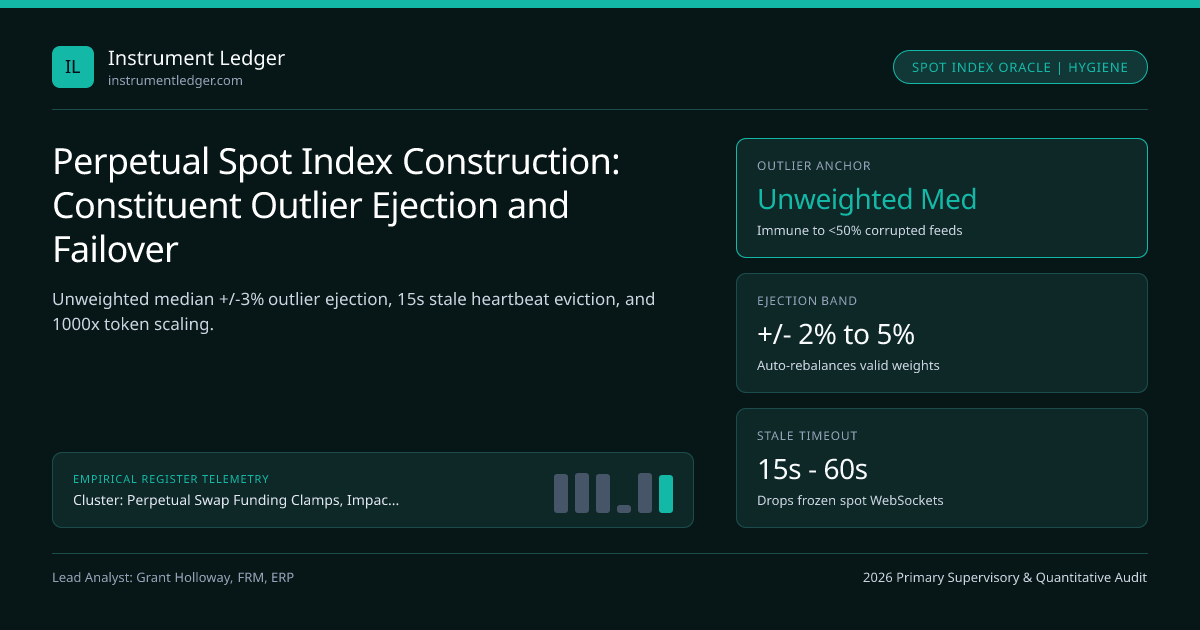
Every equation inside a perpetual swap risk engine—both Premium_Index (P) and Fair_Mark_Price—relies on the integrity of a single foundational input: the Composite Spot Price Index (S). If one constituent spot exchange suffers a localized database freeze, wallet deposit halt (inducing a +12% isolated "Kimchi-style" or localized withdrawal premium), or API WebSocket glitch, feeding that corrupted print into S would instantaneously poison Mark Prices and detonate false liquidations across billions in open interest! Institutional index engines prevent constituent contamination through four-layer automated oracle hygiene: cross-rate FX/stablecoin conversion, stale-heartbeat eviction, median-deviation clamping/ejection, and single-source fallback transitions.
Within our Perpetual Futures Funding Clamps, Mark Price and ADL Master Guide under the Perpetual Swap Funding Clamps, Impact Margin Notional, Mark Price & ADL hub, this oracle architecture audit complements Three-Component Fair Mark Price Median Specs and regulated benchmark rules in CME Bitcoin BRR 12-Partition Fixing.
Multi-Venue Weighting, Stablecoin Cross-Rates (BTC/USD vs BTC/USDT), and Heartbeats#
First, notice that a BTCUSDT linear perpetual does NOT necessarily track a BTC/USD fiat spot index—its contract specification explicitly defines whether the underlying index is BTC/USDT (polling BTC/USDT books directly plus BTC/USD × USD/USDT and BTC/USDC × USDC/USDT cross-converted quotes!) or BTC/USD (used by coin-margined BTCUSD inverse contracts and USDC-settled L1 books). During the March 2023 Silicon Valley Bank (USDC depeg to $0.88) event, BTC/USDC spot printed 13% higher numerically than BTC/USD and BTC/USDT—traders who failed to verify whether their perpetual's Spot Index cross-normalized USDC and USDT suffered violent basis shocks!
Exact Median-Deviation Outlier Clamping & Weight Re-Normalization Math#
Why must outlier detection measure distance against the unweighted median (M_spot) of surviving exchanges rather than their volume-weighted mean? If the largest constituent exchange (w_1 = 35% weight) prints a corrupted $0.01 flash crash, that $0.01 print drags the weighted mean down by -35%, potentially causing healthy exchanges to look like "+53% outliers"! By anchoring the outlier filter strictly to the unweighted median M_spot, up to floor((N - 1) / 2) corrupted venues cannot shift the reference anchor at all!
Constituent Outlier Clipping & Re-Normalized Index Formula#
- SanitizedPrice (Pi*) = {
- Ejected (wi* = 0), if |Pi - Mspot| / Mspot > Threshold_Eject (e.g., 5.0%)
- clamp(Pi, 0.98*Mspot, 1.02*M_spot), if soft-clamped at +/- 2.0% band
- P_i, otherwise
- }
- SpotIndex (S) = Sumi ( wi* * Pi* ) / Sumi ( wi* )
- Worked Constituent Wallet-Halt Isolation Audit (6 Exchanges, Equal 16.67% Base Weights, Threshold = +/-3.0%):
- Venues 1–5 print ETH/USDT at: $3,401.20, $3,402.00, $3,400.80, $3,401.50, $3,402.40
- Venue 6 halts ETH withdrawals -> isolated local short squeeze prints $3,695.00 (+8.63% dislocation!)
- Unweighted Median M_spot = 0.5 * ($3,401.50 + $3,402.00) = $3,401.75
- Venue 6 Deviation = |$3,695.00 - $3,401.75| / $3,401.75 = +8.62% > 3.0% -> Venue 6 EJECTED (w_6* = 0)!
- Re-Normalized Spot Index S = Mean(Venues 1..5) = $3,401.58 (0.00 bps contamination from Venue 6!)
Constituent Failure Modes & Oracle Defense Specification Matrix#
Review benchmark governance principles under IOSCO, FCA, and CPMI-IOSCO PFMI alongside pre-spot token launches in Pre-Launch EWMA Mark Price Oracle Design.
| Constituent Anomaly | Real Historical Precedent | Unprotected Oracle Result | Institutional Index Rulebook Defense | ||
|---|---|---|---|---|---|
| Isolated Withdrawal Halt | Korea / single-CEX wallet maintenance | +8%–25% fake Spot Index jump | Ejects any constituent ` | P_i - Median | > 3%–5%` |
| Stablecoin Peg Break | March 2023 SVB USDC $0.88 depeg | +13% divergence BTC/USDC vs USD | Explicit cross-pair USDC/USDT conversion multiplier | ||
| Matching Engine Outage | Cloud/AWS zone freeze on 1 spot CEX | Stale price drags fast-moving index | 15s–60s timestamp staleness timeout sets w_i = 0 | ||
| Token Redenomination | 1:1000 ticker split (e.g., 1000PEPE / PEPE) | 1000x decimal scaling mismatch | Scheduled index halt + coordinated multiplier scaling | ||
Total Spot Outage (N < 2) | Single-exchange monopoly listing | Manipulable 1-venue spot print | Switches Mark Price to internal Perp EWMA synthetic index |
The 1000-Multiplier Sub-Cent Token Symbology Trap (1000PEPE, 1000BONK, kSHIB)#
When trading low-unit-price tokens such as Shiba Inu SHIB, Pepe PEPE, or Bonk BONK where spot trades at $0.00001240, floating-point tick increments in matching engines become unwieldy. Perpetual contract specifications therefore bundle 1,000 spot tokens per perpetual unit under symbols like 1000PEPEUSDT or kPEPE-USD (quoting at $0.01240 instead of $0.00001240)! Quantitative multi-venue routers MUST verify the Index Scaling Multiplier (1 vs 1,000 vs 1,000,000) via exchange instrument metadata endpoints—failing to multiply spot hedge quantities by 1,000 leaves a basis bot 99.9% unhedged!
Frequently asked questions
Why do perpetual Spot Indexes compare exchanges against the unweighted median instead of the weighted average?
If a high-weight exchange prints a corrupted flash crash near zero, that print drags the weighted average down sharply, causing accurate exchanges to appear out-of-bounds. The unweighted median stays completely unaffected unless a majority of feeds fail.
What happens to a perpetual contract if spot deposits/withdrawals halt on one major exchange and its price spikes 15%?
Once that exchange spot price diverges past the +/-3% to 5% median deviation band, the index engine automatically ejects its weight (w_i = 0) and redistributes 100% of index weight across the remaining aligned exchanges.
How did the March 2023 USDC depeg affect USDC-margined vs USDT-margined perpetual Spot Indexes?
Contracts indexed to USD or USDT kept Bitcoin near $20,000 while raw BTC/USDC spot traded near 22,600 USDC. Indexes with live USDC/USD cross-rate normalization insulated perpetual Mark Prices from the temporary $0.88 stablecoin discount.
What does the k or 1000 prefix mean in perpetual symbols like 1000PEPEUSDT or kBONK?
It indicates a 1,000-unit contract multiplier applied to the underlying Spot Index so prices quote near $0.01 instead of $0.00001. Buying 100 units of 1000PEPEUSDT controls 100,000 underlying PEPE spot tokens.
Publication record
- Published
- November 14, 2026
- Updated
- November 15, 2026
- Author
- Grant Holloway, FRM, ERP
- Review
- Review not recorded
- Automated fact check
- Passed in the stored pipeline record
- Source URLs
- 3 recorded
AI assistance recorded: anthropic/claude-opus-4.6. This field does not establish human review or source verification.
Academic & Institutional Attribution
Cite This Research & Embed Live Data Card
Standard academic & institutional research paper citation format.
Grant Holloway, FRM, ERP. (2026, November 15). Perpetual Spot Index Construction: Constituent Outlier Ejection and Failover. Instrument Ledger. https://instrumentledger.com/specs/spot-index-constituent-outlier-ejection-circuit-weight-rebalanceRegulatory Directory Cross-Reference
Referenced Institutions & Regulatory Registries
Referenced Supervisory Authorities
Related Perpetual Funding Rate Mark Price Math & Institutional Briefings
Explore Perpetual Funding Rate Mark Price Math Hub (20) →Perpetual Funding Rate Mark Price Math
Perpetual Futures Funding Clamps, Impact Margin Notional, Mark Price and ADL GuidePerpetual Funding Rate Mark Price Math
Tiered Maintenance Margin Notional Brackets and Maintenance Deduction MathPerpetual Funding Rate Mark Price Math
Cross vs Isolated Perpetual Margin: Exact Liquidation and Bankruptcy Price MathPerpetual Funding Rate Mark Price Math
Derivatives Insurance Fund Mechanics: Surplus Capture and Daily Drawdown CapsPerpetual Funding Rate Mark Price Math
Auto-Deleveraging (ADL) Queue Math: PnL-Times-Leverage Percentile RankingPerpetual Funding Rate Mark Price Math
Inverse Coin-Margined vs Linear USDT Perpetuals: 1/P Convexity and Hedging MathPerpetual Funding Rate Mark Price Math
Quanto Perpetual Futures Specs: Fixed Cross-Currency Multipliers & CovariancePerpetual Funding Rate Mark Price Math
Perpetual Funding Rate Caps & Interval Compression: -2% Squeeze MechanicsSpan2 Portfolio Margin Cross Offsets
CBOT Treasury Yield Curve Spreads (TUT, NOB, FYT): DV01 Ratios & SPAN 2Span2 Portfolio Margin Cross Offsets
CME-FICC Cross-Margining Specs: Cash Treasury Repo vs CBOT Futures OffsetsSpan2 Portfolio Margin Cross Offsets
Eurex Clearing Prisma Margin Specs: Filtered HVaR & Bund-Swap OffsetsSpan2 Portfolio Margin Cross Offsets
ICE Clear IRM 2 Margin Specs: Brent, Gasoil & Dutch TTF Natural Gas VaR
Instrument Ledger Data, Benchmarks & Contributor Records
CC BY 4.0 Open Data
Open Institutional Datasets (CSV / JSON) →
Download desk-compiled quantitative series & schemas.
2026 Reference Matrix
2026 Institutional Benchmarks & Thresholds →
Statutory capital, clearing, margin & rate conventions.
Editorial Records
Authors & Review Records →
View named contributors where those records are available.
Complete Index
Master Research & Dossier Archive →
Browse all published briefings by topic pillar & date.