
Futures Tick Value Delivery Settlement
COMEX Gold Futures (GC vs MGC) 100-Oz Warrant Allocation and First Notice Rules
COMEX Gold futures (GC) mandate physical delivery of 100 troy ounces (+/-5%) of 0.995-fine gold bullion via electronic depository warrants, while Micro Gold (MGC) accumulates 10 ACE certificates before physical redemption.
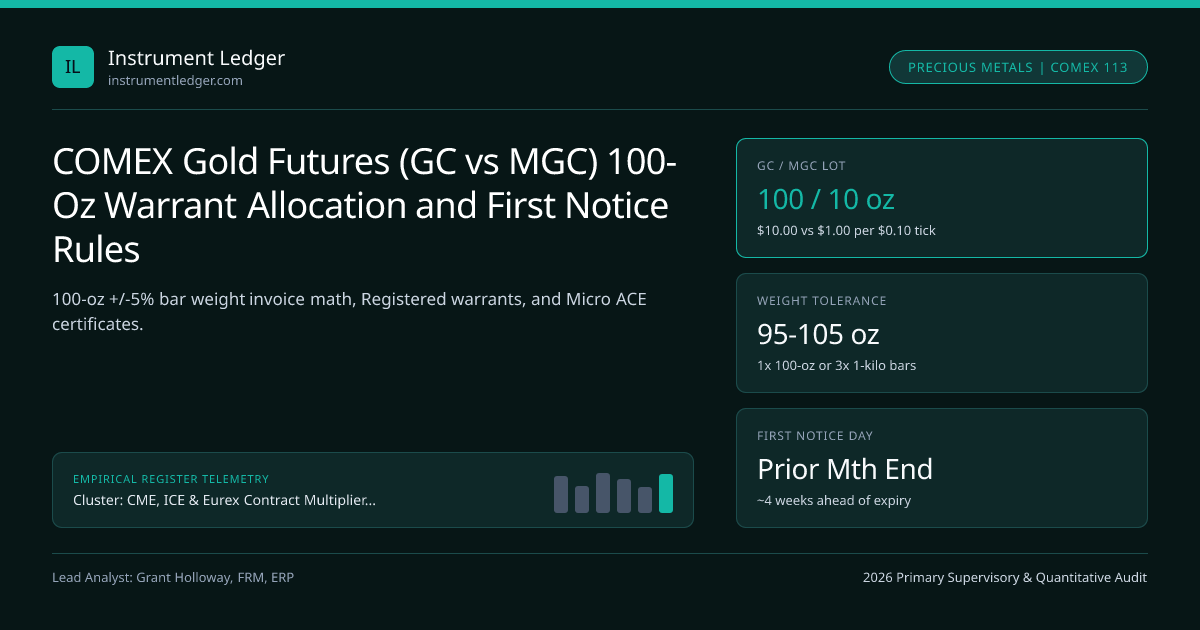
Under COMEX Rulebook Chapter 113, the benchmark Gold futures contract (GC) specifies a physical lot size of 100 troy ounces of refined bullion assaying at least 0.995 fineness, quoted in US dollars and cents per troy ounce with a minimum outright tick increment of $0.10/oz ($10.00 per contract). Its 1/10th counterpart, Micro Gold (MGC, Chapter 120), represents 10 troy ounces at the same $0.10/oz minimum fluctuation ($1.00 per tick). At $2,750.00/oz, one GC lot represents $275,000 in bullion value, and holding a long position past First Position Day exposes the account to mandatory electronic warrant allocation starting on First Notice Day (FND)—the last business day of the month preceding the contract delivery month.
As part of our CME, ICE and Eurex Futures Multipliers and Delivery Guide in the CME, ICE & Eurex Contract Multipliers, Tick Values & Delivery Mechanics hub, this guide details COMEX bar weight tolerances, Registered vs Eligible vault tiers, Accumulated Certificates of Exchange (ACE), and how deliverable bullion differs from tokenized spot wrappers like Tether Gold XAUT and PAX Gold PAXG.
Active Liquidity Cycle vs Non-Benchmark Serial Months#
Although COMEX lists GC across the current calendar month, the next two calendar months, and any February, April, June, August, October, and December (G, J, M, Q, V, Z) within a 23-month window, open interest concentrates overwhelmingly in those even-numbered active months (with April, June, August, and December dominating). Notice that June (M) and December (Z) overlap equity IMM cycles, while March (H) and September (U) are thin serial months in COMEX Gold! Institutional desks that blindly apply H, M, U, Z equity futures roll calendars to GC find themselves trapped in illiquid March or September serial books where bid-ask spreads widen to 4–8 ticks ($40–$80).
Bar Weight Tolerance (95–105 oz) and Exact Invoice Formula#
Physical gold bars cast by COMEX-approved refiners do not weigh 100.000 troy ounces to the milligram. COMEX Chapter 113 permits a seller to satisfy one GC contract by delivering either one 100-troy-ounce bar OR three 1-kilogram bars (3 × 32.1507 = 96.4522 troy oz), provided the aggregate fine troy ounce weight falls within ±5% of 100 ounces (95.000 to 105.000 fine troy ounces). Critically, the buyer pays for the exact assayed fine troy ounces stamped on the electronic warrant—not a flat 100 ounces—plus accrued depository storage deductions up to Delivery Day.
Assayed Fine-Ounce Warrant Billing Calculation#
- DeliveryInvoiceUSD = FineTroyOunces * SettlementPriceIntent_Day
- Worked COMEX GC Warrant Invoice (3x 1-Kilogram 0.9999-Fine Bars vs 1x Cast 100-Oz Bar):
- Case A (Three 1-kg bars): Gross = 3 * 32.1507 = 96.4521 oz; Fineness = 0.9999 -> Fine = 96.4425 oz
- At Settlement = $2,750.00/oz -> Invoice = 96.4425 * $2,750.00 = $265,216.88
- Case B (Heavy 100-oz bar): Gross = 104.200 oz; Fineness = 0.9960 -> Fine = 103.7832 oz
- At Settlement = $2,750.00/oz -> Invoice = 103.7832 * $2,750.00 = $285,403.80
- Funding Variance Range for Stopping Long: $285,403.80 - $265,216.88 = $20,186.92 cash buffer required!
Deliverable Bullion vs Micro ACE & Tokenized Vault Comparison#
Treasury desks comparing gold lease/carry curves in the Listed Contract Basis and Implied Repo Calculator also evaluate COMEX Silver mechanics in COMEX Silver (SI vs SIL) 5,000-Oz Vault Delivery and spot bullion swap points in XAU/USD Spot Bullion CFD vs COMEX GC Roll Specs.
| Specification Dimension | COMEX Gold (GC) | COMEX Micro Gold (MGC) | LBMA / Tokenized (XAUT / PAXG) | Clearing & Operational Rule |
|---|---|---|---|---|
| Oversight / Rulebook | COMEX Ch. 113 (CFTC) | COMEX Ch. 120 (CFTC) | Vault Custody (XAUT / PAXG) | CFTC-regulated CCP under PFMI |
| Unit Size & Tolerance | 100 oz (±5%: 95–105 fine oz) | 10 oz (delivers 1 ACE unit) | 1.000 fine troy oz per token | 10 ACEs convert to 1 full GC warrant |
| Outright / Spread Tick | $0.10 ($10) / $0.05 ($5 ICS) | $0.10 ($1.00) / $0.05 ($0.50) | $0.01–$0.10 venue-dependent | Reduced 5-cent ICS spread saves 50% |
| First Notice Day (FND) | Last bus. day of prior month | Last bus. day of prior month | N/A (spot continuous title) | Roll 2+ business days before month-end |
| Vault Classification | COMEX Registered Warrant | ACE Fractional Warrant | London Good Delivery 400-oz / Swiss | Eligible metal requires warranting to deliver |
Registered vs Eligible Vault Metal and EFP Basis Shocks#
Public commentary frequently misinterprets daily COMEX depository stock reports by conflating Eligible metal with Registered metal. Eligible gold sits inside approved New York-area depositories (Brink's, HSBC, JPMorgan, Manfra Tordella & Brookes, Malca-Amit) and satisfies every weight and 0.995-purity requirement, but its owner has not instructed the depository to issue a deliverable electronic warrant. Only Registered bullion holds an active CME Clearing electronic warrant immediately assignable on Notice Day—though an Eligible owner can convert bars to Registered intraday via administrative instruction if the futures-over-London EFP (Exchange for Physical) spread spikes sufficiently above trans-Atlantic airfreight and recasting costs (as occurred in March 2020 when London 400-oz bars had to be recast into 1-kilo/100-oz COMEX bars).
Frequently asked questions
What happens if a trader holds 1 Micro Gold (MGC) contract into physical delivery?
Because COMEX physical bars weigh ~100 troy ounces, 1 MGC contract (10 oz) delivers 1 Accumulated Certificate of Exchange (ACE) representing 10% ownership of a COMEX gold warrant. Once an account accumulates 10 ACEs, it can redeem them for a full 100-oz Registered gold warrant.
Why did my COMEX Gold delivery invoice charge for 96.44 ounces instead of 100 ounces?
COMEX Rulebook Chapter 113 permits delivery of either one 100-oz bar or three 1-kilogram bars (totaling ~96.45 troy ounces) within a +/-5% weight tolerance. The buyer is invoiced strictly for the exact assayed fine troy ounces stamped on the assigned warrant.
Which contract months have institutional liquidity in COMEX Gold (GC)?
Liquidity concentrates in February (G), April (J), June (M), August (Q), October (V), and December (Z). Unlike equity index futures, March (H) and September (U) are thin serial months in COMEX Gold and should not be used for primary institutional hedging.
What is the difference between Registered and Eligible gold in COMEX vault reports?
Both Registered and Eligible gold meet COMEX 0.995 purity and refiner standards inside approved depositories. Registered gold has an active electronic delivery warrant attached for futures settlement, while Eligible gold belongs to vault clients who have not placed it up for delivery.
Publication record
- Published
- November 14, 2026
- Updated
- November 15, 2026
- Author
- Grant Holloway, FRM, ERP
- Review
- Review not recorded
- Automated fact check
- Passed in the stored pipeline record
- Source URLs
- 3 recorded
AI assistance recorded: anthropic/claude-opus-4.6. This field does not establish human review or source verification.
Academic & Institutional Attribution
Cite This Research & Embed Live Data Card
Standard academic & institutional research paper citation format.
Grant Holloway, FRM, ERP. (2026, November 15). COMEX Gold Futures (GC vs MGC) 100-Oz Warrant Allocation and First Notice Rules. Instrument Ledger. https://instrumentledger.com/specs/comex-gold-gc-mgc-100-oz-warrant-allocation-delivery-specRegulatory Directory Cross-Reference
Referenced Institutions & Regulatory Registries
Referenced Supervisory Authorities
Related Futures Tick Value Delivery Settlement & Institutional Briefings
Explore Futures Tick Value Delivery Settlement Hub (20) →Futures Tick Value Delivery Settlement
CME, ICE and Eurex Futures Contract Multipliers, Tick Values and Delivery Mechanics GuideFutures Tick Value Delivery Settlement
COMEX Silver (SI vs SIL) 5,000-Oz Bar Tolerance and Vault Warrant Delivery SpecsFutures Tick Value Delivery Settlement
NYMEX WTI Crude Oil (CL vs MCL) Cushing Pipeline Delivery and Expiry CutoffsFutures Tick Value Delivery Settlement
ICE Brent Crude Futures Cash-Settled Index vs EFP Cargo SpecificationsFutures Tick Value Delivery Settlement
Trading at Settlement (TAS) and Reduced-Tick Calendar Spreads in CME FuturesFutures Tick Value Delivery Settlement
CBOT 10-Year (ZN) and Ultra 10-Year (TN) Conversion Factors and CTD MathFutures Tick Value Delivery Settlement
CBOT 2-Year Treasury Note (ZT) Eighth-32nd Tick Increments and Invoice PricingFutures Tick Value Delivery Settlement
CME Three-Month SOFR (SR3) vs One-Month (SR1) Compounded Final Settlement MathPerpetual Funding Rate Mark Price Math
Three-Component Perpetual Mark Price Median: Preventing Wick LiquidationsPerpetual Funding Rate Mark Price Math
Perpetual Spot Index Construction: Constituent Outlier Ejection and FailoverPerpetual Funding Rate Mark Price Math
Tiered Maintenance Margin Notional Brackets and Maintenance Deduction MathPerpetual Funding Rate Mark Price Math
Cross vs Isolated Perpetual Margin: Exact Liquidation and Bankruptcy Price Math
Instrument Ledger Data, Benchmarks & Contributor Records
CC BY 4.0 Open Data
Open Institutional Datasets (CSV / JSON) →
Download desk-compiled quantitative series & schemas.
2026 Reference Matrix
2026 Institutional Benchmarks & Thresholds →
Statutory capital, clearing, margin & rate conventions.
Editorial Records
Authors & Review Records →
View named contributors where those records are available.
Complete Index
Master Research & Dossier Archive →
Browse all published briefings by topic pillar & date.