
Futures Tick Value Delivery Settlement
CBOT 10-Year (ZN) and Ultra 10-Year (TN) Conversion Factors and CTD Math
CBOT 10-Year (ZN) and Ultra 10-Year (TN) Treasury futures normalize heterogeneous sovereign bond baskets using 6.00% notional yield Conversion Factors—creating predictable Cheapest-to-Deliver (CTD) duration switches and wild-card delivery options.
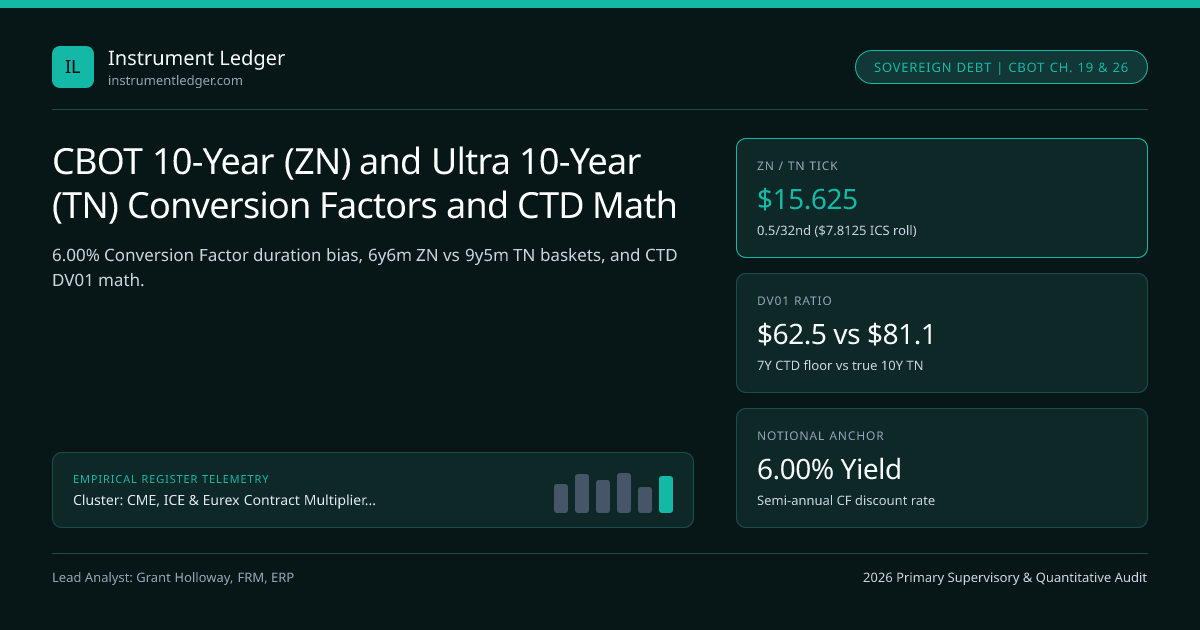
Under CBOT Rulebook Chapters 19 and 26, both the 10-Year US Treasury Note (ZN) and Ultra 10-Year US Treasury Note (TN) carry a $100,000 face par value and quote in points ($1,000) and one-half of 1/32nd of a point ($15.625 minimum outright tick; $7.8125 in ICS calendar spreads). Yet despite sharing a "10-year" label, their deliverable sovereign bond baskets split sharply: ZN accepts any US Treasury note with remaining maturity between 6 years 6 months and 10 years, whereas TN restricts delivery strictly to original-issue 10-year notes with remaining maturity between 9 years 5 months and 10 years. That maturity boundary shifts empirical contract duration (DV01) by roughly 25% to 30% between ZN and TN!
Within the CME, ICE & Eurex Contract Multipliers, Tick Values & Delivery Mechanics cluster and our CME, ICE and Eurex Futures Multipliers and Delivery Guide, this fixed-income specification deep-dive pairs directly with our Listed Contract Basis and Implied Repo Calculator, CBOT 2-Year Treasury (ZT) Eighth-32nd Tick Math, and Eurex Euro-Bund (FGBL) 6% Notional Coupon Baskets.
6.00% Notional Coupon Conversion Factors and Duration Bias#
Because short clearing members hold the unilateral right to deliver any eligible CUSIP inside the CBOT Treasury Futures Delivery Basket Standard, CBOT scales the futures settlement price by each bond's published Conversion Factor (CF)—equal to the clean price per $1 par at which that specific Treasury note would yield 6.00% compounded semi-annually on the first day of the delivery month (with remaining maturity rounded down to the nearest quarter-year).
This 6.00% discounting anchor produces a foundational rule of Treasury basis trading:
- When market yields sit BELOW 6.00% (e.g., 4.15% in 2026), bonds with shorter maturity and higher coupons trade cheaper relative to their
CF. Consequently, the Cheapest-to-Deliver (CTD) bond inZNgravitates toward the 6.5-to-7.0-year floor of the basket—makingZNbehave economically like a 7-year Treasury note, NOT a 10-year on-the-run note! - When market yields rise ABOVE 6.00%, the CTD flips toward the longest-duration, lowest-coupon 10-year note at the top of the basket, extending
ZNduration abruptly (negative convexity for unhedged longs).
Gross Basis, Net Basis, Implied Repo and DV01 Hedge Ratio#
Fixed-income desks never hedge $100 million of cash 10-year Treasuries 1-for-1 with 1,000 ZN contracts! Because futures track CTD_Clean_Price / CF, the empirical Futures DV01 equals the CTD bond's cash DV01 divided by its Conversion Factor (DV01_Futures = DV01_CTD / CF). Let's compute a complete CTD basis and DV01 hedge ratio:
Principal Invoice and CTD-Adjusted DV01 Formula#
- TotalDeliveryInvoice = PrincipalInvoiceUSD + AccruedInterestto_Delivery
- GrossBasis (32nds) = CashCleanPrice - (FuturesPrice * CF)
- FuturesDV01 = CTDBondDV01per100k / ConversionFactor
- Worked ZN Basis & Hedge Ratio Example (4.125% Coupon 7-Year Note CTD, CF = 0.9018):
- Cash Clean Price = 99-16 (99.5000); ZN Futures = 110-06+ (110.203125); Accrued = $1,145.83
- Converted Price = 110.203125 * 0.9018 = 99.3812 -> Gross Basis = 99.5000 - 99.3812 = +0.1188 pts (+3.80/32nds)
- Total Fedwire Invoice = ($100,000 * 0.993812) + $1,145.83 = $99,381.20 + $1,145.83 = $100,527.03
- If Cash CTD DV01 = $56.40 per $100k par -> ZN Futures DV01 = $56.40 / 0.9018 = $62.54 per ZN contract!
- Hedging $10M of On-The-Run 10Y Cash Notes (DV01 = $8,120) requires:
- 8,120 / 62.54 = 130 ZN contracts (NOT 100!) — or 100 Ultra TN contracts (DV01 ~$81.10)!
Sovereign Treasury Futures Specification Matrix#
Institutional repo and rates desks cross-margin cash Treasuries cleared at DTCC's Fixed Income Clearing Corporation against CBOT futures via the CME-FICC Treasury Cross-Margining Program, analyzed further in CME-FICC Cross-Margining Mechanics and CBOT Treasury Yield Curve Spread Credits (TUT, NOB, FYT).
| Contract Symbol | Par Notional | Deliverable Maturity Window | Outright Tick | ICS Roll Tick | Typical DV01 (~4.2% Yld) |
|---|---|---|---|---|---|
2-Year Note (ZT) | $200,000 | 1y9m to 2y0m (orig <=5y3m) | 1/8 of 1/32 ($7.8125) | 1/8 of 1/32 ($7.8125) | ~$37.50 |
5-Year Note (ZF) | $100,000 | 4y2m to 5y3m (orig <=5y3m) | 1/4 of 1/32 ($7.8125) | 1/4 of 1/32 ($7.8125) | ~$43.80 |
10-Year Note (ZN) | $100,000 | 6y6m to 10y0m | 1/2 of 1/32 ($15.625) | 1/4 of 1/32 ($7.8125) | ~$62.50 |
Ultra 10-Year (TN) | $100,000 | 9y5m to 10y0m (orig 10Y) | 1/2 of 1/32 ($15.625) | 1/4 of 1/32 ($7.8125) | ~$81.10 |
Classic Bond (ZB) | $100,000 | 15y0m to 25y0m | 1/32 ($31.25) | 1/4 of 1/32 ($7.8125) | ~$126.00 |
Ultra T-Bond (UB) | $100,000 | 25y0m to 30y0m | 1/32 ($31.25) | 1/4 of 1/32 ($7.8125) | ~$178.00 |
Embedded Short Delivery Options: Quality, Timing, Wild-Card and End-of-Month#
Net Basis (Gross Basis - Carry) trades slightly above zero prior to delivery month because the short holds four embedded CBOT rulebook options:
- Quality (Switch) Option: Right to switch delivery to an alternate CUSIP if yield shifts or repo squeezes dethrone the current CTD.
- Timing Option: Right to deliver on any business day of the delivery month (delivering early when positive carry >0, or waiting until month-end when carry <0).
- Wild-Card Option: CBOT Treasury futures lock their daily settlement invoice price at 14:00 CT (15:00 ET), whereas shorts have until evening clearing cutoffs to declare Intent to Deliver—capturing late-afternoon cash bond selloffs while billing the fixed 14:00 CT invoice!
- End-of-Month Option: Expiring Treasury futures stop trading 7 business days prior to the last business day of the delivery month, giving surviving shorts a full week where the invoice price is permanently frozen while cash CUSIPs continue trading.
Frequently asked questions
Why does the CBOT 10-Year Treasury Note future (ZN) trade like a 7-year bond instead of a 10-year bond?
ZN allows delivery of any Treasury note with 6 years 6 months to 10 years remaining maturity, normalized at a 6.00% notional yield. Whenever prevailing Treasury yields sit below 6.00%, shorter-duration ~6.5–7.0 year notes become Cheapest-to-Deliver (CTD), governing ZN price and DV01.
How does CME Ultra 10-Year (TN) solve the duration mismatch of ZN for 10-year bond hedgers?
Ultra 10-Year (TN) restricts its deliverable basket strictly to original-issue 10-year Treasury notes with at least 9 years 5 months remaining maturity at delivery, pinning the CTD onto recent 10-year benchmark auctions (~$81 DV01 vs ~$62.50 on ZN).
How is the exact Fedwire cash invoice calculated when taking delivery on 1 ZN contract?
Multiply $1,000 by the decimal futures settlement price and by the delivered CUSIP published Conversion Factor, then add exact semi-annual accrued Treasury coupon interest from the last coupon date through the Fedwire Delivery Day.
What is the End-of-Month (EOM) option in CBOT Treasury futures?
ZN, TN, ZB, and UB stop trading seven business days before the end of the delivery month, locking the final futures settlement price permanently while shorts retain seven additional business days to monitor cash bond swings and select the cheapest CUSIP.
Publication record
- Published
- November 14, 2026
- Updated
- November 15, 2026
- Author
- Grant Holloway, FRM, ERP
- Review
- Review not recorded
- Automated fact check
- Passed in the stored pipeline record
- Source URLs
- 3 recorded
AI assistance recorded: anthropic/claude-opus-4.6. This field does not establish human review or source verification.
Academic & Institutional Attribution
Cite This Research & Embed Live Data Card
Standard academic & institutional research paper citation format.
Grant Holloway, FRM, ERP. (2026, November 15). CBOT 10-Year (ZN) and Ultra 10-Year (TN) Conversion Factors and CTD Math. Instrument Ledger. https://instrumentledger.com/specs/cbot-10-year-treasury-zn-ultra-tn-conversion-factor-ctd-mathRegulatory Directory Cross-Reference
Referenced Institutions & Regulatory Registries
Primary Tier-1 Supervisory Registries
Related Futures Tick Value Delivery Settlement & Institutional Briefings
Explore Futures Tick Value Delivery Settlement Hub (20) →Futures Tick Value Delivery Settlement
CME, ICE and Eurex Futures Contract Multipliers, Tick Values and Delivery Mechanics GuideFutures Tick Value Delivery Settlement
CBOT 2-Year Treasury Note (ZT) Eighth-32nd Tick Increments and Invoice PricingFutures Tick Value Delivery Settlement
CME Three-Month SOFR (SR3) vs One-Month (SR1) Compounded Final Settlement MathFutures Tick Value Delivery Settlement
ICE Three-Month SONIA Compounding Formula and Actual/365 IMM Settlement RulesFutures Tick Value Delivery Settlement
Eurex Euro-Bund (FGBL) 0.01 Tick Value, 6% Notional Coupon and Delivery BasketFutures Tick Value Delivery Settlement
Eurex DAX (FDAX), Mini-DAX (FDXM) and Micro-DAX (FDXS) Multipliers and SpecsFutures Tick Value Delivery Settlement
CBOT Corn (ZC) and Soybean (ZS) Quarter-Cent Ticks and Shipping CertificatesFutures Tick Value Delivery Settlement
COMEX High Grade Copper (HG) vs LME 25-Tonne Grade A Warrant SpecificationsPerpetual Funding Rate Mark Price Math
Auto-Deleveraging (ADL) Queue Math: PnL-Times-Leverage Percentile RankingPerpetual Funding Rate Mark Price Math
Inverse Coin-Margined vs Linear USDT Perpetuals: 1/P Convexity and Hedging MathPerpetual Funding Rate Mark Price Math
Quanto Perpetual Futures Specs: Fixed Cross-Currency Multipliers & CovariancePerpetual Funding Rate Mark Price Math
Perpetual Funding Rate Caps & Interval Compression: -2% Squeeze Mechanics
Instrument Ledger Data, Benchmarks & Contributor Records
CC BY 4.0 Open Data
Open Institutional Datasets (CSV / JSON) →
Download desk-compiled quantitative series & schemas.
2026 Reference Matrix
2026 Institutional Benchmarks & Thresholds →
Statutory capital, clearing, margin & rate conventions.
Editorial Records
Authors & Review Records →
View named contributors where those records are available.
Complete Index
Master Research & Dossier Archive →
Browse all published briefings by topic pillar & date.