
Futures Tick Value Delivery Settlement
Trading at Settlement (TAS) and Reduced-Tick Calendar Spreads in CME Futures
Institutional index trackers and commodity index funds roll trillions in quarterly exposure using CME Globex reduced-tick Intra-Commodity Spreads (ICS) and Trading at Settlement (TAS) books that compress execution slippage by up to 80%.
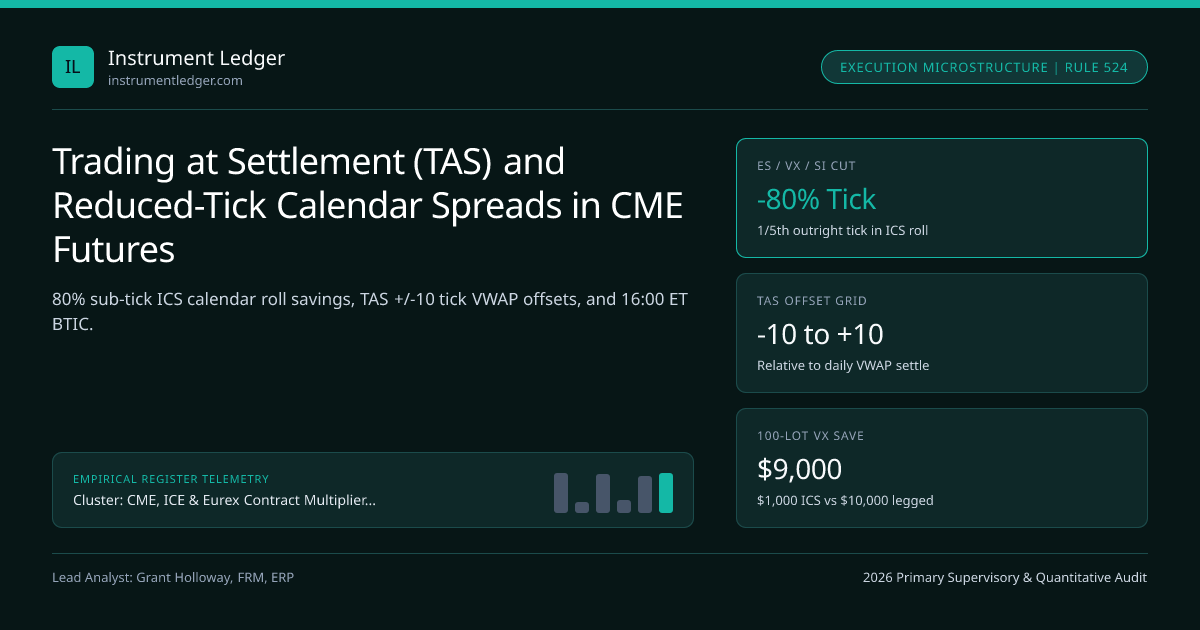
Under CME Rule 524, Trading at Settlement (TAS) and Intra-Commodity Calendar Spreads (ICS) operate as specialized Globex central limit order books that decouple spread and benchmark execution from noisy outright tick grids. In TAS, traders submit bids and offers quoted as zero ( + '0, flat settlement' + ) or ±N minimum ticks relative to that day's not-yet-determined official closing VWAP settlement price; once the afternoon settlement window closes, CME Clearing converts every matched TAS trade into a regular cleared futures position at Settlement ± Offset. Simultaneously, ICS calendar spread books slice minimum tick increments by 50% to 80% relative to outright legs, eliminating legging risk during quarterly equity and monthly commodity rolls.
Part of our CME, ICE and Eurex Futures Multipliers and Delivery Guide inside the CME, ICE & Eurex Contract Multipliers, Tick Values & Delivery Mechanics hub, this microstructure analysis covers TAS, BTIC (Basis Trade at Index Close), and reduced-tick ICS mechanics overseen by the CFTC.
How TAS, TAM and BTIC Pricing Offsets Clear on CME Globex#
Commodity index ETFs (such as S&P GSCI and Bloomberg Commodity Index replicators) face a strict mandate: roll 20% of front-month futures exposure into the second month each day across Business Days 5 through 9 of the month at the exact daily exchange settlement price with zero tracking error. Executing 15,000 outright CL contracts inside the 120-second 14:28–14:30 ET VWAP window would destabilize prices. Instead, passive funds post TAS Calendar Spread (CLTS) orders hours earlier at + '0 (flat)' + or + '-1 tick' + , while liquidity-providing banks absorb the flow and hedge incrementally across the session.
Similarly, in equity indices (ES, NQ, RTY) and CME Bitcoin (BTC), Basis Trade at Index Close (BTIC) allows institutional desks to trade the futures contract at an agreed basis spread ( + '±0.05 index points' + ) over the official 16:00 ET cash index close—converting messy MOC (Market-on-Close) basket rebalancing into a single deterministic futures print.
Implied-In vs Implied-Out Matching Engine Algorithms#
When an ICS spread book shares the same tick increment as its outright legs (such as CL at $0.01/bbl), CME Globex activates bidirectional Implied Orders: resting outright bids in CLM and resting outright offers in CLN synthesize an Implied-In bid in the CLM-CLN spread book, while a resting spread order combined with one outright leg synthesizes an Implied-Out quote in the deferred outright book. However, when ICS trades on a finer sub-tick grid (such as ES spreads at 0.05 points vs 0.25-point outrights), fractional spread prices like +14.15 cannot imply out onto the 0.25-point outright grid—only exact 0.25-point multiples (+14.00, +14.25) interact with implied outright queues!
Quantifying Quarterly ICS Roll Savings vs Outright Legging#
- AssignedBTICFuturesPrice = OfficialCashIndexClose4PMET + NegotiatedBTICBasis_Points
- Worked Quarterly Roll Audit (Rolling 250 Cboe VIX VX Contracts & 500 CME ES Contracts):
- 1. VIX Futures (VX): Legging two outrights crosses 2 * $50.00 = $100.00/spread; VX ICS tick = 0.01 pt ($10.00)
- Savings on 250 VX lots = 250 * ($100.00 - $10.00) = $22,500.00 saved per monthly roll!
- 2. E-mini S&P (ES): Legging two outrights crosses 2 * $12.50 = $25.00/spread; ES ICS tick = 0.05 pt ($2.50)
- Savings on 500 ES lots = 500 * ($25.00 - $2.50) = $11,250.00 saved per quarterly roll!
Cross-Asset TAS, BTIC and Reduced-Tick ICS Specification Matrix#
Compare fair-value quarterly roll basis in the Listed Contract Basis and Implied Repo Calculator alongside contract pages for CME E-mini Specs, NYMEX WTI Specs, and Cboe VIX Specs.
| Benchmark Contract | Outright Tick | ICS Spread Tick | Tick Reduction | TAS / BTIC Mechanism | Cutoff Window |
|---|---|---|---|---|---|
E-mini S&P 500 (ES) | 0.25 pt ($12.50) | 0.05 pt ($2.50) | 80.0% | EST (BTIC vs 16:00 ET SPX Close) | 16:00 ET Cash Close |
Cboe VIX (VX) | 0.05 pt ($50.00) | 0.01 pt ($10.00) | 80.0% | VXT (TAS ±0.50 pt in 0.01 steps) | 16:00 ET CFE Settle |
COMEX Silver (SI) | $0.005/oz ($25.00) | $0.001/oz ($5.00) | 80.0% | SIT (TAS ±10 ticks) | 13:25 ET VWAP |
COMEX Gold (GC) | $0.10/oz ($10.00) | $0.05/oz ($5.00) | 50.0% | GCT (TAS ±10 ticks in $0.10) | 13:30 ET VWAP |
CBOT 10Y Note (ZN) | 0.5/32 ($15.625) | 0.25/32 ($7.8125) | 50.0% | Quarterly ICS Treasury Roll | 15:00 ET Bond Close |
NYMEX WTI (CL) | $0.01/bbl ($10.00) | $0.01/bbl ($10.00) | 0% ( eliminates 2nd leg) | CLT / TAM (London 16:30 Marker) | 14:30 ET VWAP |
Regulatory Restrictions and Limit-Locked TAS Suspensions#
Under CME Rule 524 and CFTC anti-manipulation enforcement, traders are strictly prohibited from entering TAS orders on one side while simultaneously banging the 2-minute closing VWAP outright book ("banging the close") to skew the settlement price in favor of a larger pre-positioned TAS block—conduct that triggered landmark CFTC enforcement penalties in crude oil and palladium. Additionally, TAS is disallowed on the Last Trading Day of physically delivered contracts in several venues or automatically suspended whenever the underlying outright contract hits a daily price limit or circuit breaker during the settlement window. Review VIX term-structure roll mechanics in Cboe VIX Wednesday Morning SOQ Settlement and Treasury roll pricing in CBOT 10-Year Conversion Factor and CTD Math.
Frequently asked questions
What does a TAS trade executed at -2 mean on NYMEX WTI Crude Oil (CLT)?
A CLT trade matched at -2 guarantees that once NYMEX calculates the official 14:28–14:30 ET daily settlement price (for example, $74.85/bbl), CME Clearing books your cleared WTI futures position two ticks ($0.02/bbl) below settlement at $74.83/bbl.
How does BTIC (Basis Trade at Index Close) differ from TAS in CME E-mini S&P 500 futures?
TAS prices relative to the futures contract own daily VWAP settlement, whereas BTIC prices the futures trade as a basis spread (in 0.05-point steps) directly over or under the official 16:00 ET S&P 500 cash index closing value.
Why should traders never leg quarterly futures rolls using two separate market or limit orders?
Legging two outrights pays two full outright bid-ask spreads (e.g., 2 x $12.50 = $25.00 on ES or 2 x $50 = $100 on VX) and exposes the trader to directional price drift between fills, whereas the ICS spread book executes atomically at 1/5th the tick width.
What happens to open TAS orders if the underlying futures contract hits a limit-up circuit breaker?
Under CME Rule 524, if an underlying futures contract trades at or locks at its daily price fluctuation limit during the settlement determination window, TAS eligibility and unsettled synthetic price assignments are subject to exchange halt rules.
Publication record
- Published
- November 14, 2026
- Updated
- November 14, 2026
- Author
- Grant Holloway, FRM, ERP
- Review
- Review not recorded
- Automated fact check
- Passed in the stored pipeline record
- Source URLs
- 3 recorded
AI assistance recorded: anthropic/claude-opus-4.6. This field does not establish human review or source verification.
Academic & Institutional Attribution
Cite This Research & Embed Live Data Card
Standard academic & institutional research paper citation format.
Grant Holloway, FRM, ERP. (2026, November 14). Trading at Settlement (TAS) and Reduced-Tick Calendar Spreads in CME Futures. Instrument Ledger. https://instrumentledger.com/specs/cme-tas-trading-at-settlement-reduced-tick-calendar-spreadsRegulatory Directory Cross-Reference
Referenced Institutions & Regulatory Registries
Referenced Supervisory Authorities
Related Futures Tick Value Delivery Settlement & Institutional Briefings
Explore Futures Tick Value Delivery Settlement Hub (20) →Futures Tick Value Delivery Settlement
CME, ICE and Eurex Futures Contract Multipliers, Tick Values and Delivery Mechanics GuideFutures Tick Value Delivery Settlement
CBOT 10-Year (ZN) and Ultra 10-Year (TN) Conversion Factors and CTD MathFutures Tick Value Delivery Settlement
CBOT 2-Year Treasury Note (ZT) Eighth-32nd Tick Increments and Invoice PricingFutures Tick Value Delivery Settlement
CME Three-Month SOFR (SR3) vs One-Month (SR1) Compounded Final Settlement MathFutures Tick Value Delivery Settlement
ICE Three-Month SONIA Compounding Formula and Actual/365 IMM Settlement RulesFutures Tick Value Delivery Settlement
Eurex Euro-Bund (FGBL) 0.01 Tick Value, 6% Notional Coupon and Delivery BasketFutures Tick Value Delivery Settlement
Eurex DAX (FDAX), Mini-DAX (FDXM) and Micro-DAX (FDXS) Multipliers and SpecsFutures Tick Value Delivery Settlement
CBOT Corn (ZC) and Soybean (ZS) Quarter-Cent Ticks and Shipping CertificatesPerpetual Funding Rate Mark Price Math
Derivatives Insurance Fund Mechanics: Surplus Capture and Daily Drawdown CapsPerpetual Funding Rate Mark Price Math
Auto-Deleveraging (ADL) Queue Math: PnL-Times-Leverage Percentile RankingPerpetual Funding Rate Mark Price Math
Inverse Coin-Margined vs Linear USDT Perpetuals: 1/P Convexity and Hedging MathPerpetual Funding Rate Mark Price Math
Quanto Perpetual Futures Specs: Fixed Cross-Currency Multipliers & Covariance
Instrument Ledger Data, Benchmarks & Contributor Records
CC BY 4.0 Open Data
Open Institutional Datasets (CSV / JSON) →
Download desk-compiled quantitative series & schemas.
2026 Reference Matrix
2026 Institutional Benchmarks & Thresholds →
Statutory capital, clearing, margin & rate conventions.
Editorial Records
Authors & Review Records →
View named contributors where those records are available.
Complete Index
Master Research & Dossier Archive →
Browse all published briefings by topic pillar & date.