
Futures Tick Value Delivery Settlement
CME Three-Month SOFR (SR3) vs One-Month (SR1) Compounded Final Settlement Math
Following the USD LIBOR cessation, CME Three-Month SOFR (SR3) and One-Month SOFR (SR1) anchor global short-term interest rate hedging through distinct daily compounded-in-arrears versus arithmetic average final settlement formulas.
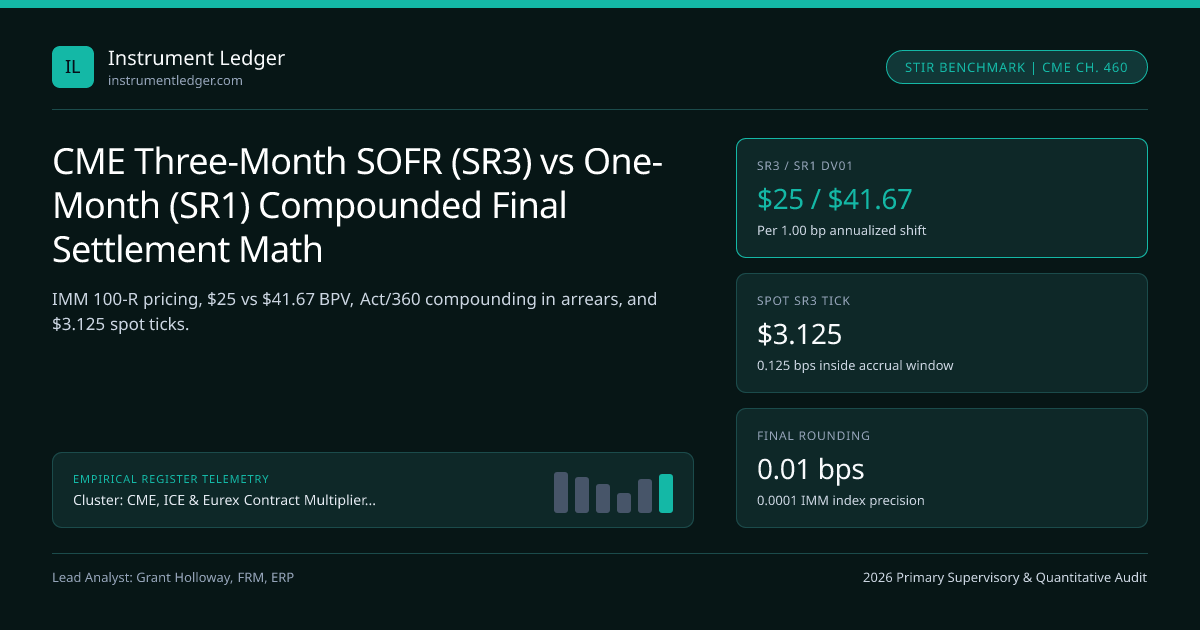
CME Rulebook Chapters 460 and 461 govern the world's deepest short-term interest rate (STIR) derivatives complex: Three-Month SOFR (SR3) and One-Month SOFR (SR1) futures, both quoted on the International Monetary Market (IMM) index convention as 100.000 minus R, where R expresses the realized overnight Secured Overnight Financing Rate published daily at 08:00 ET by the Federal Reserve Bank of New York. While SR3 sizes its basis-point value (BPV / DV01) at $25.00 per basis point ($2,500 per 1.00 index point on a $1,000,000 notional 90-day deposit), SR1 sizes its basis-point value at $41.67 per basis point ($4,167 per 1.00 index point on a $5,000,000 notional 30-day deposit). Even more critically, SR3 compounds daily overnight SOFR in arrears on US government securities business days, whereas SR1 computes a simple arithmetic average across all calendar days of the delivery month.
Within our CME, ICE and Eurex Futures Multipliers and Delivery Guide under the CME, ICE & Eurex Contract Multipliers, Tick Values & Delivery Mechanics hub, this rate-fixing specification compares CME STIR rules with ICE Three-Month SONIA Compounding Specifications and par OIS structures in Eris SOFR Swap Futures Contract Specifications.
Progressive Near-Term Tick Reductions in SR3 and SR1#
Unlike equity futures where tick sizes remain static until expiration, CME STIR contracts narrow minimum tick increments as contracts approach or enter their reference accrual window—because a large portion of daily overnight SOFR fixings inside the active quarter has already been locked in by the NY Fed!
- Three-Month SOFR (SR3): Deferred contracts quote in 0.005 index points (0.50 bps = $12.50 per tick); contracts within four months of the start of their reference quarter step down to 0.0025 points (0.25 bps = $6.25 per tick); and the active front contract already inside its three-month IMM accrual window steps down to 0.00125 points (0.125 bps = $3.125 per tick)!
- One-Month SOFR (SR1): Deferred contracts quote in 0.005 points (0.50 bps = $20.835 per tick), stepping down in the spot and nearby month to 0.0025 points (0.25 bps = $10.4175 per tick).
Exact Compounded-in-Arrears (SR3) vs Simple Average (SR1) Math#
Why did Eurodollar futures stop trading before their 3-month forward deposit began, whereas SR3 continues trading for three additional months after its IMM reference month starts? Forward-looking LIBOR fixed on Day 0, whereas overnight SOFR is backward-looking—for example, March 2026 SR3 (SR3H6) measures overnight SOFR starting on the third Wednesday of March 2026 and ending on the day before the third Wednesday of June 2026! Over weekends and SIFMA bond-market holidays, Friday's (or pre-holiday) published SOFR rate applies without compounding over the multi-day weight d_i (d_i = 3 across normal Friday-to-Monday weekends).
Compounded SR3 vs Simple Average SR1 Rate Math#
- SR1ArithmeticRate (RSR1) = ( 1 / Dmonth ) * Sum{j=1..Dmonth} ( r_j )
- FinalSettlementPrice = 100.0000 - RoundtoNearest_0.0001(R)
- Worked FOMC 25 bps Mid-Month Cut Comparison (30-Day April Window: 15 Days @ 4.50%, 15 Days @ 4.25%):
- One-Month SR1 Arithmetic Average: (15 * 4.50% + 15 * 4.25%) / 30 = 4.3750% -> Settles at 95.6250
- Three-Month SR3 Compounding Effect (91-day IMM quarter: 45 days @ 4.50%, 46 days @ 4.25%):
- Compounded Factor = (1 + 0.045/360)^45 * (1 + 0.0425/360)^46 - 1 = 0.0111216
- Annualized R_SR3 = 0.0111216 * (360 / 91) * 100 = 4.3998% -> Settles at 95.6002 (~2.5 bps compounding pickup!)
Global STIR & Swap Futures Specification Matrix#
Model convexity bias between linear STIR futures and discounted OIS cashflows using our Listed Contract Basis and Implied Repo Calculator alongside CBOT 2-Year Treasury Note (ZT) Specs and CFTC clearing standards.
| Contract Parameter | CME 3-Month SOFR (SR3) | CME 1-Month SOFR (SR1) | ICE 3-Month SONIA (SFI) | CME Eris SOFR Swap |
|---|---|---|---|---|
| Notional Deposit Equivalent | $1,000,000 (3-Month) | $5,000,000 (1-Month) | £1,000,000 (3-Month) | $100,000 Multi-Year OIS |
| Value of 1.00 bps (DV01) | $25.00 | $41.67 | £25.00 (Act/365 adjusted) | Tenor-dependent (~$19–$88) |
| Rate Accrual Formula | Compounded in Arrears | Simple Arithmetic Mean | Compounded in Arrears | NPV + Price Alignment (PAI) |
| Reference Accrual Window | 3rd Wed M to 3rd Wed M+3 | Calendar Day 1 to Month-End | 3rd Wed M to 3rd Wed M+3 | Standardized IMM OIS Dates |
| Convexity Bias vs OIS | Requires convexity adjustment | Negligible 1M convexity | Requires convexity adjustment | Zero convexity bias (Eris Spec) |
Isolating FOMC Rate Decisions and Zero-Convexity Alternatives#
Because SR1 spans exact calendar months (May 1–31, June 1–30) via simple arithmetic averaging, FOMC rate-hike/cut probability models use adjacent SR1 contracts around non-FOMC months to extract pure basis-point policy expectations down to a tenth of a basis point. Conversely, over 3-year to 10-year horizons (Green, Blue, and Gold SR3 packs and bundles), daily mark-to-market variation margin paid at $25.00/bp immediately—rather than discounted at quarter-end like an OTC Overnight Index Swap (OIS)—creates a positive futures-OIS convexity bias where SR3 implied rates trade higher than forward OIS swaps by 0.5 × σ2 × T1 × T2. Desks seeking futures margin efficiency without convexity drift route multi-year hedges into Eris SOFR Swap Futures, examined in MPOR Comparison: LCH SwapClear vs CME Eris SOFR Futures.
Frequently asked questions
Why does the March CME Three-Month SOFR (SR3H) contract keep trading until June?
Unlike discontinued LIBOR (which fixed forward on Day 1), SOFR is a backward-looking overnight repo rate. March SR3 measures realized daily SOFR from the third Wednesday of March until the third Wednesday of June, so final settlement cannot occur until June.
What is the formula difference between CME SR3 and SR1 final settlement?
SR3 compounds daily overnight SOFR on Actual/360 across SIFMA US Government Securities business days (applying weekend weights without weekend compounding), whereas SR1 takes an uncompounded simple arithmetic mean across every calendar day of the month.
Why does the minimum tick value of SR3 drop to $3.125 in the front contract?
Once an SR3 contract enters its 3-month reference period, elapsed days of overnight SOFR are permanently fixed, reducing remaining price volatility. Narrowing the tick to 0.00125 points (0.125 bps = $3.125) preserves tight bid-ask spreads through final fixing.
How is weekend and holiday SOFR treated in the SR3 compounding formula?
For non-business days (weekends and SIFMA holidays), the NY Fed SOFR rate published for the immediately preceding US government securities business day applies linearly across the multi-day count d_i (e.g., d_i = 3 for Friday through Sunday).
Publication record
- Published
- November 14, 2026
- Updated
- November 14, 2026
- Author
- Grant Holloway, FRM, ERP
- Review
- Review not recorded
- Automated fact check
- Passed in the stored pipeline record
- Source URLs
- 3 recorded
AI assistance recorded: anthropic/claude-opus-4.6. This field does not establish human review or source verification.
Academic & Institutional Attribution
Cite This Research & Embed Live Data Card
Standard academic & institutional research paper citation format.
Grant Holloway, FRM, ERP. (2026, November 14). CME Three-Month SOFR (SR3) vs One-Month (SR1) Compounded Final Settlement Math. Instrument Ledger. https://instrumentledger.com/specs/three-month-sofr-sr3-compounded-arrears-final-settlement-fixingRegulatory Directory Cross-Reference
Referenced Institutions & Regulatory Registries
Referenced Supervisory Authorities
Related Futures Tick Value Delivery Settlement & Institutional Briefings
Explore Futures Tick Value Delivery Settlement Hub (20) →Futures Tick Value Delivery Settlement
CME, ICE and Eurex Futures Contract Multipliers, Tick Values and Delivery Mechanics GuideFutures Tick Value Delivery Settlement
ICE Three-Month SONIA Compounding Formula and Actual/365 IMM Settlement RulesFutures Tick Value Delivery Settlement
Eurex Euro-Bund (FGBL) 0.01 Tick Value, 6% Notional Coupon and Delivery BasketFutures Tick Value Delivery Settlement
Eurex DAX (FDAX), Mini-DAX (FDXM) and Micro-DAX (FDXS) Multipliers and SpecsFutures Tick Value Delivery Settlement
CBOT Corn (ZC) and Soybean (ZS) Quarter-Cent Ticks and Shipping CertificatesFutures Tick Value Delivery Settlement
COMEX High Grade Copper (HG) vs LME 25-Tonne Grade A Warrant SpecificationsFutures Tick Value Delivery Settlement
NYMEX Henry Hub Natural Gas (NG) 10,000 MMBtu and Sabine Pipe Line DeliveryFutures Tick Value Delivery Settlement
CME Euro FX (6E) and Japanese Yen (6J) Half-Pip Ticks and CLS Physical DeliveryPerpetual Funding Rate Mark Price Math
Quanto Perpetual Futures Specs: Fixed Cross-Currency Multipliers & CovariancePerpetual Funding Rate Mark Price Math
Perpetual Funding Rate Caps & Interval Compression: -2% Squeeze MechanicsPerpetual Funding Rate Mark Price Math
TWAP Premium Index Weighting & 8-Hour Funding Boundary MicrostructurePerpetual Funding Rate Mark Price Math
Delta-Neutral Perpetual Cash-and-Carry Yield Attribution & Net ROE Math
Instrument Ledger Data, Benchmarks & Contributor Records
CC BY 4.0 Open Data
Open Institutional Datasets (CSV / JSON) →
Download desk-compiled quantitative series & schemas.
2026 Reference Matrix
2026 Institutional Benchmarks & Thresholds →
Statutory capital, clearing, margin & rate conventions.
Editorial Records
Authors & Review Records →
View named contributors where those records are available.
Complete Index
Master Research & Dossier Archive →
Browse all published briefings by topic pillar & date.