
Perpetual Funding Rate Mark Price Math
Derivatives Insurance Fund Mechanics: Surplus Capture and Daily Drawdown Caps
Acting as the sole pre-funded buffer between leveraged bankruptcies and profitable trader clawbacks, perpetual Insurance Funds harvest liquidation clearance surpluses during orderly sessions and enforce daily drawdown caps during crashes.
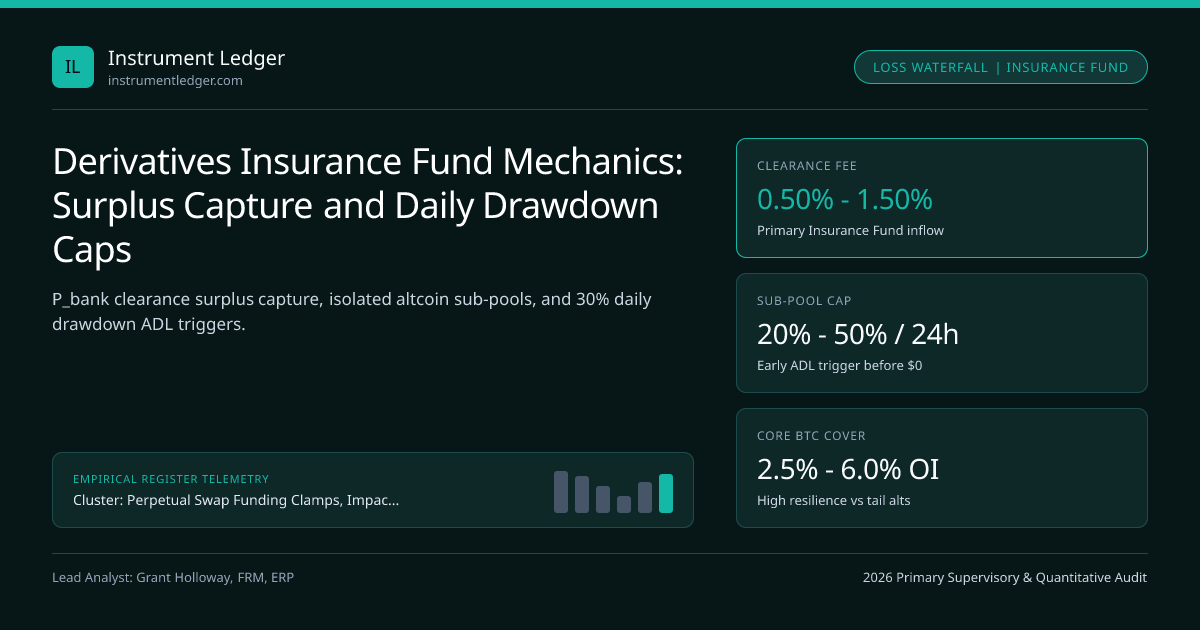
Traditional regulated clearinghouses like CME Clearing and Eurex Clearing sit atop a multi-billion-dollar Clearing Member Default Waterfall governed by CPMI-IOSCO Principles for Financial Market Infrastructures (PFMI): if a leveraged client defaults beyond their posted margin, their Futures Commission Merchant (FCM) is legally liable to make the clearinghouse whole using corporate capital! Direct-access perpetual swap exchanges have no intermediating FCM balance sheets and zero legal recourse to collect negative account balances from anonymous retail or offshore entities. Instead, perpetual venues interpose an automated Exchange Insurance Fund that harvests residual margin when liquidations execute better than Bankruptcy Price (P_bank), and spends that reserve when crash cascades execute worse than P_bank.
Within our Perpetual Futures Funding Clamps, Mark Price and ADL Master Guide under the Perpetual Swap Funding Clamps, Impact Margin Notional, Mark Price & ADL hub, this solvency audit bridges Perpetual Bankruptcy vs Liquidation Price Equations directly to Auto-Deleveraging (ADL) Queue Percentile Ranking.
Exact Cashflow Accounting of an Insurance Fund Takeover#
Suppose our 100-BTC long trader from earlier (Entry = $90,000, P_liq = $85,330.77, P_bank = $84,000.00) breaches P_liq at 03:14 UTC. Under a full takeover or residual-clearance model:
- The liquidation engine assumes ownership of the 100-BTC long at
P_bank = $84,000.00(where the liquidated trader's equity is $0.00) and submits a limit sell order on the live CLOB bounded at$84,000.00(or slices via TWAP/backstop liquidity providers). - Surplus Case (Orderly Book): The 100-BTC sell fills at a VWAP of
$85,120.00. The+$1,120.00/BTC × 100 = +$112,000.00clearance surplus (or configured Liquidation Clearance Fee, typically0.50%–1.50%of notional on partial-refund venues where excess residual equity above the fee is returned to the user!) flows straight into the Insurance Fund! - Deficit Case (Flash Crash Gap): Suppose Bitcoin BTC gaps down 9% in two seconds so the best available bid sits at
$82,400.00. Clearing 100 BTC at$82,400.00against$84,000.00P_bankcrystallizes a-$1,600.00/BTC × 100 = -$160,000.00bankruptcy deficit, paid immediately out of the Insurance Fund!
The "Daily Percentage Drawdown Trigger" Secret: Why ADL Fires Before $0!#
Many institutional traders mistakenly assume that as long as an exchange advertises a $1.2 Billion USDT Insurance Fund, Auto-Deleveraging (ADL) is impossible! Read the fine print of exchange ADL rulebooks carefully:
- Isolated vs Shared Sub-Funds: Major venues partition their Insurance Fund into asset-group sub-pools (for example, one shared pool for
BTCÐUSDT contracts, and tiny $2M–$15M isolated pools for high-volatility newly listed altcoins or Official Trump TRUMP / meme contracts) so a manipulated altcoin squeeze cannot drain the core Bitcoin Insurance Fund! - Peak-to-Trough Drawdown Circuit Breakers: Even within a funded pool, several venues trigger
ADLautomatically if a single volatility event draws down more thanX%(e.g.,25%–35%) of that sub-fund's 24-hour high-water mark, preserving capital for remaining open interest rather than letting one whale wipe the fund to$0!
Sub-Fund Bankruptcy Deficit & Drawdown Trigger Equations#
- NetInsuranceTransferShortLiq = |Q| * ( Pbankshort - ExecutionFillVWAP )
- ADLActivationCondition = ( SubFundBalance <= 0 ) OR ( SubFundDrawdown24h >= MaxDrawdownCapPct )
- Worked Altcoin Sub-Fund Depletion Stress Test (Isolated Meme Sub-Fund = $8,500,000 USDT, 30% Daily Drawdown Cap):
- Maximum Loss Capacity Before Early ADL Trigger = $8,500,000 * 30.0% = $2,550,000 USDT!
- A single $25,000,000 cornered short position gapping +16% past P_bank incurs -$4,000,000 bankruptcy loss:
- First $2,550,000 absorbed by Sub-Fund -> Remaining $1,450,000 deficit IMMEDIATELY triggers ADL against winning longs!
Clearing Counterparty Default Architecture Comparison#
Contrast crypto Insurance Funds and on-chain backstop vaults (Hyperliquid HYPE HLP) against CFTC-regulated FCM default waterfalls under CFTC and PFMI standards.
| Solvency Layer | Traditional CCP (CME / Eurex) | Centralized Crypto Perp (CEX) | On-Chain Backstop Vault (HLP / DEX) |
|---|---|---|---|
| Layer 1: Trader Equity | Initial + Variation Margin | Isolated / Cross Wallet Balance | On-Chain USDC Margin Account |
| Layer 2: Broker Guarantee | FCM Corporate Capital (Legal Debt) | None (Zero negative-balance chase) | None (Non-custodial smart contract) |
| Layer 3: Mutualized Reserve | CCP Skin-in-the-Game + Default Fund | Exchange Insurance Sub-Fund | Liquidator Backstop Vault (HLP) |
| Layer 4: Assessment Power | Unfunded Clearing Member Assessments | None | None |
| Terminal Recovery Tool | Partial Tear-Up / VMGH (Extreme Rare) | Auto-Deleveraging (ADL) (Routine on alts!) | Auto-Deleveraging (ADL) |
Full-Confiscation vs Fixed-Clearance-Fee Liquidation Specifications#
Historically, early perpetual exchanges confiscated 100% of remaining margin at P_liq (taking over the entire position at P_bank even if MMR was 2.5% and the book only slipped 0.05%—turning liquidations into a massive exchange/Insurance Fund profit center!). Under modern regulatory pressure from ESMA, MAS, and SFC Hong Kong, leading institutional specifications now charge a capped Liquidation Clearance Fee (e.g., 1.00%–1.50% on linear perps): if a liquidated account clears on the orderbook with 2.10% equity remaining, 1.25% goes to the Insurance Fund while the remaining 0.85% residual equity is refunded to the trader's wallet! Check exact venue fee rules alongside Incremental Partial Liquidation Engine Rules.
Frequently asked questions
How could I get Auto-Deleveraged (ADL) on an altcoin perpetual when the exchange has a $1 billion Insurance Fund?
Exchanges segregate Insurance Funds into isolated sub-pools per contract or risk group and enforce daily percentage drawdown caps (e.g., 30%). An isolated altcoin sub-pool may hold only $5 million, preventing meme-coin squeezes from draining the BTC fund.
Does the exchange keep all my remaining Maintenance Margin when my position hits Liquidation Price?
It depends on the contract specification: legacy full-takeover engines transfer 100% of remaining equity above P_bank into the Insurance Fund, whereas modern capped-fee specs charge a fixed 0.5%–1.5% clearance fee and refund any remaining surplus.
How does an on-chain liquidator vault like Hyperliquid HLP differ from a centralized Insurance Fund?
Instead of a static exchange-owned reserve, HLP is an on-chain market-making and liquidation backstop vault funded by depositors who earn liquidation surpluses and maker spreads while sharing tail drawdown risk transparently on-chain.
Why do regulated futures exchanges like CME almost never use Auto-Deleveraging (ADL)?
At CME or Eurex, clearing members (FCMs) legally guarantee client negative balances with billions in bank capital, backed further by a mutualized Clearing Member Default Fund sized to Cover-2 extreme stress under CPMI-IOSCO PFMI.
Publication record
- Published
- November 14, 2026
- Updated
- November 17, 2026
- Author
- Grant Holloway, FRM, ERP
- Review
- Review not recorded
- Automated fact check
- Passed in the stored pipeline record
- Source URLs
- 3 recorded
AI assistance recorded: anthropic/claude-opus-4.6. This field does not establish human review or source verification.
Academic & Institutional Attribution
Cite This Research & Embed Live Data Card
Standard academic & institutional research paper citation format.
Grant Holloway, FRM, ERP. (2026, November 18). Derivatives Insurance Fund Mechanics: Surplus Capture and Daily Drawdown Caps. Instrument Ledger. https://instrumentledger.com/specs/exchange-insurance-fund-inflow-liquidation-clearance-depletionRegulatory Directory Cross-Reference
Referenced Institutions & Regulatory Registries
Referenced Supervisory Authorities
Related Perpetual Funding Rate Mark Price Math & Institutional Briefings
Explore Perpetual Funding Rate Mark Price Math Hub (20) →Perpetual Funding Rate Mark Price Math
Perpetual Futures Funding Clamps, Impact Margin Notional, Mark Price and ADL GuidePerpetual Funding Rate Mark Price Math
Auto-Deleveraging (ADL) Queue Math: PnL-Times-Leverage Percentile RankingPerpetual Funding Rate Mark Price Math
Inverse Coin-Margined vs Linear USDT Perpetuals: 1/P Convexity and Hedging MathPerpetual Funding Rate Mark Price Math
Quanto Perpetual Futures Specs: Fixed Cross-Currency Multipliers & CovariancePerpetual Funding Rate Mark Price Math
Perpetual Funding Rate Caps & Interval Compression: -2% Squeeze MechanicsPerpetual Funding Rate Mark Price Math
TWAP Premium Index Weighting & 8-Hour Funding Boundary MicrostructurePerpetual Funding Rate Mark Price Math
Delta-Neutral Perpetual Cash-and-Carry Yield Attribution & Net ROE MathPerpetual Funding Rate Mark Price Math
Multi-Asset Perpetual Margin Haircuts: USDe, stETH & BTC Collateral MathSpan2 Portfolio Margin Cross Offsets
ICE Clear IRM 2 Margin Specs: Brent, Gasoil & Dutch TTF Natural Gas VaRSpan2 Portfolio Margin Cross Offsets
Futures Initial vs Maintenance Margin: The 110% Speculative Restoration RuleSpan2 Portfolio Margin Cross Offsets
CME Twice-Daily Settlement Cycle: 12:30 CT Midday Intraday Variation SweepsSpan2 Portfolio Margin Cross Offsets
Short Option Minimum (SOM) Margin Specs: Why Selling 5-Cent Tail Puts Kills ROE
Instrument Ledger Data, Benchmarks & Contributor Records
CC BY 4.0 Open Data
Open Institutional Datasets (CSV / JSON) →
Download desk-compiled quantitative series & schemas.
2026 Reference Matrix
2026 Institutional Benchmarks & Thresholds →
Statutory capital, clearing, margin & rate conventions.
Editorial Records
Authors & Review Records →
View named contributors where those records are available.
Complete Index
Master Research & Dossier Archive →
Browse all published briefings by topic pillar & date.