
Perpetual Funding Rate Mark Price Math
Perpetual Funding Rate Caps & Interval Compression: -2% Squeeze Mechanics
When spot token borrow rates spike to 300%+ APR during short squeezes or airdrop snapshots, perpetual swaps gap to deep discounts—triggering automatic funding cap expansions (+/-2% to +/-3%) and emergency 8h-to-1h interval compressions.
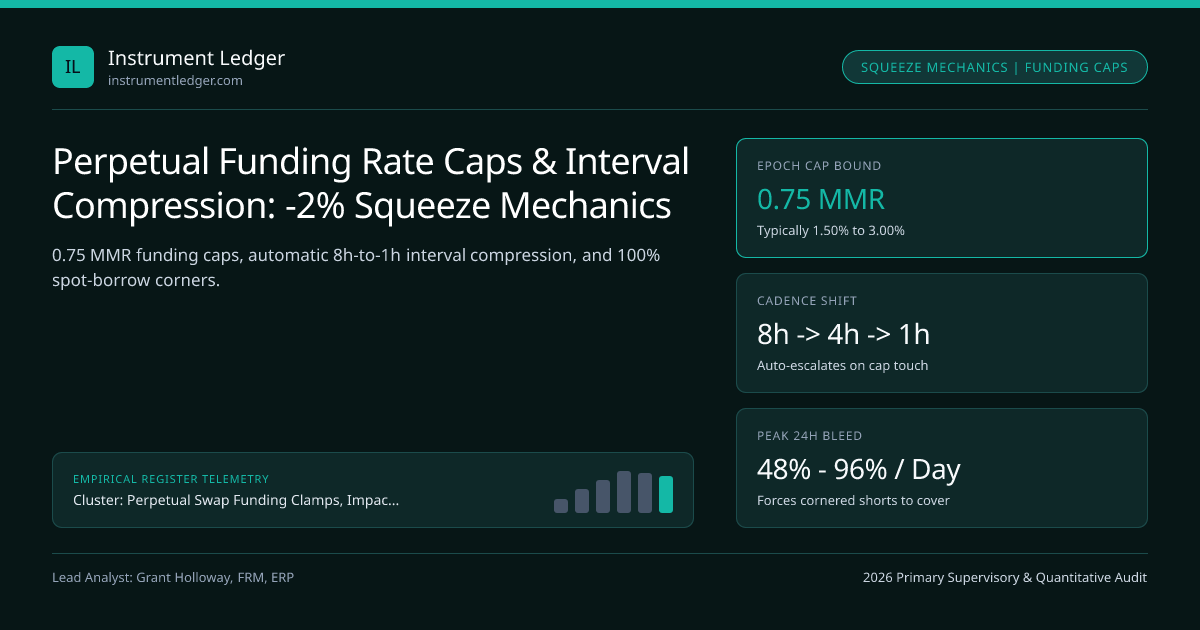
Under normal market liquidity, perpetual funding rates hover quietly between -0.02% and +0.05% per 8 hours. Yet during acute spot inventory squeezes, governance/airdrop snapshot wars, or exchange withdrawal halts on mid-cap tokens (such as Arbitrum ARB, Sui SUI, or newly listed low-float coins), traders rushing to short the perpetual push its price 5% to 18% BELOW the Spot Index! At that moment, two dynamic contract-specification circuit breakers fire automatically: Maintenance-Margin-Linked Funding Cap Bounds (typically ±0.75 × MMR_Tier_Max or hardcoded ±2.00% to ±3.00%) and Automatic Settlement Interval Compression—switching a contract mid-flight from every 8 hours to every 4 hours, 2 hours, or 1 hour, multiplying the maximum daily cash bleed on shorts from 6% per day up to 48%–72% of notional per 24 hours!
Within our Perpetual Futures Funding Clamps, Mark Price and ADL Master Guide under the Perpetual Swap Funding Clamps, Impact Margin Notional, Mark Price & ADL hub, this squeeze specification links directly to 8-Hour Perpetual Funding Clamp Math and Spot Index Constituent Outlier Ejection.
Why Perpetuals Can Trade -12% Below Spot Without Arbitrageurs Closing the Gap!#
Why doesn't a basis desk immediately Buy Spot at $1.00 + Sell Perpetual to close? Wait: to arbitrage a negative perpetual basis (Perp = $0.88, Spot = $1.00), an arbitrageur must LONG the discounted Perpetual at $0.88 and SHORT Spot at $1.00!
- The Asymmetric Arbitrage Barrier: Going Long Spot + Short Perp (positive contango) is effortless—anyone with USD can buy unlimited spot! Going Short Spot + Long Perp (negative backwardation) requires borrowing physical tokens on margin lending desks!
- When 92% of token supply is locked in staking/vesting contracts or held by a cornering whale, spot borrow utilization hits 100% and annualized borrow rates explode to 500%–2,000% APR (or spot shorting becomes completely impossible!). With the cash-and-carry arbitrage channel physically blocked, the perpetual decouples downward until capped negative funding paid by perp shorts to perp longs equals the marginal shadow cost of spot inventory!
Exact ±0.75 × MMR Cap Rule & Interval-Compression Escalation Math#
Why do centralized exchanges link a contract's maximum funding cap to ±0.75 × Maintenance_Margin_Rate (for example, if max-leverage Tier 1 MMR = 2.00%, initial funding cap = ±1.50%; if Tier 1 leverage is lowered to 10x with MMR = 4.00%, funding cap = ±3.00%)? Because under the Perpetual Contract Funding Rate Convention, if a single funding settlement exceeded 1.00 × MMR, an account sitting safely above Maintenance Margin at 07:59:59.999 UTC would be plunged past Bankruptcy Price into negative equity in a single instant at 08:00:00.000 UTC with zero orderbook opportunity to liquidate!
Capped Epoch Drain & Interval-Escalation Stress Model#
- AutoFrequencyTrigger = If |RealizedFt| >= 0.95 * |FundingCap| => NextInterval = Max( 1h, Current_Interval / 2 )
- DailyCompoundedDrain = PositionNotional * ( EpochsPer24h * PerEpoch_Cap )
- Worked Airdrop Snapshot Short-Squeeze Audit ($1,000,000 Short Perp Hedging Unvested Token Allocation):
- Hour 0 (08:00 UTC): Perp drops to -4.2% discount; F hits -2.00% cap -> Shorts pay -$20,000; Exchange triggers 8h -> 2h switch!
- Hours 2, 4, 6, 8, 10, 12 (Six 2-hour epochs at -2.00% cap while whale holds Spot bid):
- Cumulative Cash Drained from Wallet Balance = $20,000 + (6 * $20,000) = -$140,000 (-14.0% of notional in 12 hours!)
- If Short posted $250,000 margin AND Spot squeezes +12% simultaneously (-$120,000 MTM loss):
- Remaining Equity = $250,000 - $140,000 - $120,000 = -$10,000 -> FORCED LIQUIDATION BUY INTO SQUEEZE TOP!
Venue Funding Cap & Dynamic Frequency Specification Matrix#
Audit exact funding cap rules across venues alongside basis analytics in our Listed Contract Basis and Implied Repo Calculator.
| Venue / Engine Spec | Normal BTC Cap | High-Vol Altcoin Cap | Auto-Interval Compression Rule | Cap Scaling Behaviour |
|---|---|---|---|---|
CEX Tiered Cap (0.75×MMR) | ±0.30% to ±0.75% | ±1.50% to ±3.00% | Auto-shifts 8h -> 4h -> 2h -> 1h on cap hit! | Raising MMR bracket raises cap! |
| Hyperliquid On-Chain | ±4.00% / hour | ±4.00% / hour | Always 1-hour native (±96%/day max!) | Uncapped up to 4%/hr ceiling |
| dYdX Chain | Bounded by governance | Bounded per market | Continuous 1-hour block accrual | Governance parameter maxAbsFunding |
| Regulated CME / Eurex | Implied in Dated Price | N/A | Daily Mark-to-Market variation margin | Zero discrete funding shocks |
The Fatal "Locked Venture Token Hedge" Liquidity Mismatch#
Institutional treasuries and venture funds routinely make one catastrophic operational error: owning $20,000,000 of locked, unvested tokens releasing in 12 months and shorting $20,000,000 of perpetual futures with $5,000,000 cash margin to "lock in the price." Because unvested tokens cannot be delivered or sold today, if a market maker corners the tiny 3% circulating spot float and switches funding to -2.00% every 1–2 hours, your cash margin bleeds dry in 48 hours, liquidating your short at the exact top of a 3x squeeze! Never hardcode interval = 8 in quantitative carry models—always ingest fundingIntervalHours dynamically via REST/WebSocket metadata!
Frequently asked questions
Why did an exchange suddenly change a perpetual funding schedule from every 8 hours to every 1 or 2 hours?
Exchange rulebooks include automated dynamic interval-compression triggers: whenever a contract Premium Index hits the funding rate cap/floor, the engine shortens the settlement interval (8h -> 4h -> 2h -> 1h) to restore price convergence with the Spot Index.
Why do perpetual futures drop 10% below spot right before a major token airdrop snapshot?
Spot holders receive the valuable airdrop at the snapshot block while perpetual longs do NOT. Traders buy spot (capturing the airdrop) and short the perpetual to hedge price risk, driving the perpetual down by roughly the expected value of the airdrop.
Why is the per-interval funding rate cap often set to 75% of the Maintenance Margin Rate (0.75 * MMR)?
If a single discrete funding deduction exceeded 100% of Maintenance Margin, an account hovering just above its liquidation threshold one millisecond before settlement would instantly fall below zero equity at settlement, bypassing the liquidation engine.
How should quantitative execution systems handle variable funding intervals across exchanges?
Never hardcode 3 settlements per day (annualizing by * 3 * 365). Always ingest the live fundingIntervalHours field per symbol from the exchange contract-specification endpoint and normalize rates to hourly or annualized bps before comparing venues.
Publication record
- Published
- November 13, 2026
- Updated
- November 14, 2026
- Author
- Grant Holloway, FRM, ERP
- Review
- Review not recorded
- Automated fact check
- Passed in the stored pipeline record
- Source URLs
- 3 recorded
AI assistance recorded: anthropic/claude-opus-4.6. This field does not establish human review or source verification.
Academic & Institutional Attribution
Cite This Research & Embed Live Data Card
Standard academic & institutional research paper citation format.
Grant Holloway, FRM, ERP. (2026, November 14). Perpetual Funding Rate Caps & Interval Compression: -2% Squeeze Mechanics. Instrument Ledger. https://instrumentledger.com/specs/extreme-negative-funding-cap-expansion-spot-borrow-squeeze-mathRegulatory Directory Cross-Reference
Referenced Institutions & Regulatory Registries
Primary Tier-1 Supervisory Registries
Related Perpetual Funding Rate Mark Price Math & Institutional Briefings
Explore Perpetual Funding Rate Mark Price Math Hub (20) →Perpetual Funding Rate Mark Price Math
Perpetual Futures Funding Clamps, Impact Margin Notional, Mark Price and ADL GuidePerpetual Funding Rate Mark Price Math
TWAP Premium Index Weighting & 8-Hour Funding Boundary MicrostructurePerpetual Funding Rate Mark Price Math
Delta-Neutral Perpetual Cash-and-Carry Yield Attribution & Net ROE MathPerpetual Funding Rate Mark Price Math
Multi-Asset Perpetual Margin Haircuts: USDe, stETH & BTC Collateral MathPerpetual Funding Rate Mark Price Math
Incremental Partial Liquidation Engines: Tier Step-Down & Order Slicing SpecsPerpetual Funding Rate Mark Price Math
Pre-Market Perpetual Futures Specs: Internal EWMA Oracles & Spot TransitionPerpetual Funding Rate Mark Price Math
Perpetual Funding vs Quarterly Dated Futures Implied Repo: Term-Structure MathPerpetual Funding Rate Mark Price Math
Regulated Perpetual-Style Futures Specs: CFTC, Cboe, SGX & CCP ClearingSpan2 Portfolio Margin Cross Offsets
Seasonal Calendar Spread Margin Specs: Natural Gas Widowmaker & Old/New CropSpan2 Portfolio Margin Cross Offsets
CFTC Rule 39.13 Gross Customer Margin & Part 22 LSOC Segregation SpecsSpan2 Portfolio Margin Cross Offsets
OCC STANS Monte Carlo vs CME SPAN 2: SPX Options vs ES Futures Cross-MarginSpan2 Portfolio Margin Cross Offsets
Clearinghouse Collateral Haircut Schedules: T-Bills, TIPS, Gold & Concentration Caps
Instrument Ledger Data, Benchmarks & Contributor Records
CC BY 4.0 Open Data
Open Institutional Datasets (CSV / JSON) →
Download desk-compiled quantitative series & schemas.
2026 Reference Matrix
2026 Institutional Benchmarks & Thresholds →
Statutory capital, clearing, margin & rate conventions.
Editorial Records
Authors & Review Records →
View named contributors where those records are available.
Complete Index
Master Research & Dossier Archive →
Browse all published briefings by topic pillar & date.