
Span2 Portfolio Margin Cross Offsets
CME-FICC Cross-Margining Specs: Cash Treasury Repo vs CBOT Futures Offsets
By combining FICC Government Securities Division cleared cash US Treasuries and repos with CME Clearing CBOT Treasury and SOFR futures inside a joint VaR engine, cross-margining cuts sovereign basis Initial Margin by up to 75%–80%.
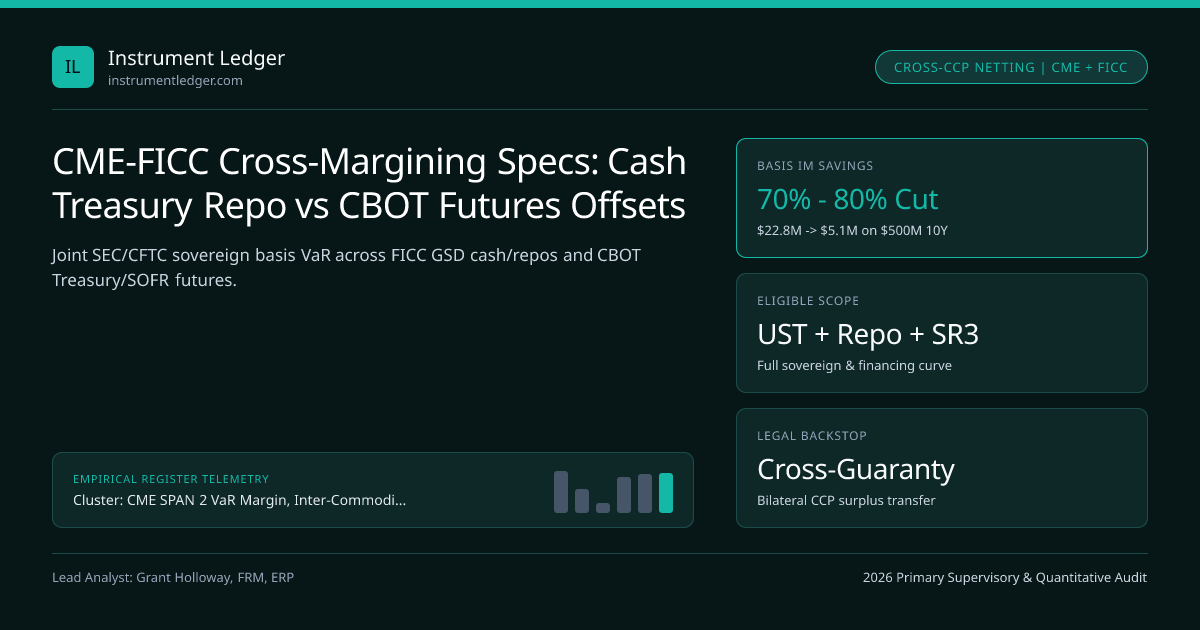
Across the $28+ trillion US Treasury market, the single largest relative-value strategy on Wall Street is the Cash-Futures Treasury Basis Trade: buying Cheapest-to-Deliver (CTD) cash US Treasury notes financed overnight in repo while shorting CBOT Treasury Futures (ZT, ZF, ZN, TN, ZB, UB) to harvest implied repo spreads. Historically, cash Treasuries and cleared repos settled at DTCC's Fixed Income Clearing Corporation (FICC Government Securities Division) under SEC oversight, while futures settled at CME Clearing under CFTC oversight—forcing primary dealers and end-user funds to post two completely separate, un-netted 100% Initial Margin pools on an economically flat duration hedge! Under the enhanced CME-FICC Cross-Margining Arrangement alongside SEC's mandatory US Treasury central clearing rule, eligible portfolios achieve 70% to 80% Initial Margin savings across both clearinghouses!
Within our CME SPAN 2 Portfolio Margin, VaR Pods and Spread Offsets Guide under the CME SPAN 2 VaR Margin, Inter-Commodity Spread Credits & Intraday Calls hub, pair this cross-CCP specification with CBOT CTD Conversion Factors & Implied Repo, CBOT Yield Curve Spreads, and our Listed Contract Basis and Implied Repo Calculator.
How Joint CME-FICC VaR Evaluates Net Sovereign Basis Risk#
How can two legally distinct clearinghouses supervised by two separate federal agencies (CFTC + SEC) safely grant an 80% margin credit without creating a default-waterfall hole?
- Eligible Product Universe: On the FICC GSD side, cleared cash US Treasury Bills, Notes, Bonds, TIPS, Agency securities, and Term/Overnight Treasury Repos; on the CME side, CBOT US Treasury Futures, Three-Month SOFR Futures (`SR3`), Eris SOFR Swap Futures, and Fed Funds (
ZQ) Futures! - Minimum Margin Reduction Calibration: Both CME (SPAN 2) and FICC (
GSD VaR) exchange position snapshots, map cash CUSIPs and futures into joint historical interest-rate curve scenarios, compute the percentage VaR reduction under each clearinghouse's proprietary risk model, and conservatively apply the more stringent (smaller) margin offset of the two!
Worked $500M Cash-Futures Basis Capital Efficiency Calculation#
Let's quantify why access to CME-FICC cross-margining completely transforms sovereign relative-value Return on Equity (ROE) when capturing a +35 bps net implied repo basis calculated in our Listed Contract Basis and Implied Repo Calculator:
Siloed Dual-CCP vs Joint Cross-Margined Capital Equations#
- CrossMarginedCombinedIM = CombinedBasisVaR(CashCTD - CF * Futures) + ResidualHaircutAddOn
- MarginCapitalFreedUSD = UnCrossMarginedTotalIM - CrossMarginedCombinedIM
- Worked $500,000,000 10-Year US Treasury Cash-Futures Basis Portfolio (Long $500M CTD Note in FICC Repo / Short ~5,880 ZN):
- Standalone Siloed Clearing:
- FICC GSD Cash/Repo VaR Margin (~2.10% of par) = $10,500,000
- CME Clearing ZN Futures SPAN 2 IM (~$2,100/lot * 5,880) = $12,348,000 -> Total Siloed IM = $22,848,000!
- Under Joint CME-FICC Cross-Margining (77.5% Empirical Basis Offset):
- Combined Cross-Margined Initial Margin = $5,140,800 -> Frees $17,707,200 of Treasury Capital (+344% Leverage Efficiency)!
Siloed Clearing vs Dealer House vs End-User Sponsored Cross-Margining#
Compare legal structures as SEC Treasury Clearing mandates expand FICC Sponsored Service and Agent Clearing access to buy-side hedge funds and asset managers:
| Clearing Access Model | Eligible Participants | Margin Netting Scope | Segregation Regime | Capital Efficiency |
|---|---|---|---|---|
| Uncrossed Siloed Accounts | Retail / Non-FICC funds | 0% Cash-Futures Offset | Separate bilateral repo + FCM LSOC | Lowest (2x double margin) |
| Joint Clearing Member (House) | Dual CME FCM + FICC GSD Banks | 75%–80% Proprietary Offset | Proprietary bank house omnibus | Maximum (~4.4x reduction) |
| Affiliated Bank/BD Structuring | Multi-entity dealer groups | 70%–80% Cross-Affiliate | Joint SEC/CFTC cross-margin acct | High (Requires dual approval) |
| End-User / Sponsored Expansion | Hedge funds & sovereigns | Expanding Customer Access | Segregated customer cross-margin | Unlocks done-away repo clearing |
Operational Crucial Distinction: Initial Margin Nets, Variation Margin Does NOT!#
Every Treasury desk treasury officer must operationalize one critical distinction in CME-FICC cross-margining: *cross-margining nets Initial Margin (IM), NOT daily Variation Margin (VM)* (unless settled via coordinated liquidity bridges)! If 10-Year yields plunge -25 bps intraday, your short ZN futures at CME owe an immediate 12:30 PM CT cash Variation Margin wire**, while your winning FICC cash Treasury leg settles mark-to-market on FICC's clearing schedule—always maintain an intraday cash timing buffer between the two clearing bank settlement windows!
Frequently asked questions
Which CME interest rate futures qualify for cross-margining against FICC cash US Treasuries and repos?
Eligible CME contracts include the full CBOT US Treasury futures suite (2Y ZT, 3Y Z3N, 5Y ZF, 10Y ZN, Ultra 10Y TN, Classic Bond ZB, Ultra Bond UB) plus Three-Month SOFR (SR3), 1-Month Fed Funds (ZQ), and Eris SOFR Swap futures.
Why did the SEC US Treasury Central Clearing mandate make CME-FICC cross-margining indispensable?
Previously, hedge funds often financed cash Treasuries in bilateral uncleared repo at 0% haircut, paying Initial Margin only on their CME futures leg. Once SEC rules mandate FICC repo clearing (charging FICC VaR IM), cross-margining prevents total basis margin from doubling.
How do CME and FICC protect each other if a cross-margined clearing firm goes bankrupt?
Under their joint SEC/CFTC-approved Cross-Guaranty Agreement, both CCPs hold cross-liens: whichever CCP holds the profitable half of the hedged basis trade liquidates it and transfers the surplus cash directly to cover the loss at the sister CCP.
Does CME-FICC cross-margining eliminate all Initial Margin on a 100% DV01-matched CTD basis trade?
No—even a perfectly DV01-matched CTD basis trade retains ~20%–25% of standalone Initial Margin because cash-futures basis itself can widen violently during repo liquidity squeezes (such as September 2019 and March 2020).
Publication record
- Published
- November 13, 2026
- Updated
- November 14, 2026
- Author
- Grant Holloway, FRM, ERP
- Review
- Review not recorded
- Automated fact check
- Passed in the stored pipeline record
- Source URLs
- 3 recorded
AI assistance recorded: anthropic/claude-opus-4.6. This field does not establish human review or source verification.
Academic & Institutional Attribution
Cite This Research & Embed Live Data Card
Standard academic & institutional research paper citation format.
Grant Holloway, FRM, ERP. (2026, November 14). CME-FICC Cross-Margining Specs: Cash Treasury Repo vs CBOT Futures Offsets. Instrument Ledger. https://instrumentledger.com/specs/cme-ficc-gsd-cross-margining-cash-treasury-repo-futures-offsetRegulatory Directory Cross-Reference
Referenced Institutions & Regulatory Registries
Related Span2 Portfolio Margin Cross Offsets & Institutional Briefings
Explore Span2 Portfolio Margin Cross Offsets Hub (20) →Span2 Portfolio Margin Cross Offsets
CME SPAN 2 Portfolio Margin, VaR Pods, Spread Offsets and Intraday Calls GuideSpan2 Portfolio Margin Cross Offsets
Eurex Clearing Prisma Margin Specs: Filtered HVaR & Bund-Swap OffsetsSpan2 Portfolio Margin Cross Offsets
ICE Clear IRM 2 Margin Specs: Brent, Gasoil & Dutch TTF Natural Gas VaRSpan2 Portfolio Margin Cross Offsets
Futures Initial vs Maintenance Margin: The 110% Speculative Restoration RuleSpan2 Portfolio Margin Cross Offsets
CME Twice-Daily Settlement Cycle: 12:30 CT Midday Intraday Variation SweepsSpan2 Portfolio Margin Cross Offsets
Short Option Minimum (SOM) Margin Specs: Why Selling 5-Cent Tail Puts Kills ROESpan2 Portfolio Margin Cross Offsets
Seasonal Calendar Spread Margin Specs: Natural Gas Widowmaker & Old/New CropSpan2 Portfolio Margin Cross Offsets
CFTC Rule 39.13 Gross Customer Margin & Part 22 LSOC Segregation SpecsLimit Up Limit Down Circuit Breakers
CME Globex Price Banding & Protection Points: Fat-Finger Collar MathLimit Up Limit Down Circuit Breakers
CBOT Grain Daily Price Limits: Expanded Limits & Synthetic Option DiscoveryLimit Up Limit Down Circuit Breakers
CME Live Cattle & Lean Hog Price Limits: Spot Uncapping & Cash ConvergenceLimit Up Limit Down Circuit Breakers
NYMEX Energy Special Price Fluctuation Limits: WTI & Gas Multi-Tier Pauses
Instrument Ledger Data, Benchmarks & Contributor Records
CC BY 4.0 Open Data
Open Institutional Datasets (CSV / JSON) →
Download desk-compiled quantitative series & schemas.
2026 Reference Matrix
2026 Institutional Benchmarks & Thresholds →
Statutory capital, clearing, margin & rate conventions.
Editorial Records
Authors & Review Records →
View named contributors where those records are available.
Complete Index
Master Research & Dossier Archive →
Browse all published briefings by topic pillar & date.