
Limit Up Limit Down Circuit Breakers
Clearly Erroneous Executions (CEE) & CME Rule 588: No-Bust Ranges vs Trade Busts
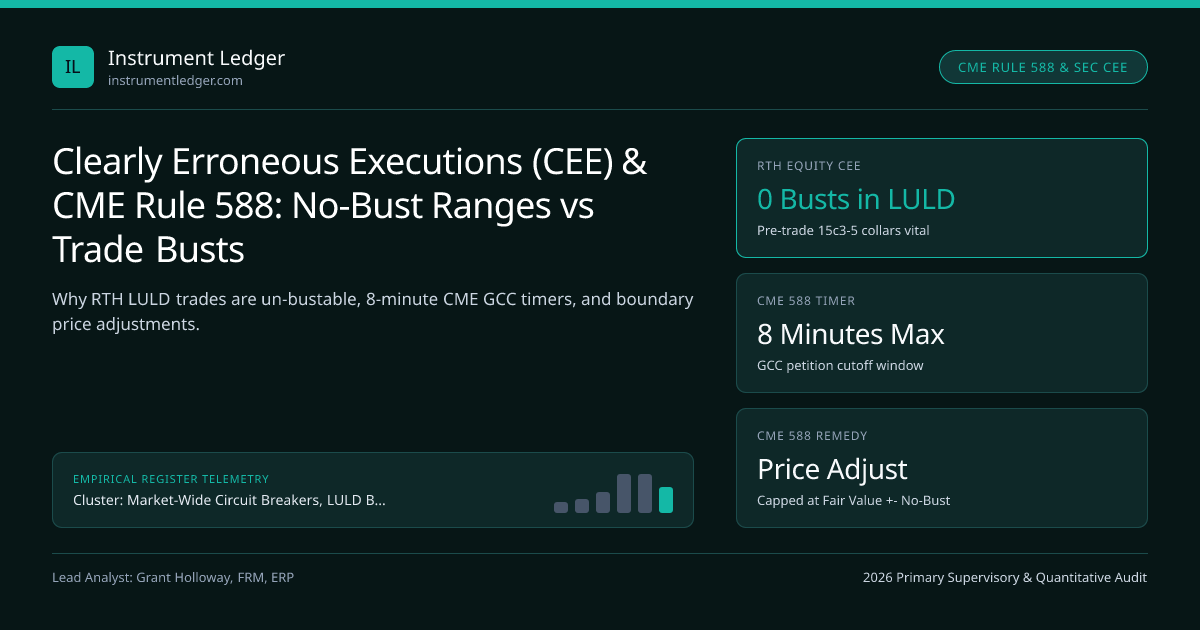
Can an exchange cancel ("bust") a fat-finger fill in milliseconds? Under post-2022 SEC Clearly Erroneous Execution (CEE) rules, trades inside active LULD bands are virtually un-bustable—while CME Rule 588 enforces strict No-Bust Ranges and favors price adjustment over cancellation.
Every institutional risk officer dreads the phone call that follows a runaway algorithm or fat-finger execution: "Can the exchange bust our trades?" Across modern North American markets overseen by the SEC and CFTC, the answer has become overwhelmingly "No—unless the print pierced an objective statutory corridor." Following the permanent 2022–2023 SEC Clearly Erroneous Execution (CEE) Reforms (NYSE Rule 7.10, Nasdaq Rule 11890, Cboe BZX 11.17) and *CME Group Rule 588 (Trade Cancellations and Price Adjustments)*, exchanges deliberately stripped away discretionary post-trade "mulligans" so counterparties hedging fills in milliseconds are never left with unhedged directional exposure 20 minutes later!
Within our Circuit Breakers & Halt Reopenings pillar and MWCB, LULD & Halt Master Guide, compliance and execution teams audit venue error corridors via our Exchange Halt & Volatility Registry, compare pre-trade CME Globex Protection Points, and verify theoretical fair value inside our Listed Contract Basis and Implied Repo Calculator.
Why SEC Rules Eliminated Most Equity "Clearly Erroneous" Busts During Regular Hours#
Before LULD existed, during the May 6, 2010 Flash Crash, US exchanges busted over 20,000 equity and ETF trades executed more than 60% away from pre-crash prices—creating massive legal chaos for market makers who had hedged one leg of a basket. Under today's permanent SEC CEE framework:
- During Regular Trading Hours (
09:30 – 16:00 ET) When LULD Bands Are Active: Any execution occurring at or inside the active LULD Upper and Lower Price Bands is CONCLUSIVELY PRESUMED NOT CLEARLY ERRONEOUS! Even if you fat-finger 200,000 shares of a Tier 1 stock+4.9%above the midpoint, zero trade bust will be granted unless a verifiable exchange systems malfunction or regulatory-halt rule violation occurred (as happened during the June 3, 2024 NYSE CTA LULD band software glitch onBRK.A). - Pre-Market (
04:00 – 09:30 ET) & Post-Market (16:00 – 20:00 ET) Without LULD: Because Reg NMS LULD bands are inactive outside09:30–16:00 ET, traditional numericCEEthresholds still apply against the Reference Price:10%for stocks<= $25.00,5%for stocks> $25.00 to $50.00, and3%for stocks> $50.00—provided the aggrieved member files a formal review petition within30 minutesof execution!
CME Group Rule 588: No-Bust Range vs Price Adjustment vs Trade Bust#
On CME, CBOT, NYMEX, and COMEX, CME Global Command Center (GCC) enforces Rule 588, which pairs pre-trade Globex Price Banding with a published contract-by-contract No-Bust Range measured around the GCC-determined Anchor / Fair Value Price (P_FV):
- Trades Inside
[P_FV - NoBust, P_FV + NoBust]: 100% FINAL & UN-BUSTABLE. Even if an algo malfunctions, GCC cannot alter or cancel fills inside theNo-Bust Range. - Price Adjustment Preferred Over Cancellation!: Crucially, when an erroneous trade (e.g., via an implied calendar spread or option strategy whose wider banding allowed a print outside the
No-Bust Range) piercesP_FV + NoBust, GCC's primary remedy under Rule588.Cis to ADMINISTRATIVELY ADJUST the trade price back to the boundaryP_FV + NoBustrather than cancelling the trade outright—preserving both counterparties' delta hedges while capping Windfall/Loss at theNo-Bustedge! - 8-Minute Filing Deadline: A party requesting GCC review under Rule
588must contact GCC within8 minutes(or GCC may initiate sua sponte review within8–15 minutes).
- Let P_FV = GCC Fair Value Reference Price at microsecond of erroneous trade
- Let Δ_NB = Contract-Specific Rule 588 No-Bust Range (in points / ticks)
- Let P_exec = Executed Trade Price
- Case 1: |Pexec - PFV| <= Δ_NB
- > Trade stands 100% as executed (Inside No-Bust Range; zero relief).
- Case 2: Pexec > PFV + Δ_NB (Futures Outright / Standard Liquid Book)
- > GCC Adjusts Trade Price downward to: Padjusted = PFV + Δ_NB
- (or Cancels ONLY in illiquid options/complex strategies per Rule 588.C!)
Comparative Error-Trade Rulebook Matrix: SEC Equities, CME, ICE & Cboe Options#
Execution and compliance desks must configure venue-specific filing timers and financial loss expectations:
| Market Venue & Rule | Governing Rulebook | Filing Deadline | Un-Bustable Safe Zone | Remedy Outside Safe Zone | Regulator |
|---|---|---|---|---|---|
US Cash Equities (RTH 09:30–16:00 ET) | NYSE 7.10 / Nasdaq 11890 (CEE) | 30 minutes | 100% of Active LULD Band (+-5% / +-10%) | Bust only on exchange tech failure / halt breach | SEC |
US Cash Equities (ETH 04:00–09:30 / 16:00–20:00) | Extended-Hours CEE | 30 minutes | <= 3% (>$50), <= 5% ($25–$50), <= 10% (<=$25) | Full Trade Cancellation (Bust) | SEC |
| CME / CBOT / NYMEX / COMEX Futures | CME Rule 588 (Table 588.H) | 8 minutes | Published No-Bust Range (e.g., ES ~12–24 pts, CL ~$0.50–$1.00) | Price Adjustment to P_FV +- Δ_NB (rarely bust) | CFTC |
| ICE Futures Europe / U.S. | ICE Error Trade Policy | 8 – 15 minutes | Published ICE No-Cancellation Range (NCR) | Adjust inside Extreme Range or Cancel above ER | FCA / CFTC |
US Listed Options (Cboe Rule 6.5) | Obvious & Catastrophic Error Rule | 15 min (Obvious) / 30 min (Catastrophic) | $0.25 – $1.00 around Theoretical Price | Adjust (Customer stands unless Catastrophic; MM adjusts) | SEC |
Operational Risk Playbook: Automating 8-Minute CME Rule 588 Detection#
To protect firm capital under FIX API execution:
- Pre-Trade Hard Fat-Finger Collars Tighter Than LULD /
No-Bust: Because SEC RTH equity fills inside a+-5%LULD band cannot be busted—and a4.8%error on a$20Mbasket costs$960,000—compliant broker-dealers under *SEC Rule15c3-5(Market Access Rule)* enforce pre-trade order collars at0.5% to 1.5%around live NBBO midpoint. - Automated Drop-Copy Fair-Value Alerting: Compare every Execution Report (
35=8) against independent L1 midpoint within100ms; if|Fill - Mid| > 0.8 * NoBust, trigger an immediate desk siren with pre-populated CME GCC phone/portal Trade IDs well inside the8-minutestatutory cutoff!
Implied Calendar Spread & Option Strategy Breach Mechanics Under Rule 588#
Why do Rule 588 breaches still happen if CME Globex enforces pre-trade Protection Points? Because multi-leg implied spreads and deep out-of-the-money options carry wider synthetic price bands than outright front-month futures—allowing an errant spread order to leg into an outright print past P_FV + NoBust that GCC subsequently adjusts back to the boundary!
Frequently asked questions
Can NYSE or Nasdaq bust a fat-finger stock trade during regular 09:30–16:00 ET trading hours?
Virtually never if LULD bands were functioning properly. Under post-2022 SEC Clearly Erroneous Execution rules, any regular-hours trade at or inside active LULD price bands is conclusively presumed valid, shifting protection entirely to pre-trade Rule 15c3-5 broker controls.
How long do I have to ask CME Global Command Center (GCC) to review an erroneous futures trade?
Under CME Rule 588, a party must contact the CME Global Command Center within 8 minutes of the trade execution; requests submitted after 8 minutes are routinely denied.
Does CME Rule 588 cancel erroneous futures trades or adjust their prices?
For liquid futures contracts breaching the Rule 588 No-Bust Range, GCC strongly favors adjusting the execution price back to the edge of the No-Bust Range (Fair Value +- No-Bust) so both counterparties keep their delta positions intact.
Why did NYSE bust Berkshire Hathaway (BRK.A) trades at $185.10 on June 3, 2024 if LULD prevents busts?
On June 3, 2024, a CTA SIP software update caused LULD reference bands themselves to malfunction and halt/reopen erroneously; SEC CEE rules explicitly retain trade-bust authority for verifiable exchange or SIP systems malfunctions.
Publication record
- Published
- November 13, 2026
- Updated
- November 15, 2026
- Author
- Grant Holloway, FRM, ERP
- Review
- Review not recorded
- Automated fact check
- Passed in the stored pipeline record
- Source URLs
- 3 recorded
AI assistance recorded: anthropic/claude-opus-4.6. This field does not establish human review or source verification.
Academic & Institutional Attribution
Cite This Research & Embed Live Data Card
Standard academic & institutional research paper citation format.
Grant Holloway, FRM, ERP. (2026, November 15). Clearly Erroneous Executions (CEE) & CME Rule 588: No-Bust Ranges vs Trade Busts. Instrument Ledger. https://instrumentledger.com/specs/clearly-erroneous-executions-cee-no-bust-ranges-cme-rule-588Regulatory Directory Cross-Reference
Referenced Institutions & Regulatory Registries
Related Limit Up Limit Down Circuit Breakers & Institutional Briefings
Explore Limit Up Limit Down Circuit Breakers Hub (20) →Limit Up Limit Down Circuit Breakers
Market-Wide Circuit Breakers, LULD Bands, CME Velocity Logic & Halt Specs GuideLimit Up Limit Down Circuit Breakers
FIX Protocol SecurityTradingStatus (Tag 326): OMS Halt State Machines & MDP 3.0Limit Up Limit Down Circuit Breakers
ETF NAV Arbitrage Dislocation When Constituent Stocks Hit LULD HaltsLimit Up Limit Down Circuit Breakers
US Equity Market-Wide Circuit Breakers (MWCB): 7%, 13%, 20% & 15:25 ET RulesLimit Up Limit Down Circuit Breakers
SEC NMS Limit-Up Limit-Down (LULD) Specs: Tier 1 vs Tier 2 Price BandsLimit Up Limit Down Circuit Breakers
LULD Straddle State vs 15-Second Limit State: 5-Minute Pause MechanicsLimit Up Limit Down Circuit Breakers
LULD Band Doubling Rules: Eliminated 09:30 Open vs Active 15:35 ET Close SpecsLimit Up Limit Down Circuit Breakers
CME Globex Overnight ±7% Hard Limits vs RTH Equity Futures Price CapsCfd Index Dividend Roll Contract Specs
US Treasury, Euro-Bund & JGB Bond CFDs: Coupon-Neutral Pricing, Decimal Ticks & RollsCfd Index Dividend Roll Contract Specs
ISO 10962 CFI Classification (JE*/JF*/JC*), UPI & EMIR Refit / MiFIR CFD ReportingMarket Insights
ProShares VIX Short-Term Futures ETF (VIXY) Stock Price, News, Quote & History - Yahoo! Finance CanadaRegulatory Compliance
CFTC approves tZERO crypto derivatives exchange ahead of $350M merger - Crypto News
Instrument Ledger Data, Benchmarks & Contributor Records
CC BY 4.0 Open Data
Open Institutional Datasets (CSV / JSON) →
Download desk-compiled quantitative series & schemas.
2026 Reference Matrix
2026 Institutional Benchmarks & Thresholds →
Statutory capital, clearing, margin & rate conventions.
Editorial Records
Authors & Review Records →
View named contributors where those records are available.
Complete Index
Master Research & Dossier Archive →
Browse all published briefings by topic pillar & date.