
Limit Up Limit Down Circuit Breakers
ETF NAV Arbitrage Dislocation When Constituent Stocks Hit LULD Halts
When 25% of a sector ETF enters staggered 5-minute NMS LULD Trading Pauses—or during chaotic market opens like August 24, 2015—Authorized Participants lose exact creation/redemption basket hedges, forcing ETF bid-ask spreads to widen to proxy beta uncertainty.
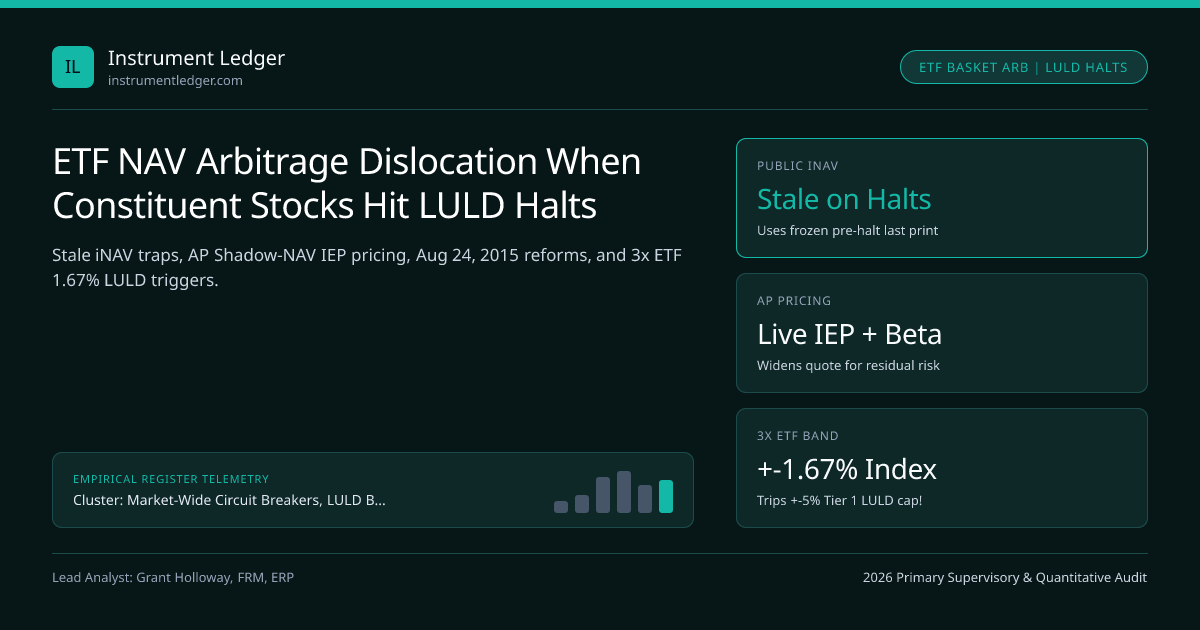
On the morning of August 24, 2015, the US equity market witnessed an unforgettable structural anomaly: over 1,278 LULD Trading Pauses fired across 471 stocks and ETFs within 30 minutes of the 09:30 ET bell, causing blue-chip ETFs like RSP, DVY, and SPLV to print 20% to 35% below the true fair value of their underlying stock baskets—even though S&P 500 cash stocks themselves were only down 4% to 5%! Again during the March 2023 Silicon Valley Bank (KRE regional bank ETF) crisis, whenever 6 to 12 regional bank constituents simultaneously entered 5-Minute NMS LULD Trading Pauses, KRE continued trading on NYSE Arca while its published Intraday Indicative Value (iNAV / IOPV) froze on stale pre-halt prints. Under SEC oversight, understanding ETF Basket Arbitrage Dislocation under Partial Constituent Halts is essential for every Authorized Participant (AP), ETF market maker, and options desk.
Within our Circuit Breakers & Halt Reopenings pillar and MWCB, LULD & Halt Master Guide, cross-asset arbitrageurs benchmark futures vs ETF basis inside our Listed Contract Basis and Implied Repo Calculator, calibrate opening-bell band widths in our Intraday 0DTE Sigma Band Calculator, and review 09:30 Open LULD Band Doubling Elimination.
Why Published iNAV Lies When ETF Constituents Are Halted#
Every 15 seconds (or sub-second on proprietary feeds), calculation agents compute an ETF's published iNAV as the weighted sum of last sale prices across its creation basket:
- Suppose Semiconductor ETF (
SMH) holds a20.5%weight inNVDA, andNVDAsuddenly plunges-5.0%on an export-control headline, triggering a 5-minute Tier 1 LULD Trading Pause at$120.00. - Over the next 4 minutes, Nasdaq's live order-imbalance feed shows
NVDA's Indicative Equilibrium Price (`IEP`) dropping another-10.0%to$108.00, while CME `NQ` Nasdaq-100 futures fall-2.8%. - Published
iNAVusesNVDA = $120.00(stale pre-halt print), overstatingSMH's true NAV by2.05%, whereas Authorized Participants (APs) pricingSMHlive substituteNVDA's real-time NasdaqIEP ($108.00)plus a residual halt-uncertainty haircut!
- Let Wopen = Open constituent weights, Pi^mid = Live NBBO midpoint of open stock i
- Let Whalt = Halted constituent weights, Pj^IEP = Live Reopening IEP (or Beta-Proxy Price) of halted stock j
- ShadowNAVETF = Sum{i in Wopen} (wi * Pi^mid) + Sum{j in Whalt} (wj * Pj^IEP) + Cash_Component
- AP Minimum Hedge Uncertainty Half-Spread (ΔS_AP):
- ΔSAP = Sbase + zalpha * sqrt( Sum{j in Whalt} wj^2 * sigma{j,residual}^2 * Δthalt )
- (Where sigma_{j,residual} is unhedgeable idiosyncratic volatility after CME ES/NQ/Sector ETF beta proxy!)
Post-August 24, 2015 Regulatory Fixes vs Remaining ETF Halt Structural Gaps#
Following the SEC's landmark investigation of August 24, 2015, US exchanges overhauled three core rules—yet critical partial-halt dynamics remain:
| Structural ETF Vulnerability | August 24, 2015 Failure Mechanism | Post-2016 / 2020 Regulatory Fix | Remaining Live Trading Edge Case (2025–2026) |
|---|---|---|---|
| Delayed Primary Cash Opens | NYSE delayed manual opens on 150+ S&P stocks -> 09:30 band doubling whipsawed ETFs on stale prior closes | Eliminated 09:30 LULD Band Doubling + automated NYSE Pillar Core Open | Concentrated thematic/regional-bank ETFs (KRE, SMH, XBI) during intraday news shocks |
| Stop-Order Cascade in ETFs | Retail brokerages routed raw Stop-Market orders directly to NYSE Arca books -> cascading ETF LULD halts | NYSE / Nasdaq eliminated native exchange Stop-Market orders | Broker-held synthetic stop-market algorithms still sweep widened AP books unless limit-collared |
ETF LULD Tier Classification | Many liquid ETFs sat in Tier 2 (+-10% bands) while Tier 1 stocks had +-5% bands | Virtually all liquid ETPs (>$2M/day ADV) classified as NMS Tier 1 (+-5.0% band) | Leveraged 2x / 3x ETFs (TQQQ, SOXL) hit a +-5% Tier 1 band when underlying moves just +-1.67%! |
Options on ETFs (SPY, QQQ, KRE) | Options stayed open with $10 wide spreads until ETF itself paused | Cboe Rule `5.34` Drill-Through + Limit State blocks | Options on SMH/KRE stay open while constituents halt until the ETF itself touches its +-5% LULD band |
The 3x Leveraged ETF (SOXL / TQQQ / SQQQ) +-1.67% LULD Trap!#
One of the sharpest contract-specification nuances in US market structure involves daily leveraged ETFs (2x and 3x ETPs):
- Because most high-volume leveraged ETFs exceed the
$2,000,000daily volume threshold, they are assigned NMS Tier 1 Status, giving them a+-5.0%LULD band (when priced> $3.00)—NOT+-15.0%! - Consequently, if the Nasdaq-100 (CME `NQ` futures) surges or drops
1.70%inside 4 minutes after a CPI or FOMC release,1x QQQstays completely open (nowhere near its+-5.0%band), while3x TQQQandSQQQhit+-5.0%and enter a 5-minute LULD Trading Pause!
Institutional Execution Protocol: Trading Sector ETFs During Partial Basket Halts#
- Compute Live Constituent Halt Weight (
W_halt) Before Routing: IfW_halt >= 10%of an ETF's creation basket, disable all market/aggressive sweep algos and anchor passive limit orders to Shadow NAV (live Nasdaq/NYSEIEP+ CME `ES`/`NQ` beta proxy) rather than publiciNAV. - Delta-Hedge Leveraged ETP Pauses via
1xCash & Futures: Quantitative market makers hedgingTQQQoptions or swap baskets immediately pivot their delta hedges over FIX API into3xnotional ofQQQshares or CMENQ/MNQfutures for the full 5-minute pause!
Fixed-Income & International ETFs: Natural 24-Hour Closed-Underlying Proxy Pricing#
Notice that international equity ETFs (EWJ, FXI, VGK) and corporate bond ETFs (HYG, LQD) trade every US afternoon while Tokyo, Hong Kong, or cash bond books are closed—using the exact same AP Shadow-NAV proxy-beta pricing engine that domestic equity ETFs activate during intraday LULD halts!
Frequently asked questions
Why does an ETF keep trading when several of its largest stock holdings are halted in LULD pauses?
An ETF is an independently listed NMS security on NYSE Arca, Nasdaq, or Cboe BZX with its own CUSIP and LULD reference price; it only enters an LULD pause if the ETF share price itself hits its +-5% band for 15 seconds (or during a 7%/13%/20% Market-Wide Circuit Breaker).
Can I trust an ETF published iNAV (IOPV) during fast volatile markets with stock halts?
No. Standard iNAV formulas plug in the last executed trade price for any halted constituent stock, causing iNAV to lag true economic value whenever live reopening auction IEPs move 5%–15% past the halt price.
Why did TQQQ or SOXL halt for 5 minutes when QQQ and SMH stayed open?
Liquid 3x leveraged ETFs priced above $3.00 carry standard Tier 1 +-5.0% LULD bands rather than 3x-widened bands; therefore, a rapid +-1.67% move in the 1x underlying index pushes the 3x ETF straight into its +-5.0% LULD boundary.
What caused ETFs to drop 20%–35% below NAV on the morning of August 24, 2015?
Delayed manual openings on hundreds of NYSE stocks combined with legacy 2x-doubled 09:30 LULD bands and retail Stop-Market order cascades drained ETF orderbooks while Authorized Participants lacked open cash prices to hedge baskets.
Publication record
- Published
- November 13, 2026
- Updated
- November 18, 2026
- Author
- Grant Holloway, FRM, ERP
- Review
- Review not recorded
- Automated fact check
- Passed in the stored pipeline record
- Source URLs
- 3 recorded
AI assistance recorded: anthropic/claude-opus-4.6. This field does not establish human review or source verification.
Academic & Institutional Attribution
Cite This Research & Embed Live Data Card
Standard academic & institutional research paper citation format.
Grant Holloway, FRM, ERP. (2026, November 18). ETF NAV Arbitrage Dislocation When Constituent Stocks Hit LULD Halts. Instrument Ledger. https://instrumentledger.com/specs/etf-nav-arbitrage-dislocation-constituent-luld-halts-basket-hedgesRegulatory Directory Cross-Reference
Referenced Institutions & Regulatory Registries
Related Limit Up Limit Down Circuit Breakers & Institutional Briefings
Explore Limit Up Limit Down Circuit Breakers Hub (20) →Limit Up Limit Down Circuit Breakers
Market-Wide Circuit Breakers, LULD Bands, CME Velocity Logic & Halt Specs GuideLimit Up Limit Down Circuit Breakers
US Equity Market-Wide Circuit Breakers (MWCB): 7%, 13%, 20% & 15:25 ET RulesLimit Up Limit Down Circuit Breakers
SEC NMS Limit-Up Limit-Down (LULD) Specs: Tier 1 vs Tier 2 Price BandsLimit Up Limit Down Circuit Breakers
LULD Straddle State vs 15-Second Limit State: 5-Minute Pause MechanicsLimit Up Limit Down Circuit Breakers
LULD Band Doubling Rules: Eliminated 09:30 Open vs Active 15:35 ET Close SpecsLimit Up Limit Down Circuit Breakers
CME Globex Overnight ±7% Hard Limits vs RTH Equity Futures Price CapsLimit Up Limit Down Circuit Breakers
CME Globex Dynamic Circuit Breakers (DCB): Rolling 60-Minute Corridor MathLimit Up Limit Down Circuit Breakers
CME Globex Velocity Logic Specs: Millisecond Stop-Cascade Integrity PausesMarket Insights
ProShares VIX Short-Term Futures ETF (VIXY) Stock Price, News, Quote & History - Yahoo! Finance CanadaRegulatory Compliance
CFTC approves tZERO crypto derivatives exchange ahead of $350M merger - Crypto NewsMarket Insights
Nikkei's 1,684-Point Surge Sparks Pullback Caution; US Stock Declines and 330-Point Futures Drop Weigh on Market - BigGo FinanceBroker Fees and Calculators
Russian crude oil prices jump on China, India demand - Nikkei Asia
Instrument Ledger Data, Benchmarks & Contributor Records
CC BY 4.0 Open Data
Open Institutional Datasets (CSV / JSON) →
Download desk-compiled quantitative series & schemas.
2026 Reference Matrix
2026 Institutional Benchmarks & Thresholds →
Statutory capital, clearing, margin & rate conventions.
Editorial Records
Authors & Review Records →
View named contributors where those records are available.
Complete Index
Master Research & Dossier Archive →
Browse all published briefings by topic pillar & date.