
Cfd Index Dividend Roll Contract Specs
DMA (Direct Market Access) Equity CFDs vs Market-Maker B-Book Synthetic Execution
Institutional equity long/short funds trade Direct Market Access (DMA) CFDs to place resting limit orders directly inside the physical Level-2 Nasdaq, LSE SETS, or Xetra orderbook and participate in Opening/Closing Auctions—contrasting sharply with internalized B-Book retail CFD execution.
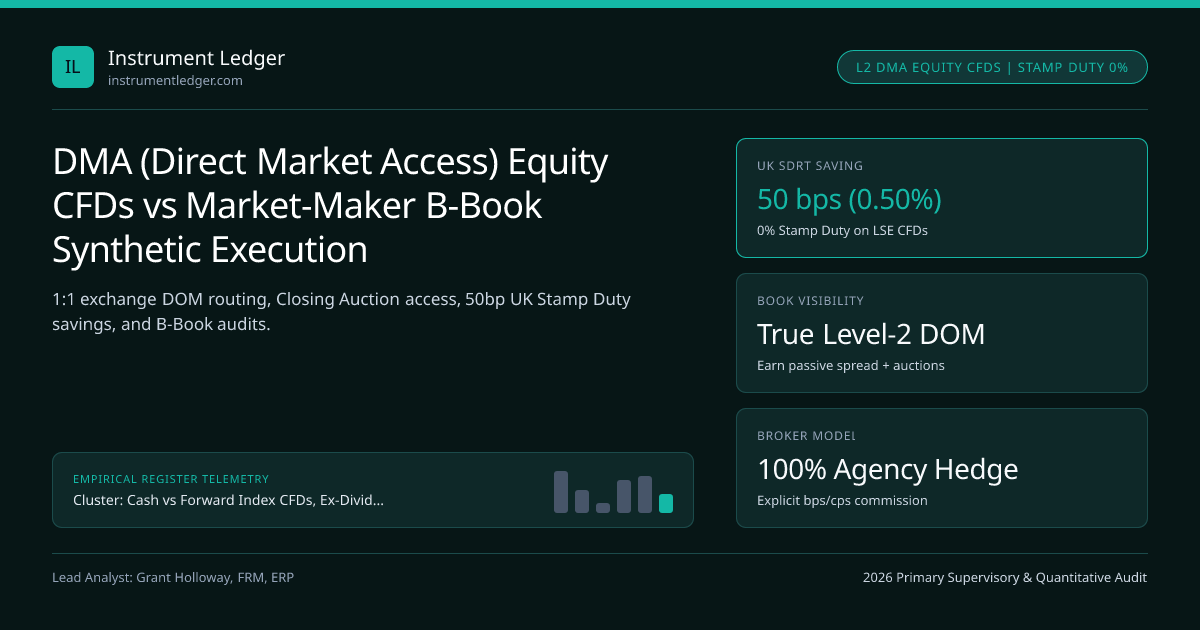
Say the acronym "CFD" in a retail trading forum and people picture a zero-commission market-maker ("B-Book") internalizing 0.05-lot trades off a synthetic quote feed. Walk onto a London Mayfair or Hong Kong Central institutional equity long/short hedge fund floor regulated by the FCA or SFC, and 60%+ of European and UK single-stock alpha is executed via Institutional Direct Market Access (DMA) Equity CFDs / Synthetic Prime Brokerage Swaps! Why? Because UK physical share purchases on the London Stock Exchange incur 0.50% (50 bps!) HM Revenue & Customs Stamp Duty Reserve Tax (SDRT)—whereas FCA-regulated DMA Equity CFDs are 100% exempt from 0.50% UK Stamp Duty (saving $50,000 on every $10M UK equity buy!) while placing real physical shares 1:1 onto the LSE SETS Level-2 orderbook!
Within our Cash vs Forward CFDs & Roll Specs pillar and Master CFD Contract Specifications Guide, institutional execution desks connect via FIX API, cTrader, and Proprietary DMA Terminals, and benchmark Halt & Closing Auction IEP Mechanics.
Microstructure Mechanics: True L2 DMA Equity CFD vs STP/A-Book vs B-Book#
When you submit Buy 5,000 BARC.L (Barclays) @ 245.10p Limit on a true Level-2 DMA CFD session:
- Zero Dealer Markup & Real Queue Priority: Your broker's Smart Order Router (
SOR) immediately fires a real physical equity buy limit order for5,000Barclays shares at245.10punder the Prime Broker's exchange member ID onto LSESETS(plus Turquoise / Cboe Europe dark/lit books if SOR-enabled). Within< 1 millisecond, you can see your own5,000shares appear inside the public LSE Level-2 Depth of Market (DOM), earning passive maker spread rather than crossing the spread! - Simultaneous Swap Wrapper: The microsecond LSE fills those
5,000physical shares on the Prime Broker's Stamp-Duty-exempt intermediary trading book, the Prime Broker books a back-to-back5,000-unitCFD to your account at245.10pplus an explicit institutional agency commission (~3 to 8 bpsin Europe/UK;$0.005–$0.01/sharein US equities)!
- 1. Physical Cash Share Purchase (Subject to 0.50% UK HMRC Stamp Duty Reserve Tax):
- CostCashUK = StampDuty(50.0 bps) + BidAskCrossorPassive(2.5 bps) + Broker_Comm(2 * 3.0 bps)
- = 58.5 bps ($5,850 immediate hurdle before breakeven!)
- 2. Institutional L2 DMA Equity CFD (0.00% UK Stamp Duty Exemption for Market-Maker Hedge!):
- CostDMACFD = StampDuty(0.0 bps!) + PassiveL2Spread(0.0 bps) + DMAComm(2 * 4.0 bps)
- + FinancingHold(Ndays * [SONIA + 0.65%] / 365)
- -> Saves +50.0 bps ($5,000 per $1M) for any holding period under ~260 calendar days!
Execution Architecture Matrix: True DMA CFD vs A-Book STP vs B-Book Market Maker#
Know exactly how to audit whether a broker claiming "DMA" is delivering genuine exchange queue access or synthetic top-of-book mirroring:
| Microstructure Feature | True Level-2 DMA CFD | A-Book / PoP Mirrored CFD | B-Book Internalized Market Maker |
|---|---|---|---|
| Order Appears in Public Exchange L2 Book? | YES — Immediately 1:1! (Test with odd lot inside spread!) | No (Hedged post-fill or aggregated at LP) | NO (100% internal ledger match) |
| Passive Spread Capture (Join/Improve Bid)? | YES (Can bid inside wide spread & get hit!) | Rarely (Usually fills only when L1 crosses) | NO (Must cross synthetic Bid/Ask) |
Opening & Closing Auction (MOO / MOC / LOC)? | YES (Full primary uncross participation!) | No (Continuous trading hours only) | No |
| Fee Structure | Raw Exchange L2 + Explicit Commission (3–10 bps / cps) | Zero-comm wide spread OR small comm + raw L1 | Zero-commission + widened spread |
| Counterparty Conflict of Interest? | Zero (100% agency pass-through) | Zero (Risk offset to upstream LP) | Broker profits if unhedged B-book loses |
| Market Data Subscription Required? | YES (Exchange L1/L2 professional/non-pro fee) | Often bundled L1 derived quote | Free derived synthetic quote |
The 10-Second Forensic Test: Proving Whether Your Broker Is True DMA!#
Want mathematical proof of whether your broker's equity CFD is genuine Level-2 DMA?
- Pick a mid-cap NYSE, Nasdaq, or LSE stock currently quoting
$50.00 Bid x $50.06 Askwith a$0.06spread while watching an independent Nasdaq TotalView / LSE Level-2 feed. - Submit a Limit Buy for
100CFD units at$50.03(splitting the spread in half!). - On True
DMA, within milliseconds the public Nasdaq/LSE National Best Bid jumps from$50.00to$50.03 (100 shares)! On a synthetic B-Book or L1-mirrored wrapper, the public exchange book stays at$50.00 x $50.06while your order sits invisibly on the broker's private server!
European Financial Transaction Tax (FTT) Nuances: UK Stamp Duty vs French/Italian FTT#
While UK 0.50% Stamp Duty (SDRT) and Irish 1.00% Stamp Duty exempt cash-settled CFDs completely, verify French (0.30%) and Spanish (0.20%) Financial Transaction Taxes (FTT—which apply to net overnight acquisitions of physical shares, sometimes partially passed through if a DMA broker holds physical hedge inventory overnight) and Italian IFTT (which includes a small flat-tier derivatives levy on Italian equity CFDs)!
SEC Reg NMS Rule 611 & MiFID II RTS 28 Best-Execution Audits on DMA Gateways#
Institutional buy-side desks request quarterly Transaction Cost Analysis (TCA) venue-fill breakdowns (BATS/Cboe, Turquoise, Aquis, primary LSE/Xetra/Nasdaq) to verify 100% pass-through of price improvement and maker rebates on agency DMA swap schedules—alongside reconciled single-stock CFD corporate action ledgers and ISO 10962 CFI & EMIR/MiFIR transaction reports!
Frequently asked questions
Why do institutional London hedge funds trade FTSE 100 stocks using CFDs instead of buying physical shares?
Buying physical UK shares incurs an immediate 0.50% (50 bps) UK Stamp Duty Reserve Tax (SDRT), whereas cash-settled Equity CFDs qualify for intermediary exemption—saving 50 bps upfront while routing identical Level-2 LSE SETS liquidity via DMA.
Can a DMA Equity CFD participate in the Nasdaq or LSE Closing Auction (MOC / LOC)?
Yes. Because true DMA routes native physical instructions through the Prime Broker exchange gateway, institutional DMA platforms support Market-on-Close (MOC), Limit-on-Close (LOC), and Opening Auction order types.
Why do DMA CFD accounts charge exchange market-data fees while retail B-Book CFD accounts give free quotes?
Exchanges (NYSE, Nasdaq, LSE, Deutsche Borse) require per-user licensing fees whenever raw, un-altered real-time Level-1/Level-2 exchange depth is displayed to a DMA trader; retail B-Book brokers stream derived proprietary CFD prices.
Is there any conflict of interest between a true DMA CFD broker and a profitable trader?
No. In a pure DMA agency model, every client trade is hedged 1:1 on the underlying exchange in real time, so the broker earns strictly its explicit execution commission and financing spread regardless of client win rate.
Publication record
- Published
- November 12, 2026
- Updated
- November 14, 2026
- Author
- Grant Holloway, FRM, ERP
- Review
- Review not recorded
- Automated fact check
- Passed in the stored pipeline record
- Source URLs
- 3 recorded
AI assistance recorded: anthropic/claude-opus-4.6. This field does not establish human review or source verification.
Academic & Institutional Attribution
Cite This Research & Embed Live Data Card
Standard academic & institutional research paper citation format.
Grant Holloway, FRM, ERP. (2026, November 14). DMA (Direct Market Access) Equity CFDs vs Market-Maker B-Book Synthetic Execution. Instrument Ledger. https://instrumentledger.com/specs/dma-direct-market-access-equity-cfds-vs-b-book-synthetic-quotesRegulatory Directory Cross-Reference
Referenced Institutions & Regulatory Registries
Related Cfd Index Dividend Roll Contract Specs & Institutional Briefings
Explore Cfd Index Dividend Roll Contract Specs Hub (20) →Cfd Index Dividend Roll Contract Specs
Cash vs Forward Index CFDs, Ex-Dividend Adjustments & Commodity Roll Specs GuideCfd Index Dividend Roll Contract Specs
Cross-Currency CFD PnL Conversion Sweeps: FX Markup Drag vs Multi-Currency LedgersCfd Index Dividend Roll Contract Specs
US Treasury, Euro-Bund & JGB Bond CFDs: Coupon-Neutral Pricing, Decimal Ticks & RollsCfd Index Dividend Roll Contract Specs
ISO 10962 CFI Classification (JE*/JF*/JC*), UPI & EMIR Refit / MiFIR CFD ReportingCfd Index Dividend Roll Contract Specs
Cash Index CFD Fair-Value Pricing: Stripping Daily Interest & Dividend CarryCfd Index Dividend Roll Contract Specs
Undated Cash CFD vs Dated Forward Index CFD: Exact Holding-Period Breakeven MathCfd Index Dividend Roll Contract Specs
Ex-Dividend Index Point Drops: CFD Long Credit & Short Debit Neutrality MathCfd Index Dividend Roll Contract Specs
IRS Section 871(m) on US500, NAS100 & Single-Stock CFDs: Qualified Index & W-8BEN MathBroker Fees and Calculators
Oil Futures Slide as Trump Says New Strikes on Iran UnlikelyMarket Insights
Weekend trading of Nvidia scandal shines light on new financial productsBroker Fees and Calculators
Oil Futures Extend Retreat As Trump Says Renewed Attacks UnlikelyMarket Insights
Stock index futures tick up despite pressure from Nvidia drop
Instrument Ledger Data, Benchmarks & Contributor Records
CC BY 4.0 Open Data
Open Institutional Datasets (CSV / JSON) →
Download desk-compiled quantitative series & schemas.
2026 Reference Matrix
2026 Institutional Benchmarks & Thresholds →
Statutory capital, clearing, margin & rate conventions.
Editorial Records
Authors & Review Records →
View named contributors where those records are available.
Complete Index
Master Research & Dossier Archive →
Browse all published briefings by topic pillar & date.